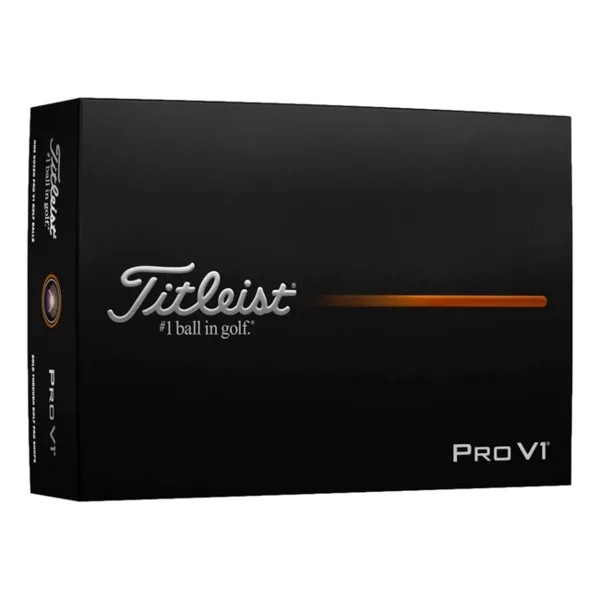
Titleist Pro V1 Golf Ball
The No. 1 ball in golf and the benchmark the entire category is measured against — the 2025 Pro V1's reformulated high-gradient core adds a touch of tee speed while keeping the soft feel, mid flight, and class-leading shot-to-shot consistency that have made it the most-played ball in professional golf. A Golf Digest Hot List Gold ball, MyGolfSpy's calibration standard, and a consensus near-top score from 16 sources.
We may earn a commission if you buy through this link — it never affects our scores or the price you pay.
The consensus
The Titleist Pro V1 is the most-played golf ball in professional golf, the best-selling ball in the game, and — 25 years after the original upended the wound-ball era — still the benchmark every competitor is measured against. The 2025 generation is a refinement of a proven formula: a new high-gradient core steepens the 'spin slope,' trimming long-game spin and adding a few yards of speed while preserving the soft feel, penetrating mid flight, and short-game control the Pro V1 is known for. Across 16 sources spanning robot testing, lab teardown, expert review, forum consensus, and retail feedback, it earns a near-universal top score, a Golf Digest Hot List Gold, and the rare distinction of being the ball MyGolfSpy uses to calibrate its entire test database.
Where sources agree most strongly: consistency and feel. MyGolfSpy's Ball Lab handed the 2025 Pro V1 a 93.0 Quality Score, a Ball Lab Quality Award, and a perfect 100% Good Ball Rate — all 36 balls tested passed with zero defects — with a compression delta of just 5.3 points, among the tightest of more than 100 balls tested. Today's Golfer's 62-ball robot test found the Pro V1 produced the most consistent backspin and compression in the field and gave it full marks for versatility, while its reviewer called it one of the best-feeling balls he'd played in years. National Club Golfer scored it a full five stars and described the move from the 2023 ball as 'a direct swap, but a big upgrade.' The recurring theme is that the Pro V1 has no real weakness — it is the complete, neutral, do-everything ball.
Where the consensus is honest about limits: distance, peak spin, and price. The Pro V1 is a neutral, mid-spin ball, not a bomber — in Today's Golfer's test the Callaway Chrome Tour was the only ball of 62 to clear 275 yards of carry and took gold off the tee, leaving the Pro V1 with a bronze. It is also not the greenside-spin leader: the Chrome Tour X, TP5, Bridgestone Tour B XS, Srixon Z-Star Diamond, and even its own firmer sibling, the Pro V1x, generate more wedge spin. And at $54.99 a dozen it sits at the top of the market just as value urethane balls — the Kirkland Signature at roughly a third of the price, the Maxfli Tour — have closed much of the gap for golfers who don't need every increment of consistency. But for the player who wants the most validated, most repeatable, most complete ball in golf — and who scores with the short game — the Pro V1 remains exactly what its tour adoption says it is: the standard.
The No. 1 ball in golf and the benchmark the entire category is measured against — the 2025 Pro V1's reformulated high-gradient core adds a touch of tee speed while keeping the soft feel, mid flight, and class-leading shot-to-shot consistency that have made it the most-played ball in professional golf. A Golf Digest Hot List Gold ball, MyGolfSpy's calibration standard, and a consensus near-top score from 16 sources.
Category ratings
What the community loves
The Pro V1 is the most-played golf ball on every major professional tour and the best-selling ball in the game, a position no competitor approaches. That dominance is more than marketing: MyGolfSpy uses the Pro V1 as the calibration ball for its entire robot test, meaning every other ball in the database is measured against the Pro V1's behavior. When an independent testing lab chooses your ball as the fixed reference point, that is the strongest possible statement about repeatability.
Consistency is the Pro V1's signature. MyGolfSpy's Ball Lab gave the 2025 Pro V1 a Quality Score of 93.0, a Ball Lab Quality Award, and a perfect 100% Good Ball Rate — all 36 balls tested passed with zero defects across cores, layers, and covers — with a compression delta of just 5.3 points, among the tightest in a 106-ball database. Today's Golfer's 62-ball robot test found the Pro V1 produced the most consistent backspin and compression of the entire field and earned a silver medal for launch-angle consistency. For a fitted player, predictability from shot to shot is worth more than any single peak number.
The headline change for 2025 is a new high-gradient core that steepens the 'spin slope' — lower spin and a little more ball speed in the long game, while maintaining (and in the wedges slightly increasing) the spin that matters for scoring. Testers measured roughly 3–4 yards more carry with driver, fairway woods, and long irons and about 300 rpm less driver spin versus the 2023 ball, paired with more iron and wedge spin. It is a genuine, if incremental, performance gain in exactly the right direction.
The Pro V1 compresses softer than the firmer Pro V1x and is widely described as one of the best-feeling balls available — a soft-but-responsive sensation off the putter and wedge that the cast urethane elastomer cover only enhanced for 2025. Today's Golfer's tester went as far as saying he couldn't remember playing a better-feeling ball in years, and reviewers consistently single out the pure roll on the green and the soft, communicative click on scoring shots.
Where specialist balls win one category and trade away another, the Pro V1 is the neutral, balanced option: mid-spin, mid-flight, and consistently strong across driver, iron, and wedge testing. Today's Golfer awarded it full marks for versatility, and Golf Monthly named it a top pick for 'complete tee-to-green performance.' Reviewers repeatedly struggle to find a real fault — the most common verdict is that it does everything well and nothing poorly, which is precisely why it fits the widest range of players.
What to watch out for
At $54.99 a dozen the Pro V1 sits at the top of the price ladder, and the gap to 'good enough' has narrowed sharply. MyGolfSpy named the Kirkland Signature the best value ball of 2025 at roughly $17.50 a dozen, and value urethane balls like the Maxfli Tour ($39.99 or less in bulk) deliver tour-style spin for far less. For golfers who lose two or more balls a round, the cumulative premium is hard to justify on performance grounds alone.
The Pro V1 is a neutral, mid-spin distance ball, not a bomber. In Today's Golfer's robot test the Callaway Chrome Tour was the only ball of 62 to exceed 275 yards of carry at 114 mph and took gold for driver performance, while the Pro V1 settled for a bronze off the tee. The 2025 core adds a few yards over its predecessor, but golfers whose single priority is raw distance will find faster balls — the Pro V1 trades a little peak speed for all-around control.
The Pro V1 generates strong wedge spin (past 5,700 rpm on a 40-yard pitch), but it is not the category's spin king. The Callaway Chrome Tour X (6,343 rpm), TaylorMade TP5, Bridgestone Tour B XS, and Srixon Z-Star Diamond all produce higher greenside spin, and even the four-piece Pro V1x spins roughly 260–400 rpm more on pitch shots. Players who want maximum bite and the steepest stopping power on firm greens have higher-spinning options.
This is evolution, not revolution. The gains over the 2023 generation are real but modest (a few yards, slightly more iron and wedge spin), and the 2025 ball measures firmer than its predecessor — compression climbed to roughly 92.5 in MyGolfSpy's testing. Reviewers note the swap is seamless and beneficial for existing Pro V1 players, but golfers who specifically loved the softest possible Pro V1 feel may notice the change, and there is no urgency to switch mid-supply.
Is it right for your game?
What real people are saying
12 quotes from across the web, grouped by 6 themes. Click a theme to read the individual quotes.
Specifications
All sources analyzed
This review synthesizes opinions from 16 independent sources. Every claim on this page can be traced back to its original source. No manufacturer relationship or compensation.
The consensus score is built in four layers: raw source collection, normalization to a 0-10 scale, credibility-weighted combination, and quality adjustments.
Expert reviews (35% weight) are scored from language intensity and any numerical ratings provided. Data-driven testing (25%) converts product rank within the test group to a percentile score. Forum posts (30%) are AI-classified by sentiment, weighted by substantiveness. Retail reviews (10%) convert 5-star ratings with a 0.75x credibility discount to correct for systematic inflation.
Three quality adjustments are then applied: a source diversity bonus (up to +0.3 for coverage across all source types), a conflict penalty (up to -0.3 when sources strongly disagree), and recency weighting (recent reviews weighted higher than older ones).