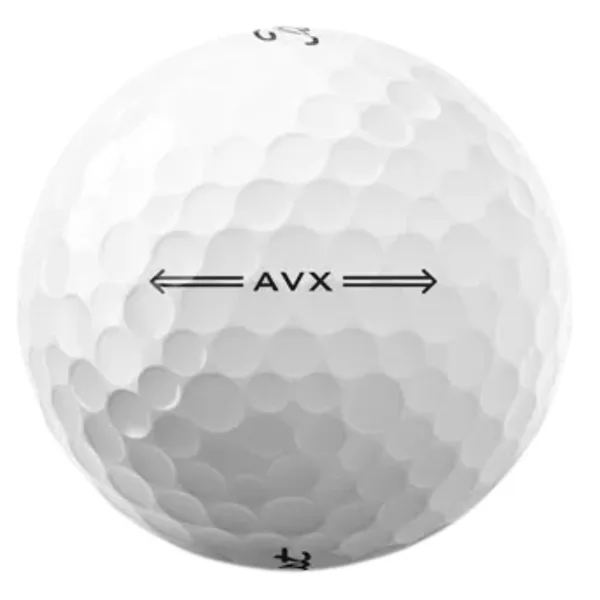
Titleist AVX Golf Ball
Titleist's 'other' urethane ball — the low-spin, low-flying, exceptionally soft premium alternative to the Pro V1, built for distance and a penetrating wind-cheating flight rather than maximum greenside bite. The reengineered 2026 fifth generation pairs a faster core with a softer, thicker urethane cover (the brief from AVX loyalists was 'more short-game spin'), and at $49.99 a dozen it undercuts the Pro V1 by $5. A genuinely loved specialist — MyGolfSpy calls it underrated — that scores high on distance, feel, and value but trades away the very greenside spin the tour benchmark is famous for.
We may earn a commission if you buy through this link — it never affects our scores or the price you pay.
The consensus
The Titleist AVX is the company's 'other' urethane ball — the low-spin, low-flying, exceptionally soft premium alternative that sits alongside the Pro V1 and Pro V1x rather than trying to be them. Where the Pro V1 is the neutral, mid-everything tour benchmark, the AVX is unapologetically specialist: it is built to fly low, spin low off the tee, feel soft, and go long, and at $49.99 a dozen it costs $5 less than the Pro V1 family. The 2026 model is the fifth generation (released January 21, 2026) and a genuine redesign — a faster core for more speed, a reengineered thin high-flex casing layer to hold long-game spin down, and a softer, thicker urethane cover added specifically because AVX loyalists asked for more greenside spin. Across 15 sources spanning robot testing, lab teardown, expert review, forum consensus, and retail feedback, it earns a strong-but-honest consensus that lands clearly in the premium tier without reaching the Pro V1's near-perfect score.
Where sources agree most strongly: distance, feel, and flight. In Today's Golfer's 62-ball robot test the AVX carried 271.1 yards at 114 mph with 162.8 mph of ball speed and only 2,613 rpm of driver spin — one of the longest, lowest-spinning balls in the field — and won the 'most consistent three-piece club golfer model' category, finishing 4th overall for consistency. National Club Golfer awarded it five stars and called it 'a very credible alternative to the Pro V1 and Pro V1x,' Today's Golfer rated it 4.5/5 in the prior generation, and reviewers across the board praise the soft ~77-compression feel and the penetrating, wind-cheating low flight. MyGolfSpy has gone so far as to call the AVX 'one of the least talked about and highly underrated' balls in golf — a quietly excellent, well-built distance ball with a devoted following.
Where the consensus is honest about limits: greenside spin, flight, and fit. The 2026 cover was reformulated to add short-game spin, but on-course testers found the gain real yet modest — Golf Monthly couldn't fully corroborate the added bite and wanted 'a few more rpm,' and Today's Golfer noted it still spins less than the Pro V1, so players who need maximum stopping power on firm greens have higher-spinning options. The low flight that wins in wind is too flat for golfers who want height, and the reduced spin that helps a slicer can exaggerate a left miss for others — this is a ball that fits a specific swing rather than flattering every player. MyGolfSpy's prior-generation teardown also rated build consistency only 'average,' a step below the Pro V1's class-leading repeatability. But for its target — the spin-heavy, slice-prone, or distance-and-soft-feel player who scores fine without tour-level greenside spin — the AVX is exactly right, and it does it for $5 less than the benchmark.
Titleist's 'other' urethane ball — the low-spin, low-flying, exceptionally soft premium alternative to the Pro V1, built for distance and a penetrating wind-cheating flight rather than maximum greenside bite. The reengineered 2026 fifth generation pairs a faster core with a softer, thicker urethane cover (the brief from AVX loyalists was 'more short-game spin'), and at $49.99 a dozen it undercuts the Pro V1 by $5. A genuinely loved specialist — MyGolfSpy calls it underrated — that scores high on distance, feel, and value but trades away the very greenside spin the tour benchmark is famous for.
Category ratings
What the community loves
Distance is the AVX's headline. A faster core plus a thin, high-flex casing layer strips spin off the long clubs, and reviewers measured the payoff directly: in Today's Golfer's 62-ball robot test the AVX carried 271.1 yards at 114 mph with 162.8 mph ball speed and just 2,613 rpm of driver spin — one of the longest, lowest-spinning balls in the field and the winner of its 'most consistent three-piece club golfer model' category. National Club Golfer recorded ball speeds up to 158 mph and driver backspin as low as 2,100 rpm. For a player who loses distance to excess spin, the AVX gives it back.
At roughly 77 compression the AVX is markedly softer than the Pro V1 (~90), and feel is the trait owners cite most. Reviewers describe a 'remarkably soft,' muted-but-responsive sensation off the face and putter, and several rate it among the best-feeling balls they've played. Golf Monthly's tester singled out the 'nice muted impact noise,' and the soft compression makes distance control on putts and partial shots intuitive. It is a premium urethane feel at a soft-ball compression — an unusual and well-liked combination.
The AVX is the lowest-flying ball in Titleist's urethane family, and its 346 quadrilateral dipyramid catenary dimple design produces a flat, boring trajectory that several reviewers called 'piercing.' Today's Golfer flagged it as 'amazing in windy conditions,' and Golf Monthly found the penetrating flight 'came into its own' into a headwind. The 2026 aero update keeps that low tee flight while adding a touch more peak height on mid-irons, broadening the window slightly without sacrificing the wind performance that defines the ball.
At $49.99 a dozen the AVX sits $5 below the $54.99 Pro V1 and Pro V1x while delivering a genuine cast/thermoplastic urethane cover, tour-style construction, and full personalization options. National Club Golfer framed it as a strong value within the premium tier ('best ball for £40'), and reviewers repeatedly position it as 'a very credible alternative to the Pro V1 and Pro V1x' for players who don't need the Pro V1's specific spin profile. It is one of the more affordable ways into a real urethane ball from the category leader.
Despite low marketing volume, the AVX has a devoted following — MyGolfSpy has publicly called it 'one of the least talked about and highly underrated' balls in golf. Reviewers praise its durability (Golf Monthly's ball was 'in excellent condition' after 18 holes of aggressive wedge play; Today's Golfer noted 'outstanding durability in cold conditions'), and MyGolfSpy's Ball Lab teardown of the prior generation returned an above-average quality score. For its niche, it is a quietly excellent, dependable ball.
What to watch out for
The AVX's defining trade-off is short-game spin. The 2026 redesign was built specifically to add greenside bite — a thicker, softer urethane cover over a firm casing — but multiple reviewers found the improvement subtle in practice. Today's Golfer's James Hogg noted the greenside-spin gain over the previous model 'wasn't dramatic' and that it still spins less than the Pro V1, while Golf Monthly couldn't fully corroborate the added-spin claims, wanting 'a few more rpm' on shorter shots. Players who rely on maximum stopping power on firm greens will out-spin it with a Pro V1, Pro V1x, TP5, or Chrome Tour X.
The piercing trajectory that wins in wind is a liability for golfers who need height. Today's Golfer noted the 'lower ball flight trajectory may not appeal to all players' and is 'unsuitable for players wanting higher launch angles.' Slower swingers who already struggle to get the ball up, and anyone who likes to fly approaches in high and stop them quickly, may find the AVX flies too flat for their game. It is a deliberately specialist flight, not a neutral one.
Because the AVX reduces spin, it also reduces shot curvature and shot-shaping feedback — a benefit for slicers but a hazard for others. Today's Golfer's reviewer cautioned that for a player who fights a low-left miss, 'the AVX could exaggerate that tendency,' and that 'for a golfer who prefers a higher-spinning ball, the downsides can have major consequences.' This is a ball that fits a specific swing type rather than flattering every player, so it rewards an honest fit.
MyGolfSpy's Ball Lab teardown of the prior-generation AVX returned an above-average overall score (76, versus a 74 database average) but only 'average' consistency: a compression range of about 10.8 points across the sample and one rejected ball with cover-seam defects. That is a solid result, but it is a clear step below the Pro V1's class-leading, tightest-in-the-database repeatability. Buyers should note this teardown predates the reengineered 2026 ball, which has not yet been independently lab-tested.
Is it right for your game?
What real people are saying
12 quotes from across the web, grouped by 6 themes. Click a theme to read the individual quotes.
Specifications
All sources analyzed
This review synthesizes opinions from 15 independent sources. Every claim on this page can be traced back to its original source. No manufacturer relationship or compensation.
The consensus score is built in four layers: raw source collection, normalization to a 0-10 scale, credibility-weighted combination, and quality adjustments.
Expert reviews (35% weight) are scored from language intensity and any numerical ratings provided. Data-driven testing (25%) converts product rank within the test group to a percentile score. Forum posts (30%) are AI-classified by sentiment, weighted by substantiveness. Retail reviews (10%) convert 5-star ratings with a 0.75x credibility discount to correct for systematic inflation.
Three quality adjustments are then applied: a source diversity bonus (up to +0.3 for coverage across all source types), a conflict penalty (up to -0.3 when sources strongly disagree), and recency weighting (recent reviews weighted higher than older ones).