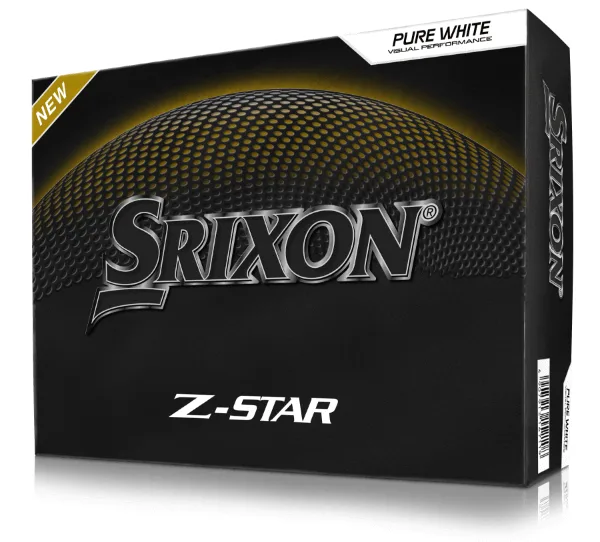
Srixon Z-Star Golf Ball
The soft-feel, approach-and-greenside specialist of the premium tour-ball class — and the consensus value pick against the Pro V1. The 2025 (9th-generation) Z-Star pairs a reformulated FastLayer DG Core 2.0 with an extra-thin biomass urethane cover and Spin Skin+ coating to deliver the softest feel of any premium urethane ball, class-leading approach-play spin, and tour-caliber stopping power for 90-mph-and-up swings. A 2025 Golf Digest Hot List Gold family member that reviewers repeatedly call one of the best golf balls you can buy — and, with frequent discounts and buy-2-get-1 deals, the smart-money alternative to a $55 tour ball.
We may earn a commission if you buy through this link — it never affects our scores or the price you pay.
The consensus
The Srixon Z-Star is the soft-feel, control-first member of the premium tour-ball class — and the ball most reviewers reach for when the question is 'what should I play instead of a Pro V1 to save money without dropping a tier?' The 2025 edition is the ninth generation of a long-running line: a 3-piece ball built around a reformulated FastLayer DG Core 2.0, an extra-thin premium urethane cover now made partly from corn-derived biomass, and Srixon's Spin Skin+ coating that adds cover friction for more greenside bite. It earned a place in Golf Digest's 2025 Hot List Gold-rated urethane family, and across roughly 15 sources — robot and lab testing, expert review, forum consensus and retail feedback — it lands a strong, consistent score just below the Pro V1 benchmark, winning back on value what it concedes on outright distance.
Where sources agree most strongly: feel and approach-play spin. Reviewers describe the Z-Star as noticeably softer off the face than essentially any other premium urethane ball — Srixon says it ties for the softest compression in the model's nine-generation history — with Golfmagic's tester calling it 'one of the very best golf balls you can buy.' On the data side, Today's Golfer's 62-ball robot test ranked the standard Z-Star second of the entire field for approach play, behind only its own Z-Star Diamond stablemate, with roughly 4,900 rpm of 7-iron spin and a penetrating, low-driver-spin flight (around 2,900 rpm off the tee at 114 mph). For a player who scores with short irons and wedges and prizes a soft, communicative feel, it is genuinely elite.
Where the consensus is honest about limits: distance, swing-speed fit, and family hierarchy. As the softest, lowest-launching Z-Star, the standard ball is the shortest of its own line at higher speeds — Golf Monthly measured it about 8 yards behind the Diamond and XV at 108 mph — and Srixon positions it for swings of roughly 90 mph and up, so slower players may prefer a lower-compression option. It is also a touch overshadowed within its own range, since the Z-Star Diamond tends to collect the headline tee-to-green medals, and MyGolfSpy's lab teardown grades its build consistency as good-but-average rather than class-leading like the Pro V1. The net: the Z-Star isn't trying to out-bomb the field or out-measure the Pro V1 on the test bench. It's the soft-feeling, green-grabbing, sensibly-priced tour ball — and on that brief, the consensus says it's one of the best buys in golf.
The soft-feel, approach-and-greenside specialist of the premium tour-ball class — and the consensus value pick against the Pro V1. The 2025 (9th-generation) Z-Star pairs a reformulated FastLayer DG Core 2.0 with an extra-thin biomass urethane cover and Spin Skin+ coating to deliver the softest feel of any premium urethane ball, class-leading approach-play spin, and tour-caliber stopping power for 90-mph-and-up swings. A 2025 Golf Digest Hot List Gold family member that reviewers repeatedly call one of the best golf balls you can buy — and, with frequent discounts and buy-2-get-1 deals, the smart-money alternative to a $55 tour ball.
Category ratings
What the community loves
Across nearly every review, feel is the Z-Star's standout. Srixon tuned the 2025 ball to a lower compression than its own Z-Star Diamond and XV (both ~102), and reviewers describe it as noticeably softer off the face than essentially any other premium, urethane-covered ball on the market — on full shots and especially on and around the green. Srixon says the 2025 Z-Star ties for the softest compression in the model's nine-generation history, and testers single out the soft, muted sensation off the wedge and putter as a genuine reason to play it.
The Z-Star's calling card on the data side is short-iron and wedge control. In Today's Golfer's 62-ball robot test the standard Z-Star ranked second of the entire field for approach play, behind only its own Z-Star Diamond stablemate, producing roughly 4,900 rpm of 7-iron backspin and close to 5,900 rpm on a 40-yard pitch. The extra-thin urethane cover and Spin Skin+ coating (which increases cover friction) are built specifically to grab the grooves and stop the ball quickly on firm greens — the area where Srixon's whole Z-Star range tests as a standout.
The Z-Star is a real tour ball, not a value imitation of one. The Z-Star family earned a 2025 Golf Digest Hot List Gold in the urethane category, and Srixon's tour staff — including Hideki Matsuyama, Shane Lowry, Keegan Bradley and Lucas Glover — play the Z-Star line (most of those marquee names use the firmer XV, with the standard Z-Star aimed at the softer-feel, 90-mph-and-up player). That validation, plus a strong showing across independent robot and lab testing, puts the Z-Star firmly in the premium conversation alongside the Pro V1, TP5 and Chrome Tour.
On paper the 2025 Z-Star carries a $54.99 MSRP, matching the Pro V1. In practice it is the smart-money tour ball: Srixon runs near-constant buy-2-dozen-get-1-free promotions, and street prices routinely fall well below MSRP (frequently into the low-$40s and lower in bulk). For a golfer who wants tour-caliber greenside spin and soft feel without paying full premium price every time, the Z-Star delivers most of the Pro V1 experience for meaningfully less real-world cost — a recurring theme in reviews and forum threads.
The reformulated FastLayer DG Core 2.0 keeps driver spin low — Today's Golfer measured roughly 2,900 rpm off the tee at 114 mph — which, paired with the 338 Speed Dimple pattern, produces a penetrating, wind-cutting ball flight that better players prize. Reviewers note the Z-Star flies a touch lower than its Diamond and XV siblings, giving it a traditional, boring tour trajectory rather than a towering one. Combined with strong durability for a soft urethane ball, it makes for a predictable, easy-to-control flight.
What to watch out for
The standard Z-Star trades speed for spin and feel. It is the lowest-launching, shortest-carrying member of its own family at higher swing speeds: Golf Monthly measured it roughly 8 yards shorter off the driver than the Z-Star Diamond and XV at 108 mph, and both Today's Golfer and Golf Monthly note it simply doesn't keep up with the firmer models — or with distance-tuned rivals like the Callaway Chrome Tour — when you swing hard. If raw tee distance is your priority, this is the wrong Z-Star.
Srixon positions the standard Z-Star for golfers who swing faster than 90 mph, and reviewers agree it is at its best when you can compress it. It is softer than the XV and Diamond, but it is still a firm-ish ~90-compression tour ball, not a low-compression 'easy launch' option. Players well under 90 mph will likely get more from a softer, lower-compression ball (Srixon's own Q-Star Tour, the AVX, or a value soft ball) and may find the Z-Star a touch firm and short for their speed.
A recurring storyline is that the standard Z-Star is the quietly-good middle child. In Golf Digest's Hot List and Today's Golfer's testing it was the Z-Star Diamond that collected the headline tee-to-green, approach and short-game medals, and several reviewers frame the Diamond as the model 'everyone should play.' The standard Z-Star is excellent, but buyers researching the range are often steered toward the Diamond (or the XV for speed), leaving the base ball a little under-celebrated.
MyGolfSpy's most recent full Ball Lab teardown of a standard Z-Star (the closely-related 2023 generation) graded its weight and diameter consistency as 'average' for the database and did not award it a Ball Lab Quality Award — solid, but a clear step behind the Pro V1's perfect Good Ball Rate and class-leading compression tightness. Srixon's own quality has improved generation over generation, but on the raw repeatability metric the Z-Star is a tier below the very best in the category.
Is it right for your game?
What real people are saying
12 quotes from across the web, grouped by 6 themes. Click a theme to read the individual quotes.
Specifications
All sources analyzed
This review synthesizes opinions from 15 independent sources. Every claim on this page can be traced back to its original source. No manufacturer relationship or compensation.
The consensus score is built in four layers: raw source collection, normalization to a 0-10 scale, credibility-weighted combination, and quality adjustments.
Expert reviews (35% weight) are scored from language intensity and any numerical ratings provided. Data-driven testing (25%) converts product rank within the test group to a percentile score. Forum posts (30%) are AI-classified by sentiment, weighted by substantiveness. Retail reviews (10%) convert 5-star ratings with a 0.75x credibility discount to correct for systematic inflation.
Three quality adjustments are then applied: a source diversity bonus (up to +0.3 for coverage across all source types), a conflict penalty (up to -0.3 when sources strongly disagree), and recency weighting (recent reviews weighted higher than older ones).