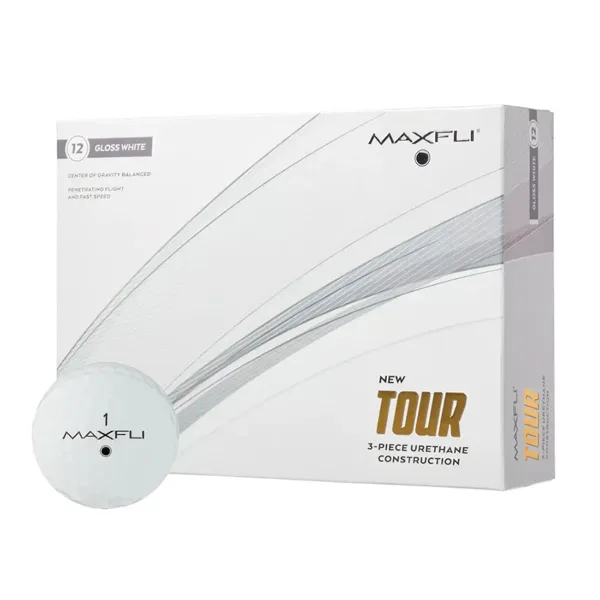
Maxfli Tour Golf Ball
The value-urethane ball that punches far above its $39.99 price — DICK'S' in-house, Foremost-built three-piece cast-urethane ball gives most golfers tour-style greenside grab, a penetrating mid flight, and genuinely premium build quality for a fraction of a Pro V1. MyGolfSpy calls it one of the most consistent balls without a Titleist logo, and the Tour family's pedigree is real (Ben Griffin's two 2025 PGA TOUR wins came with the firmer Tour X). The honest knock: reviewers find the standard Tour 'solid but average' — a notch below the premium leaders on outright wedge spin — which is exactly why it wins on value and not on spin.
We may earn a commission if you buy through this link — it never affects our scores or the price you pay.
The consensus
The Maxfli Tour is the value-urethane benchmark hiding in plain sight at DICK'S Sporting Goods. A three-piece, cast-urethane ball built by Foremost in Taiwan and sold for $39.99 a dozen (often closer to $30 in the multi-buy), it sets out to deliver most of a $55 tour ball's experience — soft feel, real greenside grab, a penetrating mid flight — at roughly a third less. Across 15 sources spanning MyGolfSpy's Ball Lab teardown, Today's Golfer's robot test, expert reviews, forums, and retail feedback, the consensus is consistent and pragmatic: this is one of the best values in the category, with genuine build quality behind it, even if the standard Tour is a balanced all-rounder rather than a category-beater.
Where the sources agree most: value and build quality. MyGolfSpy graded the Tour an above-average 85 overall, found no significant defects in its sample, confirmed full USGA size conformance, and concluded it is 'one of the most consistent balls that doesn't have a Titleist logo on it' — strong words for a sub-$40 ball. Today's Golfer's robot test framed the standard Tour as a 'goldilocks' ball that sits squarely between the firmer Tour X and softer Tour S for spin at every swing speed, with low driver spin for distance and a flight that holds its line. Add the family's tour pedigree — Lexi Thompson's Maxfli signing and Ben Griffin's two 2025 PGA TOUR wins (on the firmer Tour X) — and the 'best-kept secret in golf' framing Golf Digest gave the series, and the value case is easy to make.
Where the consensus is honest about limits: outright spin, character, and availability. The standard Tour spins roughly 10% less than a Pro V1 on full wedges and is 'noticeably less spinny' than its own Tour X and Tour S siblings, and Today's Golfer's tester was candid that it's 'a very average golf ball' — solid and balanced rather than special. Its build, while excellent for the price, is a half-step behind the near-zero-defect repeatability of the Pro V1 (diameter consistency only 'average,' weight consistency 'could be tighter'), the published compression varies by source (Maxfli ~95, MyGolfSpy ~85), and it is effectively exclusive to DICK'S and Golf Galaxy. The bottom line: at 8.7 the Maxfli Tour scores clearly below the Pro V1 (9.4) and the tour staples on premium spin and feel, but it wins decisively on value — for the golfer who wants real urethane performance without the premium price, it is one of the smartest dozens in the game.
The value-urethane ball that punches far above its $39.99 price — DICK'S' in-house, Foremost-built three-piece cast-urethane ball gives most golfers tour-style greenside grab, a penetrating mid flight, and genuinely premium build quality for a fraction of a Pro V1. MyGolfSpy calls it one of the most consistent balls without a Titleist logo, and the Tour family's pedigree is real (Ben Griffin's two 2025 PGA TOUR wins came with the firmer Tour X). The honest knock: reviewers find the standard Tour 'solid but average' — a notch below the premium leaders on outright wedge spin — which is exactly why it wins on value and not on spin.
Category ratings
What the community loves
The Maxfli Tour is a genuine three-piece cast-urethane ball at $39.99 a dozen (frequently $30 a dozen in the 48-ball multi-buy), against $54.99 for a Pro V1 or Chrome Tour. Multiple reviewers conclude it delivers most of the premium experience — soft urethane feel, real greenside grab, penetrating flight — for roughly a third less. Plugged In Golf summed up the value pitch directly: these urethane balls perform comparably to balls costing $50-plus, and for golfers who lose a sleeve or two a round, the saved money compounds fast.
Maxfli's balls are made by Foremost in Taiwan — widely regarded as the best factory not under direct OEM ownership — and the lab data shows it. MyGolfSpy's Ball Lab gave the Tour an overall grade of 85 (above the market average), found no significant defects in the sample, confirmed 100% conformed to the USGA's minimum-size requirement, and reported that none of the balls failed its roundness standard. The verdict: it is 'one of the most consistent balls that doesn't have a Titleist logo on it.' For a value ball, that quality floor is the real story.
The standard Tour sits in the middle of Maxfli's three-ball lineup: more spin and a softer feel than the firm Tour X, but lower spin and a lower, more penetrating flight than the soft Tour S. Today's Golfer's robot test called it a 'goldilocks golf ball — not too high-spinning or too low-spinning, right in the middle,' and measured it sitting directly between the X and S for spin at every swing speed. Low driver spin for distance, useful iron and wedge spin for scoring, and a flight that holds its line in wind make it an easy across-the-bag fit.
The cast urethane cover delivers the soft, communicative feel value golfers usually have to pay up for — reviewers describe 'soft and crisp' iron feedback and a soft touch on the greens with a slight click reminiscent of a Pro V1x. Around the greens the urethane bites enough to hold approach shots and check pitches, which is precisely the gap between a true tour ball and the surlyn-covered distance balls in the same price bracket. For most amateurs the greenside grab is more than enough to score with.
Maxfli's Tour series is no longer an unknown: LPGA winner Lexi Thompson signed with Maxfli in January 2024, and PGA TOUR pro Ben Griffin put a Maxfli ball in play and won the 2025 Zurich Classic and Charles Schwab Challenge with it. That validation lends credibility to the whole line and is a frequent talking point in reviews and forums — fairly noted, though, the pro bag and those wins are the firmer Tour X, not the standard Tour reviewed here.
What to watch out for
This is the honest trade for the price. Plugged In Golf measured the Maxfli Tour producing roughly 10% less backspin than a Pro V1 on full wedge shots, and Today's Golfer's robot test found the standard Tour 'noticeably less spinny' than its own Tour X and Tour S siblings off short irons and wedges. It is still enough to hold greens, but players whose scoring depends on maximum bite and the steepest stopping power on firm greens will find higher-spinning options in the Tour X, Pro V1x, TP5, or Z-Star Diamond.
The flip side of being a balanced middle option is that nothing leaps out. Today's Golfer's tester was candid: 'I find it difficult to complain and praise the Maxfli Tour because it's a very average golf ball.' It does everything competently and nothing exceptionally, which is why several reviewers nudge faster swingers toward the more characterful Tour X and slower or higher-launch players toward the softer Tour S — the standard Tour is the safe pick more than the exciting one.
Because it is a DICK'S Sporting Goods house brand, the Tour is effectively exclusive to DICK'S and Golf Galaxy (plus Maxfli.com and the resale market) — you cannot grab a dozen at most pro shops or rival retailers. The published compression also varies by source: Maxfli markets it around 95, MyGolfSpy's gauges measured an average of 85, and Today's Golfer's robot data listed it near 100. Call it mid-to-firm, but know the exact number is inconsistent across testing.
MyGolfSpy's praise comes with caveats: while compression consistency was above average and there were no significant defects, it rated diameter consistency only 'solidly average' and noted weight consistency 'could be a little tighter.' That is a strong result for a value ball, but it is a half-step behind the class-leading, near-zero-defect repeatability of the Pro V1 that fitted, faster players pay the premium to get. The value is undeniable; the very last increment of shot-to-shot consistency is not quite there.
Is it right for your game?
What real people are saying
12 quotes from across the web, grouped by 6 themes. Click a theme to read the individual quotes.
Specifications
All sources analyzed
This review synthesizes opinions from 15 independent sources. Every claim on this page can be traced back to its original source. No manufacturer relationship or compensation.
The consensus score is built in four layers: raw source collection, normalization to a 0-10 scale, credibility-weighted combination, and quality adjustments.
Expert reviews (35% weight) are scored from language intensity and any numerical ratings provided. Data-driven testing (25%) converts product rank within the test group to a percentile score. Forum posts (30%) are AI-classified by sentiment, weighted by substantiveness. Retail reviews (10%) convert 5-star ratings with a 0.75x credibility discount to correct for systematic inflation.
Three quality adjustments are then applied: a source diversity bonus (up to +0.3 for coverage across all source types), a conflict penalty (up to -0.3 when sources strongly disagree), and recency weighting (recent reviews weighted higher than older ones).