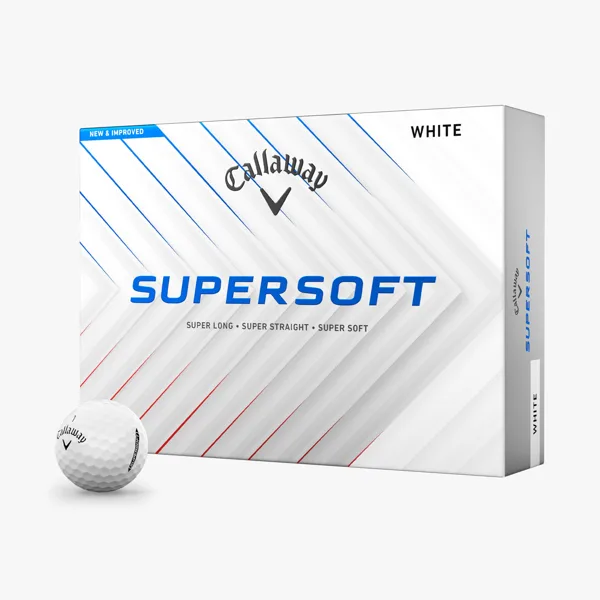
Callaway Supersoft Golf Ball
The best-selling golf ball in the game and the definitive soft-feel value pick — a 2-piece, ~41-compression ball with an updated HyperElastic SoftFast core and non-urethane Hybrid cover that delivers a pillowy feel, a straight low-spin flight, and surprisingly capable greenside performance for roughly half the price of a tour ball. Beloved by slower swingers and value seekers; honestly limited on distance-at-speed and greenside spin for better players. A consensus value score from 16 sources.
We may earn a commission if you buy through this link — it never affects our scores or the price you pay.
The consensus
The Callaway Supersoft is the best-selling golf ball in the game and the definitive soft-feel value pick — a two-piece, non-urethane ball built around an exceptionally low ~41 compression and an updated HyperElastic SoftFast core for 2025. Where the Titleist Pro V1 anchors the premium tour-ball world, the Supersoft anchors the other end of the market: roughly half the price (about $26.99 a dozen, often less on offer), a pillowy feel, and a straight, forgiving flight aimed squarely at recreational golfers. Across 16 sources spanning robot testing, lab data, expert review, forum consensus, and a mountain of retail feedback, it earns a solid value-tier score — strong where it's designed to be strong, and honest about where it isn't.
Where sources agree most strongly: feel and value. Reviewers are near-unanimous that the Supersoft is one of the softest balls you can buy and that it punches well above its price — National Club Golfer rated it 4.5 stars and was surprised a non-urethane ball felt this pleasing off the putter; Golf Monthly highlighted the value and 'superb control around the greens'; Golficity and others framed it as the smart step up for newer players who don't want to spend tour-ball money. The low-spin core also produces a straight, stable flight (helped by the HEX Aerodynamics dimple pattern) that flatters a slice or hook, and for slower swing speeds it even holds its own for distance — Today's Golfer's robot test had it in the upper third of the field for carry at the slowest driver speed.
Where the consensus is honest about limits: distance at speed, spin, and greenside bite. MyGolfSpy's 2025 ball test summed it up with the headline that the best-selling ball of the year is also one of the shortest — at faster swing speeds the Supersoft finishes near the bottom of the field, well behind Callaway's own Chrome Tour. Its low spin keeps it straight off the tee but makes it harder to hold a firm green; Today's Golfer's Rob McGarr flagged the shallow descent angle and 'extremely low' iron spin, and the Hybrid cover can't match a urethane ball for greenside grab. The verdict that emerges is clear and consistent: for slower-to-moderate swingers, beginners, and anyone who prizes soft feel and value over premium spin, the Supersoft is an easy, well-earned recommendation — but faster, better players who score with control and short-game spin should look to a urethane ball, premium or value, instead.
The best-selling golf ball in the game and the definitive soft-feel value pick — a 2-piece, ~41-compression ball with an updated HyperElastic SoftFast core and non-urethane Hybrid cover that delivers a pillowy feel, a straight low-spin flight, and surprisingly capable greenside performance for roughly half the price of a tour ball. Beloved by slower swingers and value seekers; honestly limited on distance-at-speed and greenside spin for better players. A consensus value score from 16 sources.
Category ratings
What the community loves
The Supersoft is the No. 1 best-selling golf ball on Amazon and one of the best-selling balls in golf, period — the most popular soft-feel, non-urethane franchise on the market. That mass adoption is its own kind of validation: when MyGolfSpy ran its 2025 ball test it explicitly framed the Supersoft as the category's best-seller, and the recurring reviewer verdict is that millions of recreational golfers keep buying it because the feel-and-value combination simply works for the way they play. For its target buyer it is a known, trusted, repeatable quantity.
Feel is the Supersoft's entire identity and its biggest strength. At a compression of roughly 41 (some sources cite the high-30s to low-40s) it is among the softest balls you can buy, and reviewers consistently describe a pillowy, low-effort sensation off every club. National Club Golfer was struck that a non-urethane ball felt this pleasing off the putter face, avoiding the clicky harshness that often plagues two-piece balls. For golfers who prioritize a soft, comfortable strike above all else, it delivers exactly what the name promises.
At about $26.99 a dozen at retail — and frequently nearer $20–25 on offer — the Supersoft costs roughly half what a urethane tour ball does, and value is the single most-cited reason reviewers recommend it. Golf Monthly called out the value for money directly; National Club Golfer judged the performance 'top notch' for the price; Golficity positioned it as the smart step up for players a year or two into the game who lose several balls a round but want better quality than bargain-bin or refurbished balls. The cost-per-round math is hard to argue with.
The HyperElastic SoftFast core is engineered to cut long-game spin, and the HEX Aerodynamics dimple pattern keeps flight stable and low-drag. The practical payoff is a straight, forgiving ball flight that takes some sting out of a slice or hook — exactly what a higher-spin, less-consistent swing benefits from. Reviewers note a mid-to-high launch that helps players who struggle to get the ball up, and the low spin keeps wayward tee shots from curving as violently as a spinnier ball would.
The same low-spin design that costs the Supersoft yards at tour speed actually helps slower swingers: in Today's Golfer's robot test it climbed into the upper third of the field for carry at the slowest driver speed, and MyGolfSpy found that at moderate swing speed it finished third-longest off the tee. The non-urethane Hybrid cover is also tougher and more scuff-resistant than soft urethane, so a dozen lasts longer — a meaningful plus for the value-minded golfer it's built for.
What to watch out for
MyGolfSpy's 2025 test put it bluntly: the best-selling ball of the year is also one of the shortest. At a fast driver swing speed the Supersoft was among the second-shortest balls in the entire field — measurably behind premium distance balls like the Callaway Chrome Tour — because its ultra-soft, low-spin construction simply can't return the ball speed a faster player generates. The distance gap closes at slower speeds, but a player who swings hard leaves real yardage on the table.
The low-spin profile that keeps tee shots straight is a liability into the green. Today's Golfer's Rob McGarr warned that the low spin combined with a shallow descent angle makes shots roll out more on landing — not ideal when you're trying to hit and hold a green — and flagged the mid-iron spin as 'extremely low.' Approach control and stopping power are the Supersoft's clearest performance weakness, and better players who score by attacking pins will feel it most.
Reviewers are honest that the Hybrid cover, while better than most two-piece ionomers, cannot match a cast-urethane tour ball for greenside bite. In robot testing the Supersoft sat in the bottom third for wedge spin, and short-game grab on full pitches and firm-green chips is where the gap to a Pro V1, Chrome Tour, or even the urethane value balls (Kirkland, Maxfli Tour) is most obvious. Its greenside performance is praised relative to its price, not relative to premium balls.
The near-universal caveat is the swing-speed ceiling: reviewers repeatedly cap the Supersoft's ideal user at roughly 100 mph of driver speed, above which the low spin and soft compression cost both distance and control. A few testers also note a cosmetic nitpick — the shallow HEX dimple pattern can make the ball look almost smooth, like a range ball, at address — though all agree it doesn't affect performance. Faster, better players are simply not the audience.
Is it right for your game?
What real people are saying
12 quotes from across the web, grouped by 6 themes. Click a theme to read the individual quotes.
Specifications
All sources analyzed
This review synthesizes opinions from 16 independent sources. Every claim on this page can be traced back to its original source. No manufacturer relationship or compensation.
The consensus score is built in four layers: raw source collection, normalization to a 0-10 scale, credibility-weighted combination, and quality adjustments.
Expert reviews (35% weight) are scored from language intensity and any numerical ratings provided. Data-driven testing (25%) converts product rank within the test group to a percentile score. Forum posts (30%) are AI-classified by sentiment, weighted by substantiveness. Retail reviews (10%) convert 5-star ratings with a 0.75x credibility discount to correct for systematic inflation.
Three quality adjustments are then applied: a source diversity bonus (up to +0.3 for coverage across all source types), a conflict penalty (up to -0.3 when sources strongly disagree), and recency weighting (recent reviews weighted higher than older ones).