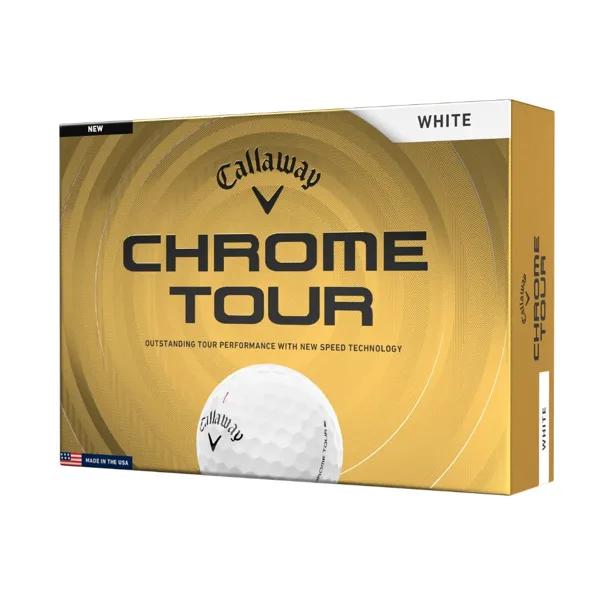
Callaway Chrome Tour Golf Ball
The robot-test distance darling and the most credible challenger to the Pro V1 — in Today's Golfer's 62-ball test the Chrome Tour was the only ball to clear 275 yards of carry at 114 mph, and the outlet named it the better ball for most golfers. A four-piece cast-urethane tour ball with a new 16%-stiffer Tour Fast Mantle for 2026, a Golf Digest Hot List Gold, a MyGolfSpy Ball Lab Quality Award with a perfect 100% Good Ball Rate, and Xander Schauffele's two-major weapon. A near-top consensus from 16 sources, edged only by the Pro V1's deeper consistency and feel pedigree — and dinged for soft-cover durability.
We may earn a commission if you buy through this link — it never affects our scores or the price you pay.
The consensus
The Callaway Chrome Tour is the most credible challenger the Titleist Pro V1 has faced in years — and on one metric, distance, the independent robot data hands it the crown. In Today's Golfer's 62-ball test it was the only model to clear 275 yards of carry at 114 mph, it led at every swing speed tested, and the outlet concluded it was 'the better golf ball for the majority of golfers,' a striking verdict given the Pro V1's No. 1 status. The 2026 ball is a four-piece cast-urethane tour ball built around a new Tour Fast Mantle — an outer mantle roughly 16% stiffer (higher flex modulus), four years in development — engineered to add ball speed and lower long-game spin while preserving the greenside control of a premium ball. Across 16 sources spanning robot testing, lab teardown, expert review, forum consensus, and retail feedback, it earns a near-top consensus score, a Golf Digest Hot List Gold, and the kind of tour pedigree — two of Xander Schauffele's major wins, Akshay Bhatia's Arnold Palmer Invitational title — that moves a ball from 'alternative' to 'first choice.'
Where the sources agree most strongly: distance and build quality. The Chrome Tour pairs its class-leading carry with manufacturing that matches the benchmark — MyGolfSpy's Ball Lab handed the 2026 ball a 92 Quality Score, a Ball Lab Quality Award, and a perfect 100% Good Ball Rate, with all 36 balls passing inspection and excellent compression symmetry. BallCaddie went as far as calling it the tour ball that 'out-consistents' the Pro V1 on the specific consistency metrics it measured. Golf Monthly's Joe Ferguson summed up the mood — 'Look out Titleist, Callaway has upped its game a notch here' — while Today's Golfer gave it full marks for both tee-to-green performance and versatility. The Seamless Tour Aero cover (332 dimples) delivers a stable, penetrating flight reviewers single out in wind, and the feel sits just on the soft side of the tour class.
Where the consensus is honest about limits: durability, feel, and price. The soft, high-friction urethane cover scuffs readily — Today's Golfer's tester found it 'didn't survive full rounds' — the clearest and most-repeated knock on the ball. The 2026 ball is also mid-firm, not soft: independent compression reads around 87 and firmer on some 2026 measurements (on par with the Pro V1), and National Club Golfer's reviewer found it 'a little too firm' even while conceding the numbers were faultless. And at $57.99 a dozen it is among the most expensive balls made, a notch above even the Pro V1 — though Callaway's frequent Buy-3-Get-1 promotions give it a real cost edge over Titleist's locked pricing. The net: the Chrome Tour is a genuine co-leader of the tour-ball class and the distance pick of the group, edged for the top spot only by the Pro V1's deeper consistency and feel pedigree — a one-notch gap, not a category apart.
The robot-test distance darling and the most credible challenger to the Pro V1 — in Today's Golfer's 62-ball test the Chrome Tour was the only ball to clear 275 yards of carry at 114 mph, and the outlet named it the better ball for most golfers. A four-piece cast-urethane tour ball with a new 16%-stiffer Tour Fast Mantle for 2026, a Golf Digest Hot List Gold, a MyGolfSpy Ball Lab Quality Award with a perfect 100% Good Ball Rate, and Xander Schauffele's two-major weapon. A near-top consensus from 16 sources, edged only by the Pro V1's deeper consistency and feel pedigree — and dinged for soft-cover durability.
Category ratings
What the community loves
Distance is the Chrome Tour's signature. In Today's Golfer's 62-ball robot test the Chrome Tour was the single ball in the entire field to exceed 275 yards of carry at 114 mph, and it carried that advantage across every swing speed tested — leading at 93 mph and 78 mph as well. In the outlet's head-to-head against the Pro V1 it produced more ball speed (165.1 vs 163.9 mph) and longer carry (275.4 vs 273.2 yards). For golfers whose first question of a golf ball is 'how far does it go,' the data points to one answer at the top of the tour-ball class.
The Chrome Tour is not just fast, it is exceptionally well made. MyGolfSpy's Ball Lab gave the 2026 ball a Quality Score of 92 and a Ball Lab Quality Award, with all 36 balls passing inspection at a perfect 100% Good Ball Rate — zero defects across cores, layers, and covers — and excellent compression symmetry. That puts the Chrome Tour in the same elite manufacturing tier as the Pro V1, and BallCaddie went as far as framing it as the tour ball that 'out-consistents' the benchmark on the specific consistency metrics it measured. For a challenger brand, matching Titleist on build quality is the hardest thing to do.
The headline change for 2026 is the Tour Fast Mantle — an outer mantle with a roughly 16% higher flex modulus (16% stiffer), four years in development, engineered to raise ball speed and lower long-game spin while preserving the greenside control of a premium ball. Reviewers measured the intended effect: more speed off the tee, low driver spin, and short-game spin held over from the previous model. National Club Golfer and Today's Golfer both confirmed the new ball does exactly what Callaway claims — faster off the tee while still stopping quickly on the greens.
The Chrome Tour has become one of the most-played premium balls on tour, and its résumé is real: Xander Schauffele captured two major championships in 2024 playing a Chrome Tour, Akshay Bhatia won at the Arnold Palmer Invitational with it, and Sam Burns and Min Woo Lee headline a deepening tour stable. Tour adoption at that level is the strongest evidence a ball performs under pressure — and it has moved the Chrome Tour from 'Pro V1 alternative' to a genuine first-choice tour ball in its own right.
The Seamless Tour Aero dimple pattern (332 dimples) gives the Chrome Tour a notably stable, penetrating-but-mid-high ball flight that reviewers single out in wind, and Golf Monthly's tester praised its consistent spin across the bag. Feel sits, in Plugged In Golf's words, 'just barely on the soft side of Tour balls' — softer than the Pro V1x and the firmer Chrome Tour X — with a slightly muted, responsive click on irons and wedges. It is a complete tee-to-green package, with Today's Golfer awarding full marks for both tee-to-green performance and versatility.
What to watch out for
Durability is the Chrome Tour's clearest weakness. In Today's Golfer's hands-on testing the urethane cover scuffed easily and, in the reviewer's words, 'didn't survive full rounds,' earning a low durability mark — the same complaint leveled at the Chrome Tour X. It is the price of a soft, high-friction tour cover, and some players will not mind, but golfers who play firm courses, hit a lot of cart paths, or simply want a ball to look new after 18 holes should know the cover marks more readily than they may expect from a $57.99 ball.
The 2026 ball is a mid-firm tour ball, not a soft one, and the new 16%-stiffer Tour Fast Mantle tips it firmer still. National Club Golfer's reviewer captured the split honestly — 'for me it felt a little too firm, but numbers-wise I absolutely cannot fault it.' Independent compression readings land around 87 and run firmer on some 2026 measurements, roughly on par with the Pro V1 and noticeably firmer than the soft-feel crowd. Players who prioritize a soft, muted sensation over raw speed may prefer the Chrome Soft, the Pro V1, or a lower-compression option.
At $57.99 a dozen the Chrome Tour is one of the most expensive balls available, a touch above even the Pro V1's $54.99. The saving grace is that Callaway runs frequent 'Buy 3 dozen, get 1 free' promotions that drop the effective price into the low-$40s — a real advantage over Titleist's locked pricing — but at full retail it sits at the very top of the ladder, and value urethane balls (Kirkland Signature, Maxfli Tour, Srixon Q-Star Tour) deliver much of the experience for far less.
The Chrome Tour matches the Pro V1 on build quality, but the Pro V1 remains MyGolfSpy's calibration ball and the most-played, most-documented ball in golf — Today's Golfer noted the Pro V1 was the single most consistent model across its entire 62-ball field even as the Chrome Tour won on distance. The Chrome Tour is a genuine co-leader, but for a fitted player who values predictability above every other trait, the benchmark still belongs to Titleist by a nose.
Is it right for your game?
What real people are saying
12 quotes from across the web, grouped by 6 themes. Click a theme to read the individual quotes.
Specifications
All sources analyzed
This review synthesizes opinions from 16 independent sources. Every claim on this page can be traced back to its original source. No manufacturer relationship or compensation.
The consensus score is built in four layers: raw source collection, normalization to a 0-10 scale, credibility-weighted combination, and quality adjustments.
Expert reviews (35% weight) are scored from language intensity and any numerical ratings provided. Data-driven testing (25%) converts product rank within the test group to a percentile score. Forum posts (30%) are AI-classified by sentiment, weighted by substantiveness. Retail reviews (10%) convert 5-star ratings with a 0.75x credibility discount to correct for systematic inflation.
Three quality adjustments are then applied: a source diversity bonus (up to +0.3 for coverage across all source types), a conflict penalty (up to -0.3 when sources strongly disagree), and recency weighting (recent reviews weighted higher than older ones).