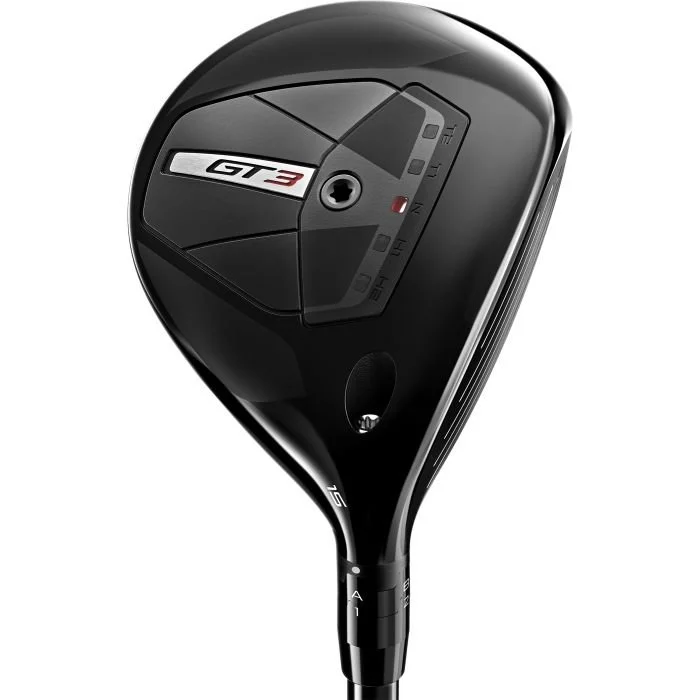
Titleist GT3 Fairway Wood
The shot-maker's fairway wood — 5-position CG Track adjustability and low-spin design deliver tour-level workability and a penetrating ball flight that better players demand, backed by a Golf Digest Gold Medal.
We may earn a commission if you buy through this link — it never affects our scores or the price you pay.
The consensus
The Titleist GT3 is the shot-maker's fairway wood in Titleist's GT lineup — a Golf Digest Gold Medal winner built for better players who demand trajectory control, workability, and the most adjustable setup in the fairway wood category. The signature 5-position SureFit CG Track system (H2/H1/Neutral/T1/T2) allows heel-to-toe weight bias tuning for draw or fade preference, and combined with the 16-position SureFit Hosel, creates approximately 30 total loft/lie/bias combinations that no competitor matches.
The deeper face and lower-spin design produce a penetrating, controlled ball flight that's ideal for windy conditions and approach shots into greens. The forged 465 stainless steel L-Cup face preserves ball speed on off-center hits — SGGT measured ball speed retention within 6 mph of center on mishits — while the Seamless Thermoform Crown (Proprietary Matrix Polymer, ~5x lighter than steel) redistributes weight for improved launch over the TSR3 predecessor. Testing showed approximately 3 mph more ball speed and 3 extra yards of carry versus the outgoing model.
The GT3 demands more from the golfer than the GT2 or most competitors. Multiple reviewers caution that it requires a consistent descending strike — sweepers are directed to the GT2. The compact head provides less MOI, meaning mishits lose more distance. Only three lofts are available (15°/16.5°/18°), limiting versatility for creative bag builds. But for low handicappers who shape shots and value precision over forgiveness, the GT3 is the most tunable fairway wood in golf — now at the $329 discount price, it's a premium tool at a mid-tier cost.
The shot-maker's fairway wood — 5-position CG Track adjustability and low-spin design deliver tour-level workability and a penetrating ball flight that better players demand, backed by a Golf Digest Gold Medal.
Category ratings
Where to buy
Prices checked June 2026. We may earn a commission from links above at no extra cost to you.
What the community loves
The 5-position SureFit CG Track system (H2/H1/Neutral/T1/T2) combined with the 16-position SureFit Hosel creates approximately 30 total setup combinations. This heel-to-toe weight bias tuning is unique in the fairway wood category and lets fitters dial in precise draw/fade bias.
Lower spin and deeper face enable golfers to flight the ball both ways. Plugged In Golf called it a 'true shot-maker's club,' and Golf Monthly praised it as 'ideal for those who like to hit different shots.' The fade bias helps prevent hooks while still allowing draws when needed.
Produces a lower, more piercing trajectory than the GT2 — ideal for windy conditions and approach shots into greens. National Club Golfer praised the 'penetrating ball flight' and the ability to flight the ball under wind when needed.
Classic 'old-school Titleist' metallic feedback with a slightly deeper tone than previous models. The impact provides immediate awareness of strike quality — you know exactly where on the face you hit it. Today's Golfer described the sensation as 'compact and inviting you to hit down hard on it.'
The deeper face, compact profile, and high-gloss black crown create what Golf Monthly called 'extremely premium looks.' The pear shape is described as timeless — a tour-influenced design that better players find confidence-inspiring at address.
Testing showed approximately 3 mph more ball speed and 3 extra yards of carry versus the TSR3. Ball speed retention is strong — never dropping below 6 mph less than the cleanest strike on off-center hits. The L-Cup face design is the primary driver of this improvement.
What to watch out for
The compact head means less MOI. Golfers who frequently miss across the face will notice more distance loss than with the GT2. This is a precision club that rewards center-face contact — not forgiving enough for high handicappers.
Best for players who hit down on the ball with their fairway woods. The deeper face and low-spin design are optimized for a descending angle of attack. Sweeping swings get less benefit — those players should choose the GT2 instead.
The deeper face and lower-spin design make it harder to get airborne from thick rough compared to the GT2 or competitors with higher MOI. The mid-launch bias limits rescue ability when the lie is poor.
Available in just 15°, 16.5°, and 18° — no 13.5° mini-driver or 21° 7-wood like the GT2 offers. Players wanting a strong 3-wood or a dedicated 7-wood must look to other models.
Is it right for your game?
The GT3 is a club that divides golfers by skill level. Low handicappers praise the CG Track adjustability, penetrating flight, and shot-shaping control. But multiple reviewers caution that it requires a descending strike — sweepers and high handicappers are consistently redirected to the GT2 or GT1. Today's Golfer gave it only 4/5 (vs 5/5 for the GT2) specifically because of the narrower audience.
What real people are saying
16 quotes from across the web, grouped by 8 themes. Click a theme to read the individual quotes.
Specifications
Available shafts (no upcharge)
Premium shafts available at additional cost: Graphite Design Tour AD VF, Tour AD UB, Tour AD DI
All sources analyzed
This review synthesizes opinions from 13 independent sources. Every claim on this page can be traced back to its original source. No manufacturer relationship or compensation.
The consensus score is built in four layers: raw source collection, normalization to a 0-10 scale, credibility-weighted combination, and quality adjustments.
Expert reviews (35% weight) are scored from language intensity and any numerical ratings provided. Data-driven testing (25%) converts product rank within the test group to a percentile score. Forum posts (30%) are AI-classified by sentiment, weighted by substantiveness. Retail reviews (10%) convert 5-star ratings with a 0.75x credibility discount to correct for systematic inflation.
Three quality adjustments are then applied: a source diversity bonus (up to +0.3 for coverage across all source types), a conflict penalty (up to -0.3 when sources strongly disagree), and recency weighting (recent reviews weighted higher than older ones).