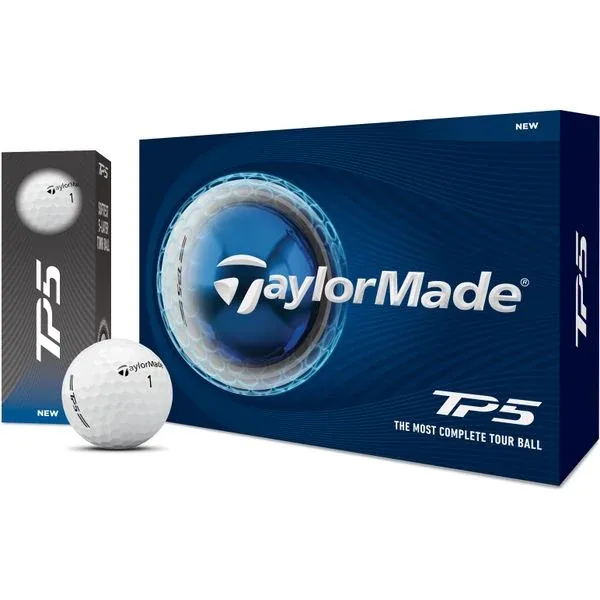
TaylorMade TP5 Golf Ball
The softer, higher-spinning half of golf's only five-layer tour ball — the TP5 is the spin-and-feel pick of the premium category, posting the third-highest greenside spin in a 62-ball robot test and a marshmallow-soft feel reviewers rave about, now reborn for 2026 with TaylorMade's largest tour core and a paint-to-the-millionth-of-a-gram microcoating for tighter dispersion. The gamer of Rory McIlroy and a MyGolfSpy Ball Lab Quality Award winner, it sits a notch below the Pro V1 benchmark on outright validation and value but matches — and on spin out-spins — the field.
We may earn a commission if you buy through this link — it never affects our scores or the price you pay.
The consensus
The TaylorMade TP5 is the softer, higher-spinning half of the only five-layer tour ball in golf — and the spin-and-feel pick of the premium category. Where the Titleist Pro V1 is the neutral, do-everything benchmark, the TP5 leans into one thing and does it better than almost anything: greenside spin. In Today's Golfer's 62-ball robot test it posted roughly 6,100 rpm on the 40-yard pitch, the third-highest of the entire field behind the Callaway Chrome Tour X and Srixon Z-Star Diamond, and reviewers consistently single out its 'marshmallow-soft' feel off the wedge and putter. The 2026 generation rebuilds it around TaylorMade's largest tour core for more speed and adds a new microcoating process — paint applied 'to the one-millionth of a gram' — aimed at tighter dispersion. Across 16 sources spanning lab teardown, robot testing, expert review, forum consensus, and retail feedback, it earns a strong consensus score and a MyGolfSpy Ball Lab Quality Award, landing in the tour-ball cluster just a notch below the Pro V1.
Where sources agree most strongly: spin, feel, and tour pedigree. The TP5 is the highest-spinning of TaylorMade's two five-layer balls, engineered so each layer activates at a different swing speed — low spin off the tee, high spin into the greens. That construction is validated at the very top of the game: Rory McIlroy games the TP5 and credits it with helping him hold the green on the approach that completed his career Grand Slam, with Nelly Korda and Tommy Fleetwood among the staff on the line (Collin Morikawa plays the firmer TP5x). On feel, Golf Monthly called it 'marshmallow soft,' describing the ball as seeming to 'stay on the wedge face for an eternity.' And on quality, MyGolfSpy's Ball Lab handed the 2026 ball a Quality Score of 91 and a Quality Award, with all 36 balls passing inspection with zero defects — TaylorMade's most consistent TP5 yet.
Where the consensus is honest about limits: distance, price, and the compression story. The TP5 is the higher-flying, higher-spinning ball of the pair, so it is not the outright distance leader — it runs a couple of mph slower off the driver than its sibling the TP5x, and faster, lower-spin balls like the Chrome Tour took the tee-to-green honors in the robot field (though the TP5 actually out-carried the Pro V1 by about 4.5 yards at 100 mph, closing the old distance gap). At $57.99 a dozen it sits at the very top of the market, a few dollars above even the Pro V1, just as value urethane balls — the Kirkland Signature at roughly a third of the price, the Maxfli Tour — have closed much of the gap. And buyers should note the compression story: marketed in the mid-80s but measured firmer by MyGolfSpy (high-80s to low-90s), it feels softer than the number thanks to muted acoustics. For the player who wants the most greenside spin and the softest feel in the premium tier — and who scores with the short game — the TP5 is the tour ball to beat. It earns a 9.2, sitting just below the Pro V1's 9.4 on overall validation and value while out-spinning it around the greens.
The softer, higher-spinning half of golf's only five-layer tour ball — the TP5 is the spin-and-feel pick of the premium category, posting the third-highest greenside spin in a 62-ball robot test and a marshmallow-soft feel reviewers rave about, now reborn for 2026 with TaylorMade's largest tour core and a paint-to-the-millionth-of-a-gram microcoating for tighter dispersion. The gamer of Rory McIlroy and a MyGolfSpy Ball Lab Quality Award winner, it sits a notch below the Pro V1 benchmark on outright validation and value but matches — and on spin out-spins — the field.
Category ratings
What the community loves
Spin is the TP5's identity. In Today's Golfer's 62-ball robot test it generated roughly 6,100 rpm on the 40-yard pitch — the third-highest greenside spin in the entire field, behind the Callaway Chrome Tour X and Srixon Z-Star Diamond (6,343 rpm) — and ranked as one of the highest-spinning balls overall through the bag. For a player whose scoring lives on firm greens and partial wedges, the TP5 delivers the bite and stopping power that the neutral, mid-spin Pro V1 deliberately tempers. It is the spin pick of the premium tier.
The TP5 is the softer of TaylorMade's two five-layer balls, and its feel is a near-universal highlight. Golf Monthly described it as 'marshmallow soft,' with the ball seeming to 'stay on the wedge face for an eternity, rolling up the grooves.' The 2024 reformulation used a lower-density acoustic core material to mute the sound — and because feel is so closely tied to sound, testers consistently report it feeling softer than its compression number suggests, off both the wedge and the putter.
The TP5 is the only major-brand ball built with five layers (a large core, three progressive mantle layers, and a cast-urethane cover), engineered so each layer activates at a different swing speed — low driver spin off the tee, high spin into the greens. That construction is validated where it matters most: Rory McIlroy switched to the TP5 and credits it with helping him hold the green on his approach to the 72nd hole en route to completing the career Grand Slam, and Nelly Korda and Tommy Fleetwood are among the staff playing the line. When the best ball-strikers in the world trust it, the engineering claim earns weight.
The 2026 generation is built around quality control. MyGolfSpy's Ball Lab handed it a Quality Score of 91 and a Ball Lab Quality Award, with all 36 balls tested passing inspection with zero defects for a perfect Good Ball Rate — the standout result of the teardown. TaylorMade's new microcoating process applies paint 'to the one-millionth of a gram' for an ultra-thin, perfectly even finish that the company says tightens dispersion in the wind, and category director Mike Fox calls the TP5/TP5x 'our most consistent Tour golf ball family, ever.'
Distance was historically the trade-off for choosing the softer TP5, but the reworked core narrowed it. In Today's Golfer's robot test the TP5 actually out-carried the Pro V1 by about 4.5 yards at a 100 mph driver swing (144.9 mph ball speed, 244.3 yards of carry) and produced 'virtually identical data to the Titleist across lots of our test metrics.' It still gives up a couple of mph and a few yards to its faster sibling the TP5x, but the days of the TP5 being a notably short tour ball are over.
What to watch out for
The 2026 TP5 carries a $57.99 MSRP per dozen, a few dollars above even the Pro V1 ($54.99) and at the very top of the market. The gap to 'good enough' has narrowed sharply: value urethane balls like the Maxfli Tour and the much-praised Kirkland Signature (around a third of the price) deliver tour-style spin and feel for far less. For golfers who lose two or more balls a round, the premium is hard to justify on performance grounds alone.
The TP5 is the higher-spinning, higher-launching, softer ball of the pair — which by design means it is not the longest. In Today's Golfer's testing it ran roughly 2 mph slower off the driver than the TP5x and flew higher, and neither five-layer ball was the outright distance winner of the 62-ball field (faster, lower-spin balls like the Callaway Chrome Tour took the tee-to-green honors). Players whose single priority is raw carry should look at the TP5x or a dedicated distance ball.
What the TP5 'is' on compression depends on who you ask. TaylorMade markets it around the mid-80s (often quoted 83–88) as a medium-soft/medium-firm ball, but MyGolfSpy's independent gauge measured it firmer — around 88 for the 2024 ball and roughly 92 for the 2026 ball, putting it in the firm range of their database. The muted acoustics make it feel softer than those numbers imply, but buyers expecting a genuinely low-compression, easy-to-compress ball for slow swings should fit by feel rather than the marketing spec.
As the softer, higher-spin urethane ball, the TP5 has drawn periodic forum complaints about cover scuffing and shorter cosmetic life than firmer balls — a recurring thread topic across generations. TaylorMade says the cover durability was improved for the recent versions, and Today's Golfer rated the current ball 'very durable,' but it remains a milder, more variable point than for the firmest tour balls, and the softest covers always trade a little resilience for greenside grab.
Is it right for your game?
What real people are saying
12 quotes from across the web, grouped by 6 themes. Click a theme to read the individual quotes.
Specifications
All sources analyzed
This review synthesizes opinions from 16 independent sources. Every claim on this page can be traced back to its original source. No manufacturer relationship or compensation.
The consensus score is built in four layers: raw source collection, normalization to a 0-10 scale, credibility-weighted combination, and quality adjustments.
Expert reviews (35% weight) are scored from language intensity and any numerical ratings provided. Data-driven testing (25%) converts product rank within the test group to a percentile score. Forum posts (30%) are AI-classified by sentiment, weighted by substantiveness. Retail reviews (10%) convert 5-star ratings with a 0.75x credibility discount to correct for systematic inflation.
Three quality adjustments are then applied: a source diversity bonus (up to +0.3 for coverage across all source types), a conflict penalty (up to -0.3 when sources strongly disagree), and recency weighting (recent reviews weighted higher than older ones).