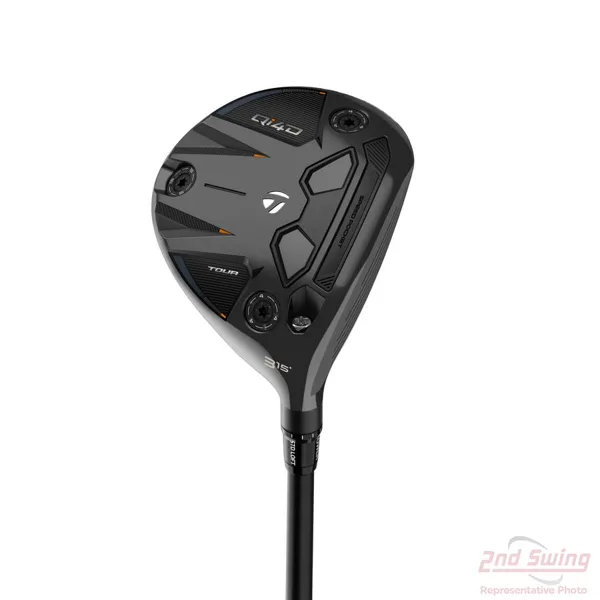
TaylorMade Qi4D Tour Fairway Wood
TaylorMade's compact 175cc players' fairway wood and Today's Golfer's Best Low-Spin winner for 2026 — the most adjustable fairway wood the brand has ever built (a three-weight Trajectory Adjustment System plus a 4° sleeve) trades a few mph of ball speed against the core Qi4D for elite workability, a penetrating low-spin flight, and a traditional wooden feel.
We may earn a commission if you buy through this link — it never affects our scores or the price you pay.
The consensus
The TaylorMade Qi4D Tour is the compact, low-spinning players' model in the 2026 Qi4D fairway wood family — the head built for skilled, fast-swinging golfers who prize control over outright forgiveness. At just 175cc with a titanium face and body, a carbon-fiber crown, and a 65g tungsten mass pad sitting low and forward, directly behind the titanium face, it produces a flat, penetrating, low-spin flight. In Today's Golfer's comprehensive 2026 test of every new fairway wood, it earned the Best Low-Spin honor, spinning the lowest in the field (2,266 rpm) and carrying the second-longest overall at 257.6 yards off a 150.2 mph ball speed, with one of the tightest dispersions in the test.
What sets the Tour apart from the rest of the lineup is adjustability. It replaces the core Qi4D's single sliding weight with a three-port Trajectory Adjustment System — a 15g weight and two 4g weights that move between heel (draw), toe (fade), and rear (stability) positions — and pairs it with a 4° adjustable loft sleeve that tunes loft, lie, and face angle. Golf Monthly's Sam De'Ath called the result 'arguably the most customisation we have ever seen in a fairway wood' and rated it 'undoubtedly the best-looking head in the lineup.' Reviewers across the board praised the workability, the premium compact shape, and a traditional, muted 'more wooden than metallic' sound and feel.
The honest trade-offs are speed and forgiveness. The compact head gives up roughly 6 mph of ball speed and about 7 yards of carry to the standard Qi4D, it demands center-face contact, and at $449.99 it sits at the very top of the fairway wood market — about $70 more than the core model. Reviewers are unanimous that distance-seekers and inconsistent strikers should look at the standard Qi4D or the larger Qi4D Max instead. But for the better player who wants to flight and shape shots, get fit into a precise weight-and-loft combination, and have the lowest-spin, best-looking fairway wood TaylorMade makes, the Qi4D Tour is a genuinely special — if niche — long-game tool.
TaylorMade's compact 175cc players' fairway wood and Today's Golfer's Best Low-Spin winner for 2026 — the most adjustable fairway wood the brand has ever built (a three-weight Trajectory Adjustment System plus a 4° sleeve) trades a few mph of ball speed against the core Qi4D for elite workability, a penetrating low-spin flight, and a traditional wooden feel.
Category ratings
What the community loves
This is the headline strength across every review. The compact 175cc head is built to be worked both ways, and reviewers found it exceptionally easy to flight up or down and curve the ball on command. Golf Monthly's Sam De'Ath said it 'brings a level of shot-making and artistry back to the game that modern, high-MOI heads seem to cancel out,' and Plugged In Golf framed it as the choice for the skilled striker who wants versatility in the long game. For a player who shapes shots rather than just swings hard, it is the most rewarding fairway wood in the 2026 TaylorMade lineup.
The Tour swaps the core Qi4D's single sliding weight for a three-port Trajectory Adjustment System: a 15g weight plus two 4g weights that move between heel (draw bias), toe (fade bias), and rear (added stability) positions. Combine that with a 4° adjustable loft sleeve that tunes loft, lie, and face angle, and Golf Monthly called it 'arguably the most customisation we have ever seen in a fairway wood.' For fitters and tinkerers, the spread of CG and trajectory positions on offer is genuinely class-leading.
In Today's Golfer's 2026 test of every new fairway wood, the Qi4D Tour took the Best Low-Spin honor. In its forward setting it produced the lowest backspin in the field (2,266 rpm) and the second-longest overall carry (257.6 yards) off a 150.2 mph ball speed, with a tight 9.5-yard left-right dispersion. A 65g tungsten mass pad sits low and forward, directly behind the titanium face to keep the ball coming off hot and flat — exactly the flight a fast-swinging player wants off the tee or into a breeze.
Reviewers loved the acoustics. Plugged In Golf described impact as 'more wooden than metallic — deep and powerful,' with no metallic ringing, just a bassy thump, and feedback precise enough to tell you exactly where you caught it on the face. It is a more muted, classic sensation than the louder game-improvement heads, and several testers singled it out as one of the most satisfying-feeling fairway woods of the year.
From a visual standpoint Golf Monthly called it 'undoubtedly the best-looking head in the lineup' — a compact pear-shaped footprint with a tall face, a matte carbon-fiber crown, a gloss-black sole showing the three movable weights, and a distinctive blue-teal headcover. GolfWRX forum members who got hold of pre-release heads simply said 'the design is stunning.' At address it demands attention and inspires confidence in better players.
What to watch out for
The trade-off for the compact players' shape is raw speed. Golf Monthly measured ball speeds 'just over 149 mph, which was around 6 mph slower than the core model,' costing roughly 7 yards of carry, and GolfMagic noted the core and Max heads are the longer, easier options for most golfers. If your priority is maximum distance rather than control, the standard Qi4D or Qi4D Max will out-carry the Tour.
At 175cc this is a small, demanding head. Golf Monthly noted the footprint can look 'intimidating' even to confident ball strikers, and while Plugged In Golf called it 'fairly easy to hit for a players fairway wood,' both stress it rewards center-face contact and offers little bailout on mishits. It is the least forgiving fairway wood in the Qi4D family by design — not a club for inconsistent strikers.
At $449.99 (£379 in the UK) the Qi4D Tour sits at the very top of the fairway wood price range — about $70 more than the standard $379.99 Qi4D and well above most competitors. The adjustability and titanium construction justify the premium for the right player, but it is a serious outlay for a single-purpose, better-player club.
The low-spin, mid-low-launch profile relies on adequate clubhead speed; slower or higher-spin players can leave distance on the table or struggle to hold greens. Plugged In Golf also found the gap between the heel and rear weight settings smaller than expected and that the heel position didn't suit their swing — so the on-course payoff from all that adjustability depends heavily on a proper fitting.
Is it right for your game?
What real people are saying
13 quotes from across the web, grouped by 6 themes. Click a theme to read the individual quotes.
Specifications
Available shafts (no upcharge)
Premium shafts available at additional cost: Graphite Design Tour AD VF, Tour AD UB, Tour AD DI
All sources analyzed
This review synthesizes opinions from 11 independent sources. Every claim on this page can be traced back to its original source. No manufacturer relationship or compensation.
The consensus score is built in four layers: raw source collection, normalization to a 0-10 scale, credibility-weighted combination, and quality adjustments.
Expert reviews (35% weight) are scored from language intensity and any numerical ratings provided. Data-driven testing (25%) converts product rank within the test group to a percentile score. Forum posts (30%) are AI-classified by sentiment, weighted by substantiveness. Retail reviews (10%) convert 5-star ratings with a 0.75x credibility discount to correct for systematic inflation.
Three quality adjustments are then applied: a source diversity bonus (up to +0.3 for coverage across all source types), a conflict penalty (up to -0.3 when sources strongly disagree), and recency weighting (recent reviews weighted higher than older ones).