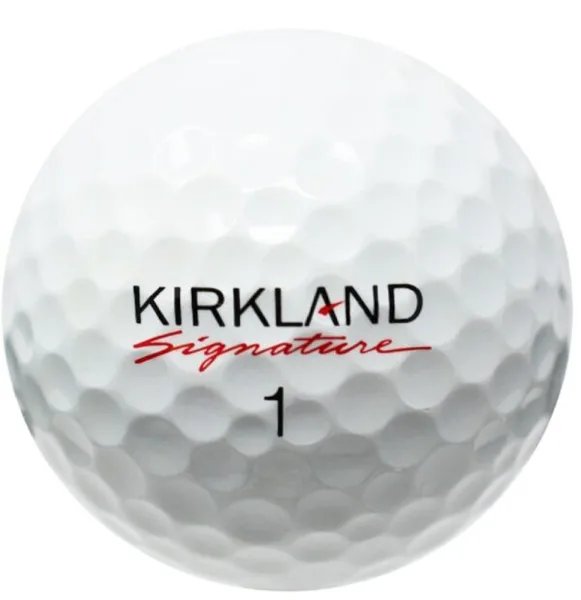
Kirkland Signature Golf Ball
Costco's cult value ball — a cast-urethane, three-piece tour-style ball that spins more than a Pro V1 on full irons and wedges yet costs barely a third as much, crowned MyGolfSpy's Best Value Golf Ball of 2025. The honest catch is consistency: independent lab teardown flags wider-than-tour variation in compression, weight, and diameter, and the feel runs firmer than a premium ball. A high-confidence 8.6 from roughly 15 sources — the category's value benchmark, not a tour-ball replacement.
We may earn a commission if you buy through this link — it never affects our scores or the price you pay.
The consensus
The Kirkland Signature golf ball is the product that reset the value end of the category — Costco's house-brand, cast-urethane ball, sold for roughly a third of a tour ball's price and famous since the original 2016 four-piece sold out and built a cult following. The current Performance+ generation is a three-piece urethane ball with a high-energy core, a 338-dimple cover, and a measured compression around 93 (medium-firm to firm). Across roughly 15 sources — robot testing, lab teardown, expert review, forum consensus, and retail feedback — it earns a high-confidence consensus and the headline accolade that defines it: MyGolfSpy's Best Value Golf Ball of 2025, awarded after the ball beat 43 rivals to the value crown on the swing robot.
Where sources agree most strongly: value and full-shot spin. Reviewers are nearly unanimous that a genuine urethane cover at about $1.50 a ball is one of the best buys in golf — Golf Monthly called the proposition 'nothing short of extraordinary' and National Club Golfer 'possibly one of the best value-for-money pieces of equipment on the market.' The spin is real, not a courtesy: Today's Golfer's robot test ranked it among the highest-spinning balls on irons and wedges, and head-to-head launch-monitor data shows it out-spinning a Pro V1 on full shots. The current core also fixes the old long-game weakness — driver spin is now controlled, and on the robot the ball was even slightly longer and straighter off the tee than a Pro V1, with improved feel and strong cover durability over earlier versions.
Where the consensus is honest about limits: consistency, feel, greenside bite, and price-of-access. MyGolfSpy's Ball Lab teardown is the key caveat — it rated the Performance+ V3's compression, weight, and diameter consistency all 'Poor,' with individual balls ranging 88–103 in compression and about 3% exceeding the USGA weight limit; where a tour ball is prized for repeatability, the Kirkland varies more unit to unit. The feel runs firmer than a Pro V1 (a distinct higher-pitched click that reviewers flag on short shots), greenside bite trails premium balls despite strong full-wedge spin, and on-course testers measured real carry losses even as the robot showed parity. Add the Costco membership and periodic stock-outs and the friction is real. But for the value-minded or slower-swinging amateur willing to trade a little softness and consistency for a urethane ball at a third of the price, the Kirkland is exactly what its reputation says: the value benchmark of the golf-ball market — an 8.6 that sits honestly below the tour-ball tier but at the very top of its own.
Costco's cult value ball — a cast-urethane, three-piece tour-style ball that spins more than a Pro V1 on full irons and wedges yet costs barely a third as much, crowned MyGolfSpy's Best Value Golf Ball of 2025. The honest catch is consistency: independent lab teardown flags wider-than-tour variation in compression, weight, and diameter, and the feel runs firmer than a premium ball. A high-confidence 8.6 from roughly 15 sources — the category's value benchmark, not a tour-ball replacement.
Category ratings
What the community loves
Kirkland is the ball that forced the industry's value reset, and 2025 only cemented it: after testing 44 ball models on its swing robot, MyGolfSpy named the Kirkland Performance+ its Best Value Golf Ball of the year, concluding that a budget golfer choosing it over a $50 tour ball gives up 'very little in overall performance across the bag.' At about $34.99 for two dozen at Costco — roughly $1.50 a ball — it delivers a genuine cast-urethane cover, the same cover family used by premium tour balls, for a fraction of the cost. Multiple reviewers call it possibly the best value-for-money piece of equipment in the game.
This is not just 'good for the price' spin. Today's Golfer's robot testing ranked the Kirkland among the best high-spin balls in the field — second-best for iron spin and third-best for wedge spin — and Golf Insider's launch-monitor work measured it generating more backspin than a Titleist Pro V1 on full shots (on the order of ~515 rpm more with irons and ~350 rpm more with wedges). For a shotmaker who wants approach shots to bite, the Kirkland delivers tour-level full-swing spin at value pricing.
The biggest fix in the current Performance+ generation is the long game. Earlier Kirklands spun too much off the driver; the new high-energy core brings driver spin down, and in MyGolfSpy's robot test the ball was actually slightly longer and straighter than the Pro V1 off the tee, with enough compression to launch with speed. Reviewers describe a penetrating, low-spinning drive — the long-game weakness of the older balls has largely been engineered out.
Each generation has softened the Kirkland's once-clicky feel: testers note a noticeably softer, more responsive impact on irons and wedges than the previous model, and a 'delight to putt with' on the greens. Durability is a recurring highlight — the thin urethane cover held up well through shots from rough, trees, and bunkers across multiple rounds with minimal scuffing, which matters most for exactly the value-minded player this ball targets.
Few balls have the grassroots following the Kirkland does. Costco and Amazon buyer reviews skew strongly positive, and forum threads on MyGolfSpy, r/golf, and r/GolfBalls are full of mid-and-higher-handicap players who switched and never looked back, citing the urethane spin, the durability, and a price that makes losing a sleeve sting far less. The community consensus is that for most amateurs the on-course gap to a tour ball is smaller than the price gap.
What to watch out for
This is the honest knock that separates the Kirkland from the balls it undercuts. MyGolfSpy's Ball Lab teardown of the Performance+ V3 rated its compression consistency 'Poor' (individual balls ranged from 88 to 103, a wide ~15-point delta), its weight consistency 'Poor,' and its diameter consistency 'Poor' — and roughly 3% of the sample exceeded the USGA's weight limit and were flagged as Bad. None of that makes it a bad ball, but where a Pro V1 is prized precisely for shot-to-shot repeatability, the Kirkland's wider unit-to-unit variation is its clearest weakness.
Despite each generation softening, the Kirkland still measures medium-firm to firm (MyGolfSpy logged ~93 average, with some Performance+ runs nearer 97 — well above a Pro V1's ~87–90), and reviewers feel it. National Club Golfer described a firm sensation off the putter and wedge with a 'distinct high-pitch sound'; Golf Insider rated feel 7/10 and called it 'almost dead' off irons. On delicate pitches and chips it simply does not feel like a Pro V1 — players who prize a soft, communicative touch will notice.
Robot data and on-course experience diverge here, and we report both. Strong full-wedge spin doesn't fully translate to greenside grab: Golf Monthly called the lack of greenside bite 'the most noticeable performance compromise' and saw significantly higher flight with less grab on the green. And while robot tests show the ball competitive (or slightly longer) off the tee, on-course testers measured real carry losses — roughly 6–10 yards less with driver and a club's worth less on some approaches versus a Pro V1 — partly because the high iron spin can balloon and shed distance. The verdict: excellent full-shot spin, but not the premium stopping power or peak carry.
Buying one is its own friction: the best price needs a Costco membership (Amazon stocks it without one but at a premium), the ball has a history of selling out, and it comes essentially in white only with no yellow guarantee, no personalization, alignment-stamp, or loyalty options. There is also lineup confusion — the current Performance+ has shipped boxed as 'V3' even when it's the improved 'V3.5' inside, so you may need to check the side stamp to know exactly which ball you have.
Is it right for your game?
What real people are saying
12 quotes from across the web, grouped by 6 themes. Click a theme to read the individual quotes.
Specifications
All sources analyzed
This review synthesizes opinions from 15 independent sources. Every claim on this page can be traced back to its original source. No manufacturer relationship or compensation.
The consensus score is built in four layers: raw source collection, normalization to a 0-10 scale, credibility-weighted combination, and quality adjustments.
Expert reviews (35% weight) are scored from language intensity and any numerical ratings provided. Data-driven testing (25%) converts product rank within the test group to a percentile score. Forum posts (30%) are AI-classified by sentiment, weighted by substantiveness. Retail reviews (10%) convert 5-star ratings with a 0.75x credibility discount to correct for systematic inflation.
Three quality adjustments are then applied: a source diversity bonus (up to +0.3 for coverage across all source types), a conflict penalty (up to -0.3 when sources strongly disagree), and recency weighting (recent reviews weighted higher than older ones).