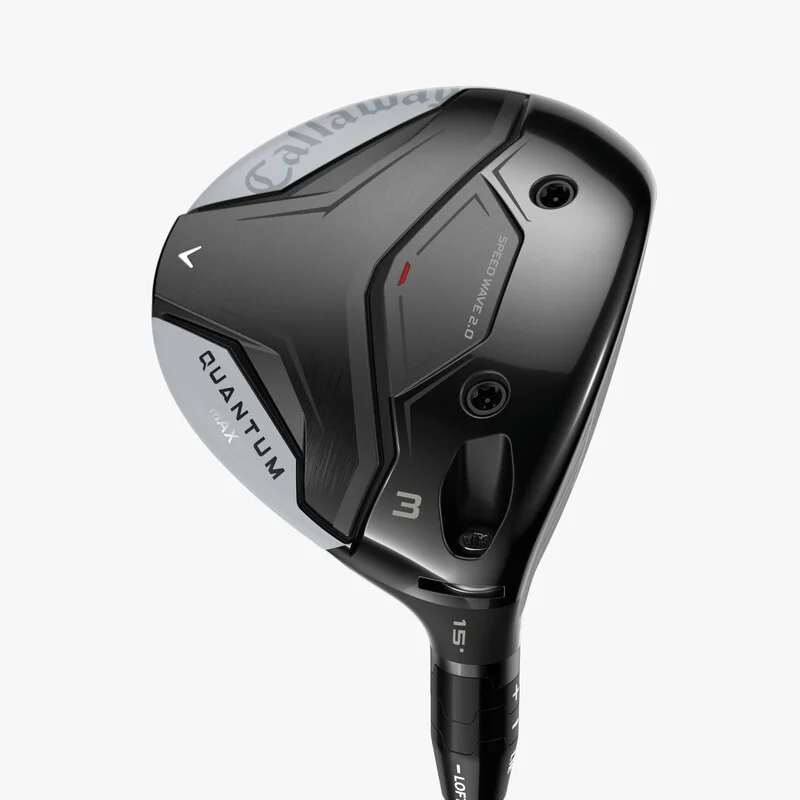
Callaway Quantum Max Fairway Wood
The longest fairway wood in 2026 independent testing — the only 3-wood to break 260 yards of carry. Tri-Force face, 40g tungsten Speed Wave, and OptiFit4 hosel deliver distance and forgiveness that earned a Golf Digest Gold Medal.
We may earn a commission if you buy through this link — it never affects our scores or the price you pay.
The consensus
The Callaway Quantum Max is the longest fairway wood in 2026 independent testing — the only 3-wood to break 260 yards of carry in Today's Golfer's comprehensive 27-model test. A Golf Digest Gold Medal winner and GolfWRX's pick for 'Most Forgiving' fairway wood of the year, it combines raw distance with the kind of mishit protection that makes amateurs hit fairway woods with confidence rather than anxiety. The Tri-Force face construction — ultra-thin titanium bonded with Poly Mesh and carbon backing — creates a larger, more responsive sweet spot, while the 40g tungsten Speed Wave 2.0 sits low and forward to specifically rescue low-face strikes.
The refined Step Sole design is a genuine improvement for turf interaction — reviewers consistently describe the head gliding through the turf rather than digging, producing clean contact from tight lies and light rough. Today's Golfer's reviewer went so far as to say he preferred hitting it off the deck than off a tee. The OptiFit4 adjustable hosel (available on the 3W, 3HL, and 5W) offers seven configurations for independent loft and lie adjustment — a first for Callaway fairway woods at this level. Seven loft options from 15-degree 3-wood to 27-degree 11-wood cover gaps that most competitors ignore.
The main criticisms center on aesthetics and accuracy. The split crown construction with prominent Callaway chevron creates a busy look that Golf Monthly and Today's Golfer both flagged — it inspires confidence at address but isn't winning beauty contests on the shelf. More substantively, the 12.7-yard left-right dispersion in testing is wider than the TaylorMade Qi4D's 8.4 yards — the Quantum Max trades some accuracy for its distance advantage. At $400, it's premium-priced but delivers on its promise: if you want the fairway wood that goes the farthest and forgives the most, this is it.
The longest fairway wood in 2026 independent testing — the only 3-wood to break 260 yards of carry. Tri-Force face, 40g tungsten Speed Wave, and OptiFit4 hosel deliver distance and forgiveness that earned a Golf Digest Gold Medal.
Category ratings
Where to buy
Prices checked June 2026. We may earn a commission from links above at no extra cost to you.
What the community loves
The only fairway wood to break 260 yards of carry in Today's Golfer's 27-model test — 260.1 yards at 153.1 mph ball speed. GolfShake called it the longest 3-wood they've ever tested. Golf Digest panelists noted up to 20 yards more distance than their average swings.
The 40g tungsten Speed Wave 2.0 sits low and forward to specifically rescue low-face strikes — the most common miss for amateurs. Golf Digest testers said it 'rewarded swings that did not deserve to be rewarded.' GolfWRX named it the most forgiving fairway wood of 2026.
The shallow face profile and refined Step Sole make it extremely easy to get airborne from tight lies, light rough, and uneven stances. Today's Golfer's reviewer said he preferred hitting it off the deck rather than off a tee — a rare compliment for a 3-wood.
The shallow profile sits flush to the turf with alignment aids that help aiming. Golf Monthly praised the confidence the address view provides, and multiple reviewers noted the neutral footprint that doesn't intimidate at address.
The refined Step Sole design reduces unwanted bounce and dig, creating a smooth glide through the turf. Golf Digest described the feel as 'smooth and elegant with no strain through impact.' Bunkered noted the head glides rather than digs.
Available on the 3W, 3HL, and 5W — seven total configurations for independent loft and lie adjustment. GolfWRX called it one of the most versatile fairway wood heads on the market. First time Callaway has offered this level of adjustability across the fairway wood lineup.
What to watch out for
The split construction with prominent Callaway chevron and face graphics create a visually cluttered look at address. Golf Monthly flagged the topline and face graphics as less clean than competitors, and Today's Golfer noted limited visual appeal on the shelf.
At 12.7 yards left-right dispersion in Today's Golfer testing, the Quantum Max trades some accuracy for its distance advantage. The TaylorMade Qi4D posted 8.4 yards — noticeably tighter. Distance-seekers will accept this tradeoff; accuracy-first players may not.
At $399.99, it sits at the top of the fairway wood market. While the distance and forgiveness performance justify the price for many, budget-conscious golfers or those building a full bag may find it a significant investment.
Designed for a straight-to-draw ball flight with maximum forgiveness. Low handicappers who want to shape shots both ways should look at the Quantum Triple Diamond instead. The auto-correcting nature limits creative shotmaking.
Is it right for your game?
The distance-vs-accuracy tradeoff is the key debate. Today's Golfer measured 260.1 yards of carry — longest in their 27-model test — but dispersion was 12.7 yards versus the Qi4D's 8.4. If raw carry distance is your priority, nothing beats it. If you value tighter dispersion, the PING G440 Max or TaylorMade Qi4D are stronger picks.
What real people are saying
22 quotes from across the web, grouped by 9 themes. Click a theme to read the individual quotes.
Specifications
Available shafts (no upcharge)
Premium shafts available at additional cost: Graphite Design Tour AD VF, Tour AD UB, Tour AD DI
All sources analyzed
This review synthesizes opinions from 12 independent sources. Every claim on this page can be traced back to its original source. No manufacturer relationship or compensation.
The consensus score is built in four layers: raw source collection, normalization to a 0-10 scale, credibility-weighted combination, and quality adjustments.
Expert reviews (35% weight) are scored from language intensity and any numerical ratings provided. Data-driven testing (25%) converts product rank within the test group to a percentile score. Forum posts (30%) are AI-classified by sentiment, weighted by substantiveness. Retail reviews (10%) convert 5-star ratings with a 0.75x credibility discount to correct for systematic inflation.
Three quality adjustments are then applied: a source diversity bonus (up to +0.3 for coverage across all source types), a conflict penalty (up to -0.3 when sources strongly disagree), and recency weighting (recent reviews weighted higher than older ones).