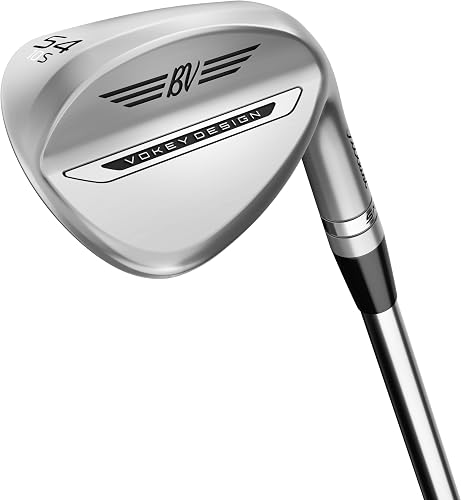
Titleist Vokey Design SM11 Wedge
The most-played wedge on every major professional tour, refreshed for 2026 — a new Vokey Spin System and a standardized center of gravity deliver predictable spin and flight across 27 loft/bounce/grind combinations, earning a Golf Digest Hot List Gold Medal and consensus praise from 16 sources.
We may earn a commission if you buy through this link — it never affects our scores or the price you pay.
The consensus
The Titleist Vokey Design SM11 is the eleventh generation of Bob Vokey's Spin Milled wedge line and the most-played wedge in professional golf, making its competitive debut at The American Express in January 2026 before reaching shops on February 20. Across 16 sources spanning expert reviews, robot-style testing, forum consensus, and retail feedback, the SM11 earns near-universal praise for spin consistency, fitting versatility, and the soft, communicative feel that has defined the Vokey name. Golf Digest awarded it a Gold Medal on the 2026 Hot List, calling out high-end quality “across the board with no real weaknesses,” and Today's Golfer named it “Best for Versatility” in its 2026 wedge test. No other wedge manufacturer approaches Vokey's tour adoption rate.
Where sources agree most strongly: the new Vokey Spin System and the standardized center of gravity. The Spin System combines a directional face texture, three shot-specific groove shapes, and Spin Milled grooves with roughly 5% more volume than the SM10, with a heat treatment claimed to roughly double groove-edge durability. The bigger story for many reviewers is the CG: for the first time it is identical across every grind within a loft, so choosing a grind for turf interaction no longer changes your launch window, while a progressive CG between loft groups produces a more penetrating, controlled flight. Six grinds (F, S, M, D, K, and the narrow tour-favorite T) across 27 loft/bounce/grind combinations give the SM11 the widest fitting matrix in the market — reviewers repeatedly called it the most fitting-friendly Vokey yet.
Where the consensus fractures: value and the upgrade question. At $199 per wedge (more for graphite and raw), the SM11 sits at the top of the market while the still-excellent SM10 has fallen to around $159. Multiple reviewers — Golf Monthly and Today's Golfer among them — found the performance gains over the SM10 subtle, with spin numbers comparable rather than transformative, and advised SM10 owners with healthy grooves to wait. It is also unambiguously a player's wedge: it rewards precise contact, naturally wants to launch the ball, and offers little bailout on mishits, and the cast head and finishes show cosmetic wear quickly. But for golfers buying fresh wedges — a first premium set or a replacement for worn grooves — the SM11 represents the current state of the art, validated by more professional players than any alternative and refined in exactly the ways that matter most to a fitted player.
The most-played wedge on every major professional tour, refreshed for 2026 — a new Vokey Spin System and a standardized center of gravity deliver predictable spin and flight across 27 loft/bounce/grind combinations, earning a Golf Digest Hot List Gold Medal and consensus praise from 16 sources.
Category ratings
What the community loves
The SM11 continues Vokey's unbroken run as the most-played wedge on the PGA Tour, DP World Tour, LPGA Tour, and Champions Tour, making its competitive debut at The American Express in January 2026. Titleist positions it as “the next generation of the PGA Tour's most-played wedge,” and the trust is earned through decades of Bob Vokey's hands-on tour van work. No other wedge approaches its adoption rate among the best players in the world — the single most validated short-game club in golf.
The headline technology is the Vokey Spin System: a directional face texture angled toward the leading edge for more friction, three shot-specific groove shapes (wider and shallower in the lob wedges, deeper and narrower in the gap wedges), and Spin Milled grooves with roughly 5% more volume than the SM10 to channel away debris. Reviewers consistently report that shots struck slightly thin still grab and stop quickly — the gain is in spin consistency and predictability from any lie rather than a single peak number.
For the first time, the center of gravity is identical across every grind within a given loft — so choosing a grind for the turf interaction you want no longer forces a compromise in launch window. The CG is also progressive between loft groups (positioned to produce a penetrating, controlled flight in the sand and lob wedges), which several reviewers single out as the most meaningful change over the SM10. Director of Wedge Development Kevin Tassistro framed it simply: all the CGs within a loft are now at the same exact point.
The SM11 offers an industry-leading 27 loft/bounce/grind configurations across six tour-proven grinds: F, S, M, D, K, and the narrow T grind — the most-played lob-wedge grind on the PGA Tour, with maximum heel, toe, and trail-edge relief. The K grind (the widest sole, built for bunkers and soft turf) now comes in both low and high bounce. Today's Golfer named the SM11 “Best for Versatility” in its 2026 wedge test, calling it the most fitting-friendly Vokey yet.
Feel is classic Vokey — a soft-but-solid sensation with a crisp click on center strikes that reviewers describe as almost transparent, plus instant, unharsh feedback on where you caught it. A high-frequency heat treatment applied to the impact zone is claimed to roughly double groove-edge durability, directly addressing the most common knock on previous Vokeys, that the grooves lose their bite over a season of play.
What to watch out for
At $199 per club for steel — $209 for graphite and roughly $229–239 for the raw finish — a three-wedge set runs close to $600 before tax. The previous-generation SM10 has dropped to about $159, and competitive wedges from Cleveland, Cobra, and Callaway deliver strong spin at lower price points. For recreational golfers, the cumulative premium over a decade of replacements is meaningful.
This is the most-repeated caveat across the coverage. Golf Monthly and several testers found the performance gains over the SM10 subtle, with spin numbers sitting alongside the best competitors rather than leaping past them. The consensus advice: if your SM10 grooves are still sharp and you're well fit, there's no urgency to switch. The CG and fitting improvements are real, but the on-course delta versus the SM10 is smaller than buyers might expect.
The SM11 rewards precise contact and punishes poor strikes; that is exactly what better players want, but it is not built for golfers who chunk or blade wedge shots. Plugged In Golf also notes the wedge naturally wants to launch the ball, so it asks more of players who need to flight shots down or hit knockdowns. Inconsistent strikers will find more help in wider-soled, cavity-back game-improvement designs.
Despite the soft feel, the SM11 is cast rather than forged, and a few reviewers noted it does not quite have the “buttery” sensation of a forged blade. The finishes also show their age fast — cosmetic scuffing appears quickly with bunker use, and the raw option is designed to rust and patina, which divides opinion and can affect resale value even though it has no effect on performance.
Is it right for your game?
Forum consensus on the SM11 is positive but measured. GolfWRX and Reddit threads rank it among the best wedges available — citing the tour-validated grind library, the new standardized CG, and improved groove durability — while consistently flagging the $199 price and the incremental gains over the still-excellent, now ~$159 SM10. The recurring advice: if your SM10 grooves are still sharp there's no rush, but if you're buying fresh it's the most fitting-friendly Vokey yet.
What real people are saying
13 quotes from across the web, grouped by 6 themes. Click a theme to read the individual quotes.
Specifications
Available shafts (no upcharge)
Premium shafts available at additional cost: Graphite Design Tour AD VF, Tour AD UB, Tour AD DI
All sources analyzed
This review synthesizes opinions from 16 independent sources. Every claim on this page can be traced back to its original source. No manufacturer relationship or compensation.
The consensus score is built in four layers: raw source collection, normalization to a 0-10 scale, credibility-weighted combination, and quality adjustments.
Expert reviews (35% weight) are scored from language intensity and any numerical ratings provided. Data-driven testing (25%) converts product rank within the test group to a percentile score. Forum posts (30%) are AI-classified by sentiment, weighted by substantiveness. Retail reviews (10%) convert 5-star ratings with a 0.75x credibility discount to correct for systematic inflation.
Three quality adjustments are then applied: a source diversity bonus (up to +0.3 for coverage across all source types), a conflict penalty (up to -0.3 when sources strongly disagree), and recency weighting (recent reviews weighted higher than older ones).