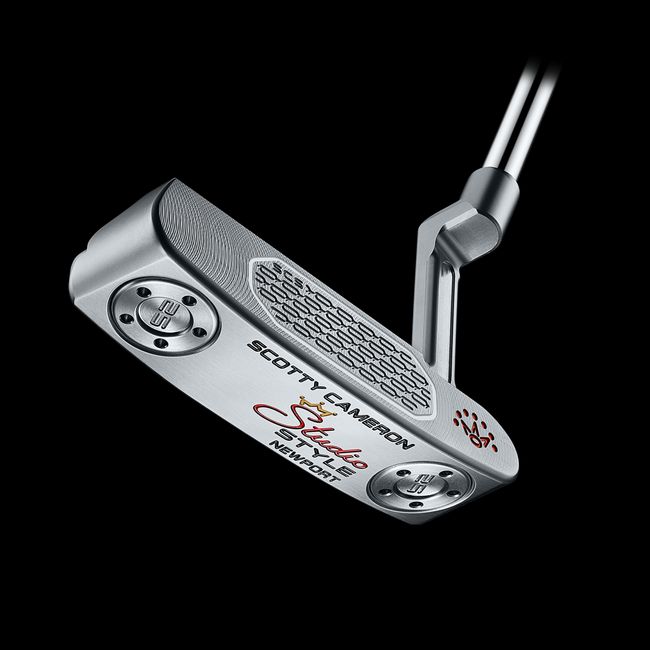
Scotty Cameron Studio Style Newport Putter
The 20th-anniversary revival of Cameron's insert-faced blade line and a 2026 Golf Digest Hot List Gold Medal winner — its new Studio Carbon Steel insert and chain-link milling deliver the softest feel Cameron has ever put in a Newport, at the highest price in the category.
We may earn a commission if you buy through this link — it never affects our scores or the price you pay.
The consensus
The Scotty Cameron Studio Style Newport is the 20th-anniversary revival of Cameron's insert-faced blade line and what the company calls the most significant redesign of its blade family in years. For the 2025-2026 generation the Newport gets an all-new Studio Carbon Steel (SCS) face insert — electroless-nickel plated for durability and fused to a milled 303 stainless body with an aerospace-grade vibration-damping adhesive — cut in a new 'chain-link' milling pattern that removes roughly half the material the ball contacts to soften impact sound while tuning speed. Across 13 sources spanning expert reviews, Golf Digest's tested Hot List, forum sentiment, and retail feedback, the Studio Style Newport earns consensus praise as one of the softest, most refined blade putters on the market. Golf Digest named it a 2026 Hot List Gold Medal winner among the softest-feeling blades, and National Club Golfer awarded it a perfect 5 out of 5.
Where sources agree most strongly: feel and distance control. Every reviewer who tested it described the new SCS insert as noticeably softer than previous Camerons — 'just the right mix of soft and responsive,' as one Golf Digest tester put it, 'so easy to get the proper feel for distance control.' The chain-link milling gets the ball rolling almost immediately off the face, and reviewers single out 30-to-50-foot distance control as a standout. National Club Golfer's Jack Backhouse said the putter 'encourages a more aggressive stroke without the fear of the ball jumping off,' calling it 'a masterclass in modern putter craftsmanship.' The misted stainless finish, cherry-red three-dot styling, and chain-link-textured Full Contact Slim grip continue Cameron's reputation as the benchmark for premium putter manufacturing — and, as ever, Cameron blades hold their resale value better than anything else in the category.
Where the consensus fractures: innovation and value. Plugged In Golf was the most measured, describing the Studio Style as 'iterative refinement rather than meaningful advancement' — a feel-and-cosmetics refresh with no substantial performance gain and only average forgiveness for a blade. MyGolfSpy framed the whole relaunch as a 'progressively retro return' that leans on heritage as much as new technology. And at $499 (rising to $549 for the Long Designs), the Newport is the most expensive standard blade in golf — $50 more than even Cameron's own Super Select Newport 2, and $150-300 more than excellent blades from Ping, Cleveland, and Odyssey that add alignment aids and adjustable weighting the Cameron lacks. This is a blade for golfers who put feel, craftsmanship, and tradition above forgiveness and value — and for that buyer, few putters feel better.
The 20th-anniversary revival of Cameron's insert-faced blade line and a 2026 Golf Digest Hot List Gold Medal winner — its new Studio Carbon Steel insert and chain-link milling deliver the softest feel Cameron has ever put in a Newport, at the highest price in the category.
Category ratings
What the community loves
The headline change is an all-new Studio Carbon Steel (SCS) face insert, electroless-nickel plated for durability and fused to the milled 303 stainless body with an aerospace-grade vibration-damping adhesive. Every reviewer who tested it described the feel as noticeably softer than previous Camerons. National Club Golfer called it 'a masterclass in modern putter craftsmanship,' Golf Digest's Hot List testers called the insert 'just the right mix of soft and responsive,' and GolfWRX users described the balance through impact as 'sublime.' For feel-first putter buyers, this is the new benchmark.
Developed over months of testing in the Putter Studio and on Tour, the chain-link milling pattern removes roughly 50% of the material the ball contacts — quieting the impact while preserving a metallic sound and tuning ball speed so players can correlate sound to distance. Reviewers single out distance control as a standout, especially from 30-50 feet, and note the ball begins rolling almost immediately off the face. Golf Digest's tester said it was 'so easy to get the proper feel for distance control.'
The Studio Style earned a Gold Medal on Golf Digest's 2026 Hot List, where it was grouped among the softest-feeling blade putters and ranked in the top five for performance across low-, mid-, and high-handicap testing. National Club Golfer awarded the Newport a perfect 5 out of 5 stars. Among newly released premium blades, it is one of the most decorated putters of the model year.
The misted stainless finish, cherry-red three-dot styling, gold-toned carbon insert, and chain-link-textured Full Contact Slim grip continue Cameron's reputation as the benchmark for premium putter manufacturing. Plugged In Golf praised the proportions and 'prominent but tasteful' branding. As with every Scotty Cameron, the Newport also retains resale value better than anything else in the category, softening the sting of the high entry price.
The Newport anchors a 12-model Studio Style lineup spanning Newport, Newport Plus, Newport 2, Newport 2 Plus, Newport 2.5 Plus and more, with multiple lengths, adjustable tungsten sole weights, left-handed options on select heads, and 38-inch counterbalanced Long Designs. The rounded heel-toe Newport head with its I-Beam plumbing neck carries moderate toe hang (around 45 degrees) that pairs naturally with an arcing stroke, and the broader family covers nearly every stroke type and turf condition.
What to watch out for
At $499 (rising to $549 for the Long Designs), the Studio Style Newport is the priciest standard blade on the market — $50 more than even Cameron's own Super Select Newport 2, and $150-300 more than excellent blades from Ping, Cleveland, and Odyssey. National Club Golfer flagged the premium price as its single drawback, and several sources argue the on-green performance gap does not match the price gap for recreational golfers.
Plugged In Golf was the most measured voice, describing the Studio Style as 'iterative refinement rather than meaningful advancement' — primarily a feel and cosmetic upgrade with no substantial performance gain over prior generations. MyGolfSpy framed the whole relaunch as a 'progressively retro return' that leans on heritage as much as new technology. Owners of a recent Cameron blade may not find enough new performance to justify upgrading.
As a compact blade, the Newport offers far less MOI and forgiveness than a mallet at any price. Plugged In Golf described forgiveness as average for the blade size, with no meaningful improvement over previous versions. Off-center strikes lose speed and direction more quickly than on high-MOI designs, so golfers who frequently miss the center will score better with a mallet.
Unlike mallets with alignment lines, dots, or sightline systems, the Newport relies on its clean topline and offset for visual alignment. Higher-handicap players in particular may find it harder to set up consistently without supplementary alignment features, which the blade does not provide.
Is it right for your game?
What real people are saying
13 quotes from across the web, grouped by 6 themes. Click a theme to read the individual quotes.
Specifications
Available shafts (no upcharge)
Premium shafts available at additional cost: Graphite Design Tour AD VF, Tour AD UB, Tour AD DI
All sources analyzed
This review synthesizes opinions from 13 independent sources. Every claim on this page can be traced back to its original source. No manufacturer relationship or compensation.
The consensus score is built in four layers: raw source collection, normalization to a 0-10 scale, credibility-weighted combination, and quality adjustments.
Expert reviews (35% weight) are scored from language intensity and any numerical ratings provided. Data-driven testing (25%) converts product rank within the test group to a percentile score. Forum posts (30%) are AI-classified by sentiment, weighted by substantiveness. Retail reviews (10%) convert 5-star ratings with a 0.75x credibility discount to correct for systematic inflation.
Three quality adjustments are then applied: a source diversity bonus (up to +0.3 for coverage across all source types), a conflict penalty (up to -0.3 when sources strongly disagree), and recency weighting (recent reviews weighted higher than older ones).