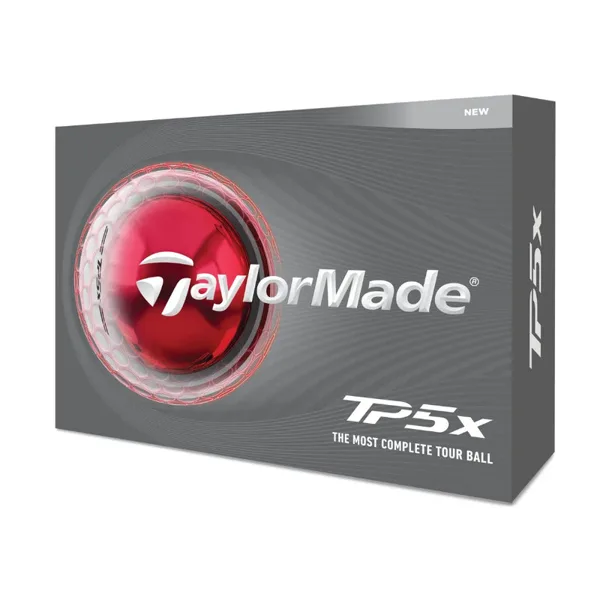
TaylorMade TP5x Golf Ball
TaylorMade's fastest, lowest-spinning five-layer tour ball — the firmer, more penetrating sibling to the TP5, built around a Speed Wrapped Core and a 322-dimple Tour Flight aerodynamic pattern that hold a piercing, wind-stable trajectory. The 2026 refresh adds 'microcoating' paint and stiffer mantle layers for roughly a mph of extra ball speed and tighter shot-to-shot consistency. A tour-validated distance ball that scores a near-top consensus from 16 sources — just behind the Pro V1 benchmark, with a firmer feel that's a love-it-or-leave-it trait.
We may earn a commission if you buy through this link — it never affects our scores or the price you pay.
The consensus
The TaylorMade TP5x is the fastest, lowest-spinning member of TaylorMade's five-layer tour family — the firmer, more penetrating counterpart to the softer TP5. Where the Titleist Pro V1 is the neutral, do-everything benchmark, the TP5x is a specialist: a Speed Wrapped Core wrapped in progressively stiffer mantle layers and a cast-urethane cover, designed to strip spin out of the driver and long irons, push ball speed to the top of the category, and fire a flat, wind-cheating trajectory. The 2026 generation (released February 2026) is a precision refresh rather than a reinvention — new 'microcoating' paint built to kill the shot-to-shot aerodynamic inconsistency that uneven paint can cause, plus stiffer mantle layers worth roughly a mph more ball speed. Across 16 sources spanning robot testing, lab teardown, expert review, forum consensus, and retail feedback, it earns a near-top consensus score, just behind the Pro V1.
Where sources agree most strongly: distance, speed, and flight. Today's Golfer's robot test rated the TP5x the lowest-spinning premium tour driver ball in its field and tied third for fastest ball speed, awarding it a full five stars; Golf Monthly's 2026 robot session measured 168.3 mph of ball speed, an ultra-low ~2,018 rpm of driver spin, and 302 yards of carry, calling the flight 'piercing' with 'massive rollout potential.' Reviewers love how stable it stays in wind, and Plugged In Golf confirmed the five-layer build does what it claims — lower driver, long-iron, and trajectory numbers than the TP5, with about a half-club of added distance over the prior generation. Tour pedigree backs it up: Tommy Fleetwood games the TP5x Pix, and the TP5/TP5x family is among the most-played non-Titleist balls in professional golf.
Where the consensus is honest about limits: feel, peak spin, and price. The TP5x is firmer and louder than the TP5 and the soft-feel benchmarks — a crisp, 'clicky' sensation that fast players prize for feedback but soft-feel players often dislike, making this a fit-by-feel ball rather than a universal one. By design it is the low-spin sibling, so it isn't the greenside-spin king (the TP5, Pro V1x, Bridgestone Tour B XS, and Chrome Tour X all spin more on wedges), and Golf Monthly cautions it can spin too low for slower swing speeds. MyGolfSpy's Ball Lab has historically flagged the line for flirting with the USGA minimum diameter and the occasional minor off-center core — strong, but a small notch behind the Pro V1's consistency benchmark, which is exactly what the 2026 microcoating effort targets. And at $57.99 a dozen it sits at the top of the market. But for the faster swinger who wants maximum tee-to-green speed, the lowest spin of any premium tour ball, and a flight that bores through wind, the TP5x is one of the best distance balls in golf — and a tour staff plays it for precisely those reasons.
TaylorMade's fastest, lowest-spinning five-layer tour ball — the firmer, more penetrating sibling to the TP5, built around a Speed Wrapped Core and a 322-dimple Tour Flight aerodynamic pattern that hold a piercing, wind-stable trajectory. The 2026 refresh adds 'microcoating' paint and stiffer mantle layers for roughly a mph of extra ball speed and tighter shot-to-shot consistency. A tour-validated distance ball that scores a near-top consensus from 16 sources — just behind the Pro V1 benchmark, with a firmer feel that's a love-it-or-leave-it trait.
Category ratings
What the community loves
The TP5x is built to bomb it. Today's Golfer's robot test rated it the lowest-spinning premium tour-level driver ball in the field and had it tied third for fastest ball speed across both 100 and 115 mph swings, while Golf Monthly's 2026 robot session clocked it at 168.3 mph ball speed, just 2,018 rpm of driver spin, and 302 yards of carry off a fast swing. For a player whose drives spin too much or balloon, the TP5x's low-spin, high-speed launch window is exactly the medicine — it trades a touch of greenside spin for real yards in the long game.
The 322-dimple Tour Flight pattern is engineered to cut drag on the way up and trap air on the way down, and reviewers consistently single out the result: a flat, forward-driving trajectory that stays stable in wind instead of climbing and stalling. Golf Monthly called the flight 'piercing' with 'massive rollout potential' and praised how stable it is in a breeze, and Today's Golfer flagged the same wind performance as a signature trait. For links and coastal golf, the trajectory alone is a reason to play it.
The TP5x is one of only two five-piece balls in golf (alongside its TP5 sibling): a Speed Wrapped Core surrounded by progressively stiffer mantle layers and a cast urethane cover, each tuned to add speed in the long game while preserving urethane grab in the short game. The 2024 Speed Wrapped Core was credited with roughly a half-club of extra distance versus the prior generation — about +1.5 mph ball speed in the irons and up to +3 mph with driver in Golf Monthly's testing — without making the ball play firmer than it had to.
The headline change for 2026 is a 'microcoating' paint process — TaylorMade found that two otherwise-identical balls could fly up to 20 yards apart purely because of uneven paint, and re-engineered the application (paint flow, cure temperatures, atomization) to apply an ultrathin, even coat. Paired with new, stiffer mantle layers worth about a mph of ball speed, it's a real, if unglamorous, attack on the exact repeatability that separates the best tour balls. MyGolfSpy's Ball Lab had already measured the 2024 ball's compression consistency as 'good,' a notch better than the database average.
The TP5x carries deep tour pedigree — Tommy Fleetwood games the TP5x Pix and the TP5/TP5x family is among the most-played non-Titleist balls in professional golf — and the firmer, more responsive feel is a feature, not a bug, for the players it suits. Reviewers describe a crisp, 'clicky' impact and plenty of feedback off the face; Today's Golfer awarded it a full five stars and said that if it were spending its own money on a premium ball, the choice would come down to the TP5x and the Chrome Tour X. Golf Monthly's verdict was that the 2024 ball was 'right out of the top drawer.'
What to watch out for
The TP5x is noticeably firmer than its TP5 sibling and the soft-feel benchmarks. Plugged In Golf described a louder, more 'crisp than soft' sensation — a 'tock' off the putter where the TP5 gives a muted 'thud.' Many faster players prize that feedback, but golfers who equate premium with a soft, quiet impact often prefer the TP5, AVX, or Pro V1. Feel is the single most divisive trait in the reviews, and it's the main reason this is a fit-by-feel ball rather than a universal pick.
Low long-game spin is the TP5x's whole identity, and the trade-off is short-game bite. Plugged In Golf measured the softer TP5 spinning a few hundred rpm more on chips and pitches, and reviewers are clear that for maximum stopping power the TP5, Pro V1x, Bridgestone Tour B XS, or Chrome Tour X spin more around the green. The TP5x still has tour-grade urethane grab — it simply isn't the spin king, and players who score by spinning wedges back may want its softer sibling.
The same low-spin, fast launch that helps a 110-mph swing can hurt a slower one. Golf Monthly's 2026 review cautioned that the TP5x 'may spin a little low for slower swing speeds,' which can cost carry, height, and stopping power for players who don't generate their own speed. Under roughly 90 mph of driver speed, the softer TP5 (or a lower-compression ball) will usually launch easier and hold greens better — the TP5x rewards speed and can leave it on the table without it.
At $57.99 a dozen for the 2026 ball the TP5x sits at the very top of the price ladder, right alongside the Pro V1, just as value urethane balls have closed much of the gap. And while build quality is strong, MyGolfSpy's Ball Lab has historically flagged the TP5/TP5x line for flirting with the USGA minimum diameter and the occasional minor off-center core — no dealbreaker, but a small notch behind the Pro V1's class-leading consistency benchmark. The 2026 microcoating effort is, in part, a direct response to that scrutiny.
Is it right for your game?
What real people are saying
12 quotes from across the web, grouped by 6 themes. Click a theme to read the individual quotes.
Specifications
All sources analyzed
This review synthesizes opinions from 16 independent sources. Every claim on this page can be traced back to its original source. No manufacturer relationship or compensation.
The consensus score is built in four layers: raw source collection, normalization to a 0-10 scale, credibility-weighted combination, and quality adjustments.
Expert reviews (35% weight) are scored from language intensity and any numerical ratings provided. Data-driven testing (25%) converts product rank within the test group to a percentile score. Forum posts (30%) are AI-classified by sentiment, weighted by substantiveness. Retail reviews (10%) convert 5-star ratings with a 0.75x credibility discount to correct for systematic inflation.
Three quality adjustments are then applied: a source diversity bonus (up to +0.3 for coverage across all source types), a conflict penalty (up to -0.3 when sources strongly disagree), and recency weighting (recent reviews weighted higher than older ones).