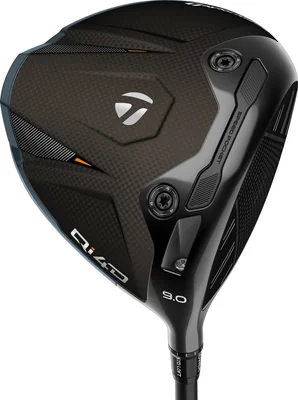
TaylorMade Qi4D Driver
The most consistent driver of 2026 — MyGolfSpy's Best Driver winner combines tour-validated speed with exceptional dispersion, though the muted feel divides opinion.
We may earn a commission if you buy through this link — it never affects our scores or the price you pay.
The consensus
The TaylorMade Qi4D is MyGolfSpy's Best Driver of 2026, GolfWRX's Best Driver of 2026, and a Golf Digest Hot List selection — the most decorated new driver this year. Across 11 sources spanning expert reviewers, robot testing, forum users, and retail feedback, the consensus is clear: this is the most consistent driver on the market. In MyGolfSpy's 42-driver, 20,580-shot test, the Qi4D produced the tightest dispersion of any driver tested, earning the overall crown despite ranking sixth for pure distance.
Where sources agree most strongly: consistency and dispersion. Today's Golfer called it the most consistent driver they've ever tested from a data perspective, measuring spin variation within 600 RPM across vertical face locations. Plugged In Golf's Club Champion fitting showed ball speed up nearly 2 mph and 7 yards of carry gained over the Qi35. Golfstead measured 5-7 additional yards of carry. The return to a compact, Qi10-style pear shape was universally praised — Golfalot called it the best-looking driver of 2026. The four-weight TAS system with 26 grams of movable mass gives fitters serious adjustability, a major upgrade from the Qi35.
Where the consensus fractures: feel and sound. Today's Golfer described the impact as 'almost dead off the face,' and Golfalot found it 'a bit thin and hollow.' But Plugged In Golf loved the 'staccato crack' and National Club Golfer praised the 'solid, powerful' carbon face feel. This is subjective territory — try before you buy. The other nuance: at $649.99, this is a premium-priced driver that won on consistency rather than raw distance. If maximum yardage is your priority above all else, there may be longer options. But if you want the tightest groupings off the tee, this is the data-driven choice for 2026.
The most consistent driver of 2026 — MyGolfSpy's Best Driver winner combines tour-validated speed with exceptional dispersion, though the muted feel divides opinion.
Category ratings
What the community loves
The defining strength across every source. MyGolfSpy's robot testing found the tightest dispersion of any 2026 driver. Today's Golfer measured spin consistency within 600 RPM across vertical face locations. Plugged In Golf's fitter showed dispersion notably tighter than the Qi35. Multiple reviewers independently called it the most consistent driver they've tested.
TaylorMade's redesigned head profile delivers measurable clubhead speed increases. Plugged In Golf measured nearly 2 mph higher ball speed and gained 7 yards of carry over the Qi35. Golfstead found 5-7 additional yards of carry. The aerodynamic improvements are real, not marketing.
TaylorMade reverted to the compact, pear-shaped address profile of the Qi10 after the stretched Qi35. Golfalot called it the best-looking driver of 2026. The bronze-tinted finish and dark carbon crown give it a premium, tour-inspired look. Multiple sources noted it looks like a modern sports car.
Four movable TAS weights (two 9g, two 4g) provide 26 grams of movable mass — a significant upgrade over the Qi35's limited adjustability. Combined with the 4-degree loft sleeve, fitters can meaningfully change ball flight and spin characteristics.
Scottie Scheffler, Rory McIlroy, and Tommy Fleetwood all put the Qi4D into play before the public launch. Wyndham Clark and Lucas Glover also switched. This level of immediate tour adoption is unusually strong endorsement.
TaylorMade's new rotation-rate-based shaft matching uses data from 20+ million driver shots. Three REAX profiles (High/Mid/Low rotation) target swing characteristics more precisely than traditional flex-based fitting. Multiple reviewers found their matched REAX shaft outperformed aftermarket options.
What to watch out for
The most consistent criticism across sources. Today's Golfer called it 'almost dead off the face.' Golfalot found it 'a bit on the thin, hollow side.' While Golf Monthly and Plugged In Golf praised the feel, the carbon face produces a dampened sensation that golfers expecting a lively, powerful impact response may find disappointing.
MyGolfSpy ranked the Qi4D sixth for distance out of 42 drivers tested. The consistency wins the overall crown, but golfers chasing maximum yardage may find competitors like the Titleist GT2 or Callaway Quantum longer on pure distance metrics.
The rotation-rate fitting concept is genuinely new, and some reviewers noted that average golfers may struggle to understand which REAX shaft suits their swing without a proper fitting session. The stock shaft selection process is less intuitive than competitors' flex-based systems.
Golfalot specifically noted that glare off the carbon face can be off-putting in certain light conditions at address. A minor aesthetic complaint but one that affects the view golfers see on every tee shot.
Is it right for your game?
Feel and sound at impact is the most debated aspect of the Qi4D. Today's Golfer called it 'almost dead off the face' while Plugged In Golf praised the 'staccato crack.' The carbon face produces a dampened sensation that divides opinion — hit this driver before buying if impact feedback matters to you.
What real people are saying
25 quotes from across the web, grouped by 9 themes. Click a theme to read the individual quotes.
Specifications
Available shafts (no upcharge)
Premium shafts available at additional cost: Graphite Design Tour AD VF, Tour AD UB, Tour AD DI
All sources analyzed
This review synthesizes opinions from 11 independent sources. Every claim on this page can be traced back to its original source. No manufacturer relationship or compensation.
The consensus score is built in four layers: raw source collection, normalization to a 0-10 scale, credibility-weighted combination, and quality adjustments.
Expert reviews (35% weight) are scored from language intensity and any numerical ratings provided. Data-driven testing (25%) converts product rank within the test group to a percentile score. Forum posts (30%) are AI-classified by sentiment, weighted by substantiveness. Retail reviews (10%) convert 5-star ratings with a 0.75x credibility discount to correct for systematic inflation.
Three quality adjustments are then applied: a source diversity bonus (up to +0.3 for coverage across all source types), a conflict penalty (up to -0.3 when sources strongly disagree), and recency weighting (recent reviews weighted higher than older ones).