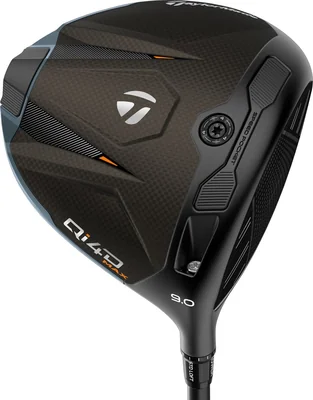
TaylorMade Qi4D Max Driver
TaylorMade's most forgiving driver for 2026 pairs a titanium-free aluminum frame with exceptional face-wide consistency, though the muted feel and marginal gains over the Qi35 Max temper the upgrade case.
We may earn a commission if you buy through this link — it never affects our scores or the price you pay.
The consensus
The TaylorMade Qi4D Max is the most forgiving model in TaylorMade's 2026 driver family and a Golf Digest Hot List Gold Medal winner. It replaces titanium with a forged 7075 aluminum collar, freeing mass to push MOI to approximately 9,700 while adding adjustable sole weights for the first time in a TaylorMade Max driver. Across 9 sources spanning expert reviewers, forum users, and retail feedback, the consensus is clear: this is a genuinely forgiving driver with strong ball speed retention across the face, though the upgrade case from the Qi35 Max is thin.
Where sources agree most strongly: forgiveness. National Club Golfer found mishits retained impressive ball speed with only marginal performance drop-off. Today's Golfer rated it 4.5/5 and called it one of the most dependable drivers when contact isn't perfect, achieving 299 yards of carry with optimized settings. Golfstead gave forgiveness a 9.8/10 and praised the dual TAS weight system for bringing meaningful adjustability to the high-MOI category. Golf Digest's Hot List testers praised the tight, solid impact feel and energetic ball speeds across the sweet spot.
Where the consensus fractures: feel and upgrade justification. Golf Monthly loved the acoustic balance, calling it lively and soft simultaneously. But Today's Golfer called the feel 'very dead' off the clubface, and Plugged In Golf found the sound thin and hollow. On performance gains, Golf Monthly's launch monitor testing showed no real numerical progress over the Qi35 Max or even the two-year-old Qi10 Max. Several reviewers also noted that the standard Qi4D is so forgiving that most golfers may not need the Max at all. Custom fitting is essential — multiple sources emphasized this driver needs proper weight configuration and REAX shaft matching to unlock its potential.
TaylorMade's most forgiving driver for 2026 pairs a titanium-free aluminum frame with exceptional face-wide consistency, though the muted feel and marginal gains over the Qi35 Max temper the upgrade case.
Category ratings
What the community loves
The defining strength across every source. National Club Golfer found ball speed retention remarkable even on off-center strikes, with mishits producing playable launch and carry numbers. Today's Golfer called it one of the most dependable drivers when you don't quite catch it. Golfstead rated forgiveness 9.8/10, calling it one of the most forgiving drivers of 2026.
Golf Monthly's headline asked if this is the best-feeling driver in golf. The reviewer praised a balance of being both lively and soft, with an acoustic signature that sits brilliantly in the middle ground. Golfstead also noted enhanced softness and depth compared to the Qi35 Max. This is a significant departure from previous-gen feel complaints.
TaylorMade's first modern Max driver with adjustable weighting. The two TAS weights (13g and 4g) let you choose between speed (heavy weight forward) or stability (heavy weight back). Today's Golfer found carry jumped from 289 to 299 yards when optimized. GolfMagic noted this is rare adjustability for the high-MOI category.
Multiple reviewers praised the darker, more elegant aesthetic over the Qi35 Max. Today's Golfer highlighted the sleek, muted color grade that beams confidence. National Club Golfer credited TaylorMade for avoiding the oversized, bulky look typical of max-forgiveness drivers. The alignment line on the crown was a welcomed addition.
Today's Golfer concluded the Qi4D Max can be tuned to suit a far wider range of golfers once loft and weighting are dialed in. The combination of loft sleeve, dual TAS weights, and three REAX shaft profiles creates more configuration options than most high-MOI competitors offer.
What to watch out for
Today's Golfer described the feel as 'very dead' off the clubface and said it performs worse than the Qi35 in terms of feedback. Plugged In Golf found the sound a bit thin and hollow. This directly contradicts Golf Monthly's praise — feel is the most polarizing attribute and highly dependent on personal preference.
Golf Monthly's testing on a Foresight GC3 showed no real progress in raw numbers over the Qi35 Max or even the two-year-old Qi10 Max. Golfstead found only 0.6-0.8 mph higher clubhead speed. Multiple reviewers questioned the upgrade justification for current Qi35 Max owners.
GolfMagic emphasized this driver really needs custom fitting to get the most out of it. Plugged In Golf struggled to keep spin under 3000 RPM with stock weight positions. The REAX shaft system adds another layer of fitting complexity that off-the-rack buyers may find confusing.
GolfMagic noted the core Qi4D has four TAS weights versus only two on the Max, making the standard model both more forgiving than expected and more adjustable. In a direct comparison, GolfMagic said they'd opt for the core Qi4D over the Max.
Is it right for your game?
Feel is the most divisive attribute — Golf Monthly called it the best-feeling driver in golf while Today's Golfer described it as 'very dead.' The upgrade case from the Qi35 Max is weak: Golf Monthly's launch monitor data showed no measurable improvement, and Golfstead found only 0.6-0.8 mph clubhead speed gains. Several reviewers noted that the standard Qi4D is so forgiving that most golfers don't need the Max. Custom fitting is essential to unlock this driver's potential.
What real people are saying
26 quotes from across the web, grouped by 9 themes. Click a theme to read the individual quotes.
Specifications
Available shafts (no upcharge)
Premium shafts available at additional cost: Graphite Design Tour AD VF, Tour AD UB, Tour AD DI
All sources analyzed
This review synthesizes opinions from 9 independent sources. Every claim on this page can be traced back to its original source. No manufacturer relationship or compensation.
The consensus score is built in four layers: raw source collection, normalization to a 0-10 scale, credibility-weighted combination, and quality adjustments.
Expert reviews (35% weight) are scored from language intensity and any numerical ratings provided. Data-driven testing (25%) converts product rank within the test group to a percentile score. Forum posts (30%) are AI-classified by sentiment, weighted by substantiveness. Retail reviews (10%) convert 5-star ratings with a 0.75x credibility discount to correct for systematic inflation.
Three quality adjustments are then applied: a source diversity bonus (up to +0.3 for coverage across all source types), a conflict penalty (up to -0.3 when sources strongly disagree), and recency weighting (recent reviews weighted higher than older ones).