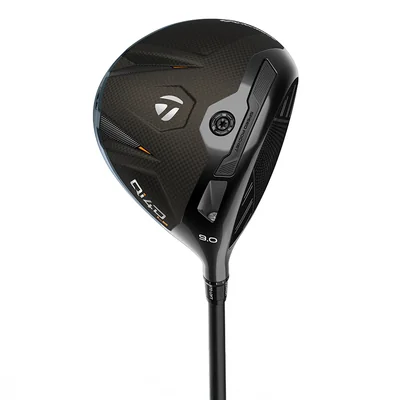
TaylorMade Qi4D LS Driver
TaylorMade's fastest, lowest-spinning driver yet — a radically reshaped aerodynamic weapon that delivers measurable speed gains for accomplished golfers who can handle a compact head and want every last yard off the tee.
We may earn a commission if you buy through this link — it never affects our scores or the price you pay.
The consensus
The TaylorMade Qi4D LS is the fastest and lowest-spinning driver in TaylorMade's 2026 lineup, built for accomplished golfers who want every last yard off the tee. Across 11 sources — expert reviewers, MyGolfSpy's data testing, GolfWRX forum impressions, and TaylorMade.com buyer reviews — the consensus is that TaylorMade has delivered a genuine step forward in aerodynamic performance, with measurable speed gains that translate to real distance on the course.
Where sources agree most strongly: speed and distance. Plugged In Golf found the Qi4D LS produced 1-2 mph more clubhead speed than competing low-spin drivers. National Club Golfer called it the longest driver they tested in 2026, with ball speeds reaching 165-166 mph. Golfstead measured 3-5 extra carry yards over the Qi35 LS predecessor. The aesthetics drew near-universal praise too — Golfalot and Today's Golfer called it one of the best-looking TaylorMade drivers in years, and the sound has returned to a more traditional, satisfying character.
Where the consensus gets complicated: forgiveness. This is unambiguously a players driver — Golf Monthly and Today's Golfer both flag that off-center hits lose more performance than with the standard Qi4D. Golfstead also noted that spin was 50-110 RPM higher than the Qi35 LS, which may disappoint golfers chasing the absolute lowest spin numbers. And at $649.99, it's a full-price premium investment. For golfers with the speed and consistency to handle it, though, the Qi4D LS offers tour-level performance in one of TaylorMade's most refined packages ever.
TaylorMade's fastest, lowest-spinning driver yet — a radically reshaped aerodynamic weapon that delivers measurable speed gains for accomplished golfers who can handle a compact head and want every last yard off the tee.
Category ratings
What the community loves
The Qi4D LS's radically reshaped head profile — developed with computational fluid dynamics — moves measurably faster through the air. Plugged In Golf found 1-2 mph more clubhead speed than competing low-spin drivers. Golfstead measured 0.5 mph clubhead and 0.8 mph ball speed gains over the Qi35 LS. Tour players are seeing 2-3 mph gains.
National Club Golfer called it the longest driver they tested in 2026, with ball speeds reaching 165-166 mph and carry distances pushing 300 yards. Golfstead measured 3-5 additional carry yards over the predecessor. Today's Golfer saw penetrating trajectories at 130 mph clubhead speed.
The compact, pear-shaped head with matte carbon finish earns near-universal aesthetic praise. Golfalot called it one of the best-looking drivers they've seen. Today's Golfer gave it a perfect 5/5 for looks. Golfstead rated it 9.7/10 for appearance.
The Qi4D LS produces a deep, muted tick at impact — a throwback to classic TaylorMade drivers and a clear step forward from the Qi35 LS. Plugged In Golf noted solid, powerful feel with no harsh oscillation. GolfWRX's launch report described the sound as slightly louder but more traditional in pitch.
The 15g and 4g movable weights let golfers shift between low-spin and more forgiving configurations. Combined with the 4-degree loft sleeve, it gives accomplished players meaningful tuning options despite the simplified two-port design versus three in the Qi35 LS.
What to watch out for
The compact head and forward CG that deliver low spin also reduce stability on mishits. Today's Golfer flagged inconsistent spin dispersal on off-center hits, and Golf Monthly noted that those seeking maximum confidence at address may be disappointed. This is a driver for accomplished strikers only.
While Tour players see 2-3 mph gains, amateur testers reported more modest improvements. Golfstead noted the distance gain was somewhat smaller than anticipated versus the Qi35 LS. Not every golfer will see the dramatic speed jump the marketing suggests.
Despite the ultra-low-spin positioning, Golfstead measured spin 50-110 RPM higher than the Qi35 LS. Today's Golfer noted that the standard Qi4D core model arguably makes the LS somewhat redundant for some golfers. Players chasing the absolute lowest spin may want to compare head-to-head.
At $649.99 MSRP — the same as every head in the Qi4D family — this is a significant investment. Some competitors offer similar performance at lower price points, especially last-generation flagships now on clearance.
Is it right for your game?
The Qi4D LS delivers genuine aerodynamic speed gains, but the size of those gains varies by swing speed — Tour players see 2-3 mph, while amateur testers report more modest 0.5-1 mph improvements. Also note: Golfstead found spin was actually 50-110 RPM higher than the Qi35 LS, despite the ultra-low-spin positioning. The standard Qi4D was MyGolfSpy's most consistent driver of 2026, so it may serve most golfers better than the LS.
What real people are saying
22 quotes from across the web, grouped by 8 themes. Click a theme to read the individual quotes.
Specifications
Available shafts (no upcharge)
Premium shafts available at additional cost: Graphite Design Tour AD VF, Tour AD UB, Tour AD DI
All sources analyzed
This review synthesizes opinions from 11 independent sources. Every claim on this page can be traced back to its original source. No manufacturer relationship or compensation.
The consensus score is built in four layers: raw source collection, normalization to a 0-10 scale, credibility-weighted combination, and quality adjustments.
Expert reviews (35% weight) are scored from language intensity and any numerical ratings provided. Data-driven testing (25%) converts product rank within the test group to a percentile score. Forum posts (30%) are AI-classified by sentiment, weighted by substantiveness. Retail reviews (10%) convert 5-star ratings with a 0.75x credibility discount to correct for systematic inflation.
Three quality adjustments are then applied: a source diversity bonus (up to +0.3 for coverage across all source types), a conflict penalty (up to -0.3 when sources strongly disagree), and recency weighting (recent reviews weighted higher than older ones).