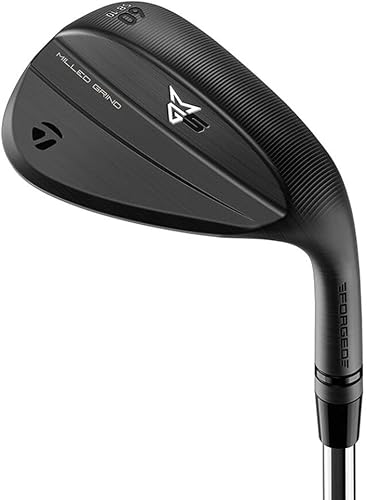
TaylorMade Milled Grind 5 Wedge
TaylorMade's first fully forged Milled Grind wedge pairs all-new aggressive saw-milled grooves with Spin Tread moisture-channeling technology for class-leading wet-weather spin and a softer feel — earning Today's Golfer's “Best for Feedback” award and broad praise across 16 sources, with feel-versus-expectation and price the only real points of debate.
We may earn a commission if you buy through this link — it never affects our scores or the price you pay.
The consensus
The TaylorMade Milled Grind 5 (MG5) is the fifth generation of TaylorMade's Milled Grind wedge line and a genuine milestone for the brand: it is the first Milled Grind ever fully forged, machined from ultrasoft carbon steel rather than cast. Available for preorder on August 7, 2025 and at retail on September 4, the MG5 drew broad, enthusiastic coverage across 16 sources spanning expert reviews, equipment-test data, forum consensus, and retail feedback. Today's Golfer named it “Best for Feedback” in its 2026 wedge test (scoring it 4.5/5), National Club Golfer awarded a full five stars, Golfalot rated it 4.4/5, and it features among Golf Digest's best wedges for 2026 — a near-universally well-reviewed release that lands just behind the tour-dominant Titleist Vokey line on our consensus.
Where sources agree most strongly: the wet-weather spin and the new groove package. The MG5's signature technology is Spin Tread — a laser-etched tread pattern on a RAW (unplated) face that channels moisture away from the grooves, which TaylorMade pairs with all-new aggressive saw-milled grooves cut to steeper walls and sharper radii. The result, claimed at roughly 13% more retained spin than the MG4 in wet conditions and confirmed anecdotally by testers who saw shots check and spin back off damp greens, is the wedge's clearest point of differentiation. Reviewers also praised the forged feel as a step up from the cast MG4, the premium P-Series-matched aesthetic in Satin Chrome and new Charcoal finishes, and the six tour-inspired grinds (SB, SC, SX, LB, HB, and the Tiger-tuned TW) shaped by master craftsman Greg Cesario.
Where the consensus fractures: feel-versus-expectation, value, and forgiveness. The move to forged was marketed as a major softness upgrade, and while reviewers agree the MG5 is softer than the MG4, several — Golf Monthly and Golfalot among them — found the impact frequency still fairly high and the feel short of truly “buttery,” with Today's Golfer giving Callaway's Opus SP a narrow edge on pure feel. At $199.99 per wedge ($219.99 for the TW grind), it sits at the top of the market alongside the Vokey SM11, and it is unambiguously a bladed player's wedge: the stronger lofts can feel short on power for slower swingers, the stock launch runs a touch high, and forgiveness is limited. But for better players buying fresh wedges — and especially for anyone who plays in wet or soft conditions — the MG5 represents one of the most complete and distinctive wedges of its generation, combining tour-grade shotmaking with a wet-weather spin solution no competitor matches as directly.
TaylorMade's first fully forged Milled Grind wedge pairs all-new aggressive saw-milled grooves with Spin Tread moisture-channeling technology for class-leading wet-weather spin and a softer feel — earning Today's Golfer's “Best for Feedback” award and broad praise across 16 sources, with feel-versus-expectation and price the only real points of debate.
Category ratings
What the community loves
The headline change is construction: the MG5 is the first Milled Grind ever forged, machined from ultrasoft carbon steel rather than cast. Reviewers consistently report a softer, more communicative sensation through impact than the MG4, with a muted, medium-soft “thwack” on full shots and a cleaner click around the greens. Plugged In Golf described the ball as feeling like it “stays on the face forever,” and Today's Golfer rewarded that responsiveness with its “Best for Feedback” award in its 2026 wedge test.
This is the MG5's genuine point of differentiation. A laser-etched “Spin Tread” pattern between the grooves on a RAW (unplated) face channels moisture away like tire treads, so spin holds up from damp lies, rough, and rain. TaylorMade claims the MG5 retains roughly 13% more spin than the MG4 once moisture is introduced, and testers repeatedly saw shots check and even spin back off the front of the green in conditions where most wedges go quiet. No competitor markets a wet-weather spin solution this aggressively.
A new saw-milling machining process let engineers tighten tolerances and cut grooves with steeper walls and sharper radii for maximum grab, especially on partial and open-face shots. Reviewers measured consistently high spin across the loft lineup with tight dispersion — Golf Monthly recorded roughly 7,600–8,300 rpm on 50-yard shots with the 54° — and noted the ball “dancing around the pin” once it hit the deck. The spin gain shows up as repeatable stopping power from a range of lies rather than a single peak number.
The MG5 offers six precision-milled grinds shaped by master wedge craftsman Greg Cesario: SB (full sole with trailing-edge relief for most swings), SC (a mid-bounce, club-pro favorite blending greenside creativity with full-shot stability), SX (the widest sole for bunkers and soft turf), LB (low bounce for shallow swings and tight, firm lies), HB (high bounce for diggers and soft conditions), and the TW grind, updated directly to Tiger Woods' current preferences. Reviewers singled out the TW grind as the most creative option around the greens, and the spread covers nearly every angle of attack and turf condition.
The MG5 adopts the minimalist, premium look of TaylorMade's P-Series irons — a refined, simplistic profile with a satin scratch face that cuts glare, a rounded leading edge, and a cleaner top-line-into-hosel transition than the MG4. It comes in Satin Chrome and a new Charcoal finish (with Tour RAW and Aged Copper available through MyMG5 custom), and the milling detail on the sole and the “FORGED” stamping reinforce the upmarket positioning. Multiple reviewers called it one of the best-looking wedges of the year.
What to watch out for
The most repeated caveat: switching to forged was meant to make the MG5 dramatically softer, and while reviewers agree it is a step up from the MG4, several found the impact frequency still fairly high and the sensation not as plush as a true forged blade. Golf Monthly and Golfalot both noted it is softer “but not as soft as expected,” and Today's Golfer felt the Callaway Opus SP edged it on pure feel — “awfully close,” but a gap nonetheless. It is a real improvement that slightly undershoots its own marketing.
At $199.99 per club — and $219.99 for the Tiger Woods TW grind — a three-wedge set runs roughly $600 before tax, putting the MG5 at the top of the market alongside Titleist's Vokey SM11. The previous-generation MG4 has dropped in price and remains excellent, and value-focused options from Cleveland and Cobra deliver strong spin for less. Several reviewers flagged the cost as the main thing holding it back.
The MG5 is a bladed, player-focused shape that rewards precise contact and offers little bailout. Golf Digest noted the stronger-lofted wedges can feel short on power, and Golf Monthly cautioned that the gap wedge may need more “pop” for slower, inconsistent strikers. Mid- and high-handicappers who chunk or blade wedge shots will find more help in wider-soled, cavity-back game-improvement designs.
A few smaller knocks recur: Today's Golfer found the stock launch slightly higher than ideal and would prefer a lower-flighted trajectory; the softer forged head and Charcoal/RAW finishes raise durability and cosmetic-wear questions over a season; and left-handed golfers have a noticeably restricted choice of lofts and grinds. None are dealbreakers, but they temper an otherwise excellent package.
Is it right for your game?
What real people are saying
12 quotes from across the web, grouped by 6 themes. Click a theme to read the individual quotes.
Specifications
Available shafts (no upcharge)
Premium shafts available at additional cost: Graphite Design Tour AD VF, Tour AD UB, Tour AD DI
All sources analyzed
This review synthesizes opinions from 16 independent sources. Every claim on this page can be traced back to its original source. No manufacturer relationship or compensation.
The consensus score is built in four layers: raw source collection, normalization to a 0-10 scale, credibility-weighted combination, and quality adjustments.
Expert reviews (35% weight) are scored from language intensity and any numerical ratings provided. Data-driven testing (25%) converts product rank within the test group to a percentile score. Forum posts (30%) are AI-classified by sentiment, weighted by substantiveness. Retail reviews (10%) convert 5-star ratings with a 0.75x credibility discount to correct for systematic inflation.
Three quality adjustments are then applied: a source diversity bonus (up to +0.3 for coverage across all source types), a conflict penalty (up to -0.3 when sources strongly disagree), and recency weighting (recent reviews weighted higher than older ones).