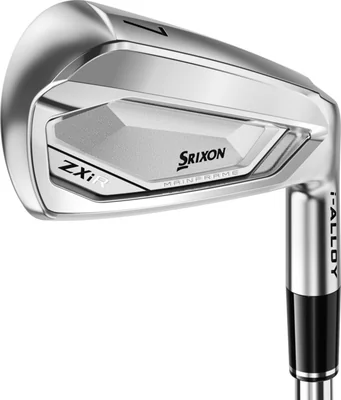
Srixon ZXiR Irons
Srixon's first game-improvement iron in a decade — the new i-Alloy steel brings a feel that rivals player's irons to a category-wide design built for mid-to-high handicappers who refuse to sacrifice touch for forgiveness.
We may earn a commission if you buy through this link — it never affects our scores or the price you pay.
The consensus
The Srixon ZXiR is a significant moment for the brand: their first dedicated game-improvement iron in a decade, and the first entry in a product segment where Srixon has historically been absent. It earned a spot on Golf Digest's 2026 Hot List and across 12 sources — spanning expert reviewers, GolfShake's TrackMan testing, and GolfWRX forum users — the core consensus is clear: the ZXiR delivers a feel that rivals player's irons while delivering the forgiveness and launch that mid-to-high handicappers need. The new i-Alloy steel (approximately 10% softer than the 431 steel standard in this category) is the most discussed differentiator, with multiple reviewers stating it produces feedback they'd only expect from forged player's irons.
Where sources agree most strongly: feel, forgiveness, and aesthetics. GolfShake's TrackMan testing confirmed solid and consistent ball speeds even on off-center strikes, with minimized side-to-side dispersion. The MainFrame milling — engineered from actual strike data of mid-to-high handicap golfers — positions the sweet spot lower on the face where this audience most frequently makes contact. The Tour V.T. Sole, adapted from the ZXi7 player's iron with wider camber for game-improvement swing paths, earned consistent praise for clean turf interaction even through softer conditions. Visually, reviewers praised the ZXiR for defying the thick-topline, oversized-head look common to the category — GolfShake called it an 'extremely clean, sophisticated' design.
The key tension: model selection matters enormously. The standard ZXiR (7-iron: 28.5°) produces a flat, penetrating ball flight that works well for golfers with moderate-to-above swing speeds and a descending attack angle — but Today's Golfer raised a significant flag, describing the trajectory as 'one of the flattest I've ever seen' and recommending the ZXiR HL 'at any speed.' The ZXiR HL (7-iron: 32.5°) addresses this with up to 4 degrees of additional loft and approximately 1,000 RPM more spin for softer landings. At $1,099.99 for a 7-piece steel set, the ZXiR sits at a competitive price point against the Callaway Elyte and Mizuno JPX 925 Hot Metal. The story here is straightforward: if you're a mid-to-high handicapper who has written off Srixon because they didn't make irons for your game, this is the iron that changes the conversation — but get fitted first.
Srixon's first game-improvement iron in a decade — the new i-Alloy steel brings a feel that rivals player's irons to a category-wide design built for mid-to-high handicappers who refuse to sacrifice touch for forgiveness.
Category ratings
What the community loves
The biggest story across every source. Srixon's new i-Alloy steel — engineered to be approximately 10% softer than the 431 steel commonly used in this category — delivers impact feedback that multiple reviewers said felt closer to a player's iron than a game-improvement design. GolfMagic described it as 'incredibly soft.' GolfShake's testing noted the feel was something they 'would only typically expect from player's irons.' This is Srixon's clearest competitive differentiation in a crowded GI market.
The MainFrame milling pattern — engineered from real strike data of mid-to-high handicap golfers — redistributes mass to where this audience most commonly misses. GolfMagic called the forgiveness 'incredible across both models.' GolfShake's Trackman testing confirmed solid and consistent ball speeds even when strikes were off-center, with minimized side-to-side dispersion. The sweet spot is positioned lower on the face than a player's iron, which is exactly where game-improvement golfers need it.
Multiple reviewers praised the ZXiR for defying the usual visual tradeoffs of the game-improvement category. GolfShake described the irons as having 'premium cavity-back badging and an extremely clean, sophisticated overall look.' The topline is cleaner than most GI irons, offset is present but restrained, and the overall profile at address inspires confidence rather than communicating a remedial look. GolfWRX members in the in-hand pics thread reacted positively to the first look.
Srixon's Tour V.T. Sole — a carryover from the ZXi7 but modified for a wider, more gradual camber suited to higher-handicap swing paths — earned consistent praise for turf performance. Today's Golfer called it 'superior.' Golf Monthly noted it was 'outstanding' for golfers who take deeper divots. The sole prevents the clubhead from laboring through softer ground, which is a common failure point for wider-soled GI irons that dig excessively.
The ZXiR/ZXiR HL pairing gives golfers real choice that competitors often lack. The standard ZXiR (7-iron: 28.5°) suits mid-handicappers with average-to-above swing speeds who need forgiveness but not a ballooning ball flight. The ZXiR HL (7-iron: 32.5°) is built for slower swingers and seniors, adding up to 4 degrees of loft and extra launch through optimized CG placement. GolfShake's Trackman testing confirmed roughly 1,000 RPM more spin from the HL, translating to noticeably softer landings.
What to watch out for
The sharpest criticism across sources. Today's Golfer's reviewer noted the standard ZXiR's trajectory was 'one of the flattest I've ever seen' — even their 4-iron flew flatter than a driver hit off the deck. The strong lofts (7-iron at 28.5°) demand sufficient attack angle and swing speed to launch the ball on a playable trajectory. For golfers below ~85 mph, the ZXiR HL is the correct model — but that nuance is easy to miss on the retail floor. Today's Golfer explicitly stated they'd 'take the ZXiR HL every single time, at any speed.'
GolfMagic was candid that the ZXiR prioritizes launch and distance over outright spin control: 'launch and distance simply take priority over outright control.' This is a deliberate design choice consistent with the game-improvement category, but golfers who want to attack pins from 150+ yards with stopping power may find themselves running through the back of greens with the short irons. The progressive groove design helps, but doesn't close the gap with player's irons in spin.
The ZXiR launched in February 2026, and as of March 2026, MyGolfSpy's Most Wanted game-improvement iron test has not yet been published with the ZXiR included. This review is based entirely on editorial reviews, TrackMan session data from GolfShake, and forum impressions — not the robot-and-human panel validation that crowns the ZXi7. Confidence will improve as independent testing accumulates.
Multiple sources emphasized that the choice between ZXiR and ZXiR HL is consequential and not intuitive from spec sheets alone. The 4-degree loft difference produces dramatically different ball flights, and the wrong choice will leave golfers frustrated. National Club Golfer and GolfShake both recommended fitting sessions before buying. The HL offset design also won't appeal to all golfers visually, which means some players who need the HL may resist it at address.
Is it right for your game?
The strongest consensus: the i-Alloy feel is genuinely different from other game-improvement irons — reviewers keep reaching for comparisons to player's irons. The key disagreement is about the standard ZXiR's launch angle. Today's Golfer was alarmed by how flat the ball flies; other sources were less concerned. The resolution: model selection is everything here. If you're buying without a fitting, default to the ZXiR HL.
What real people are saying
20 quotes from across the web, grouped by 8 themes. Click a theme to read the individual quotes.
Specifications
Available shafts (no upcharge)
Premium shafts available at additional cost: Graphite Design Tour AD VF, Tour AD UB, Tour AD DI
All sources analyzed
This review synthesizes opinions from 12 independent sources. Every claim on this page can be traced back to its original source. No manufacturer relationship or compensation.
The consensus score is built in four layers: raw source collection, normalization to a 0-10 scale, credibility-weighted combination, and quality adjustments.
Expert reviews (35% weight) are scored from language intensity and any numerical ratings provided. Data-driven testing (25%) converts product rank within the test group to a percentile score. Forum posts (30%) are AI-classified by sentiment, weighted by substantiveness. Retail reviews (10%) convert 5-star ratings with a 0.75x credibility discount to correct for systematic inflation.
Three quality adjustments are then applied: a source diversity bonus (up to +0.3 for coverage across all source types), a conflict penalty (up to -0.3 when sources strongly disagree), and recency weighting (recent reviews weighted higher than older ones).