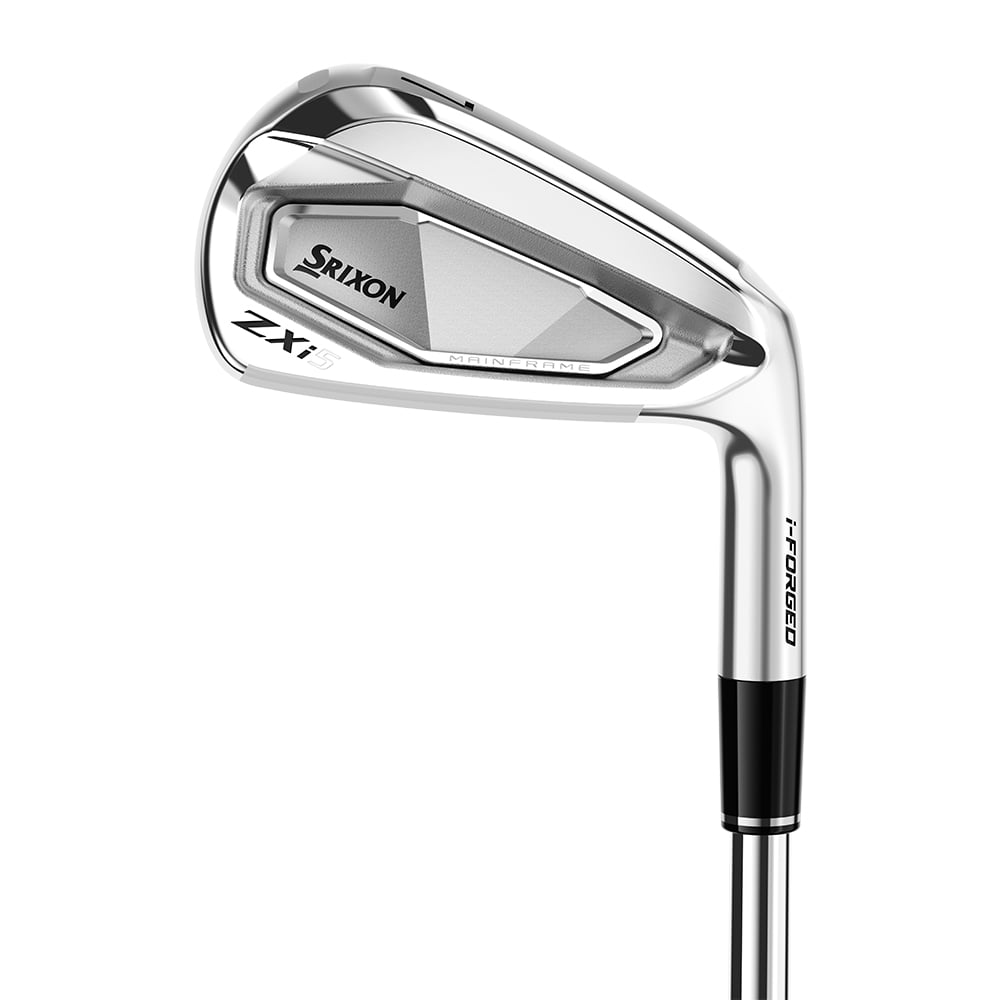
Srixon ZXi5 Irons
The players-distance iron that does almost everything — MyGolfSpy's standout 2025 ZXi5 was the only model to finish top-10 in accuracy, distance AND forgiveness, wrapping class-leading soft feel and the Tour V.T. Sole in a clean, players-style head.
We may earn a commission if you buy through this link — it never affects our scores or the price you pay.
The consensus
The Srixon ZXi5 is the players-distance iron in Srixon's 2025 ZXi family, sitting between the players' ZXi7 and the more forgiving ZXi4 — and across 15 sources spanning expert reviews, robot-and-human testing, forums, and retail, the consensus is that it is one of the most complete irons in its class. It earned a Golf Digest Hot List medal, and in MyGolfSpy's Players Distance testing it was the only iron to finish top-10 in all three scoring categories (accuracy, distance, and forgiveness) while also posting the field's best marks for sound, feel, looks, and likelihood of purchase. Plugged In Golf called it a favorite game-improvement iron of the year; Golf Sidekick named it the best overall iron for mid-handicappers.
Where sources agree most strongly: feel, turf interaction, and all-around balance. The i-FORGED construction pairs a forged S20C body with a high-strength SUP10 face that Srixon says is 14% softer than the ZX5 Mk II's, and reviewers consistently described impact as soft and crisp with minimal vibration — impressive for an iron that produces this much ball speed. MainFrame face technology (AI-designed milled channels) protects speed on off-center hits, and testers reported small distance losses and tight dispersion for such a compact head. The Tour V.T. Sole drew near-universal praise for moving cleanly through the turf, with Plugged In Golf saying it feels 'almost like a blade.' The clean, monochrome, minimally branded head looks far more like a player's iron than its forgiveness suggests.
Where the consensus has nuance: spin, distance control, and how much of a leap it really is. Golfalot measured roughly 4,400 rpm with the 7-iron and felt that wasn't quite enough to stop the ball quickly — the ZXi5 runs on the low-spin side, which suits steep, high-launch players but can leave others short of stopping power on firm greens. Golf Sidekick noted that solid strikes travel farther than expected, so gapping into the wedges deserves attention, and a few reviewers felt the gains over the ZX5 Mk II are more refinement than revolution. Golf Monthly added that shoppers wanting maximum game-improvement help may prefer a chunkier top line (or the ZXi4). At about $200 per club it is priced at the premium end. But for low- and mid-handicappers who want a soft-feeling, great-looking iron that quietly does everything well, the ZXi5 is one of the standout players-distance irons of 2025.
The players-distance iron that does almost everything — MyGolfSpy's standout 2025 ZXi5 was the only model to finish top-10 in accuracy, distance AND forgiveness, wrapping class-leading soft feel and the Tour V.T. Sole in a clean, players-style head.
Category ratings
What the community loves
Feel is the headline upgrade and the most-repeated praise across sources. The i-FORGED construction pairs a forged S20C steel body with a high-strength SUP10 steel face that Srixon says is 14% softer than the ZX5 Mk II's. Plugged In Golf described impact as 'soft and crisp,' with a deeper, softer connection at the sweet spot. Golf Monthly's tester noted a real smoothness to the hit with minimal vibration. Multiple reviewers were struck that the feel holds up despite the distance the set produces.
MyGolfSpy's 2025 Players Distance testing put the ZXi5 in rare company: it was the only iron to finish top-10 in all three scoring categories — accuracy, distance, and forgiveness — and posted the highest marks in the field for sound, feel, looks, and likelihood of purchase. It finished second for forgiveness (8.9) with strong accuracy and distance scores, making it one of the most complete players-distance irons of the year rather than a one-trick design.
The Tour V.T. Sole — with progressive widths and bounce angles through the set — earned near-universal praise for how cleanly it moves through the turf, including from tight and difficult lies. Plugged In Golf said it makes the club feel 'almost like a blade in the turf,' which appeals to better players, while Golf Monthly called the turf interaction exceptional and Golf Sidekick described it as 'amazing.' It is one of the most consistently complimented features of the entire ZXi line.
The ZXi5 looks far more like a player's iron than its forgiveness suggests. Reviewers praised the cleaned-up geometry over the ZX5 Mk II, a monochrome mix of brushed steel and high chrome, and minimal toe branding. Plugged In Golf called them the best-looking game-improvement irons on the market. Moderate blade length, a manageable topline, and modest offset give an unintimidating but genuinely premium look at address.
MainFrame face technology — Srixon's AI-designed pattern of milled channels behind the face — protects ball speed on off-center strikes, and testers felt it. Golf Sidekick measured only about a seven-yard loss on a toe strike without the ball ballooning into a hook; Golfalot lost just 10–15 yards on slight mishits. For a head this compact, the stability and consistent distances on mishits repeatedly surprised reviewers.
The ZXi5 sits between the players ZXi7 and the more forgiving ZXi4, and reviewers repeatedly framed it as the centerpiece of a combo set or a do-everything option on its own. Today's Golfer called the family the complete package and blendable at any level; Golf Sidekick named it the best overall iron for mid-handicappers; Golfstead treated it as a genuine all-rounder. Better players can blend ZXi7 scoring irons with ZXi5 long irons for extra forgiveness.
What to watch out for
The most concrete criticism. Golfalot's tester saw roughly 4,400 rpm with the 7-iron and felt that was 'not quite enough spin to stop the ball quickly,' a knock that echoes a long-running reputation that Srixon irons run low on spin. Combined with a strong-ish 31° 7-iron loft, players who need a steep, high-spinning descent to hold firm greens should pay close attention to spin during a fitting.
Several reviewers felt the on-course gains over the previous ZX5 Mk II are modest, with the headline improvement being feel rather than performance. Golfalot flagged 'minimal improvements over the previous ZX5' as a genuine consideration. If your ZX5 Mk II set is in good shape and well fit, the ZXi5 is a refinement rather than a must-upgrade.
The ZXi5 is a players-distance iron, not a true game-improvement club. Golf Monthly noted that some shoppers in this market may want a more confidence-inspiring, larger top line. Golfers who need maximum forgiveness, a thicker topline, and the easiest possible launch will be better served by the ZXi4 or a dedicated super-game-improvement set.
The ball speed that makes the ZXi5 fun can make distance control tricky: Golf Sidekick noted that 'solid hits travel further than expected,' which, paired with the low spin, demands attention to gapping into the wedges. The forged faces also scuff and ding more readily than some rivals. And at $199.99 per club — roughly $1,200 for a 5-PW set or $1,400 for 4-PW — it is priced at the premium end of the category.
Is it right for your game?
What real people are saying
15 quotes from across the web, grouped by 6 themes. Click a theme to read the individual quotes.
Specifications
Available shafts (no upcharge)
Premium shafts available at additional cost: Graphite Design Tour AD VF, Tour AD UB, Tour AD DI
All sources analyzed
This review synthesizes opinions from 15 independent sources. Every claim on this page can be traced back to its original source. No manufacturer relationship or compensation.
The consensus score is built in four layers: raw source collection, normalization to a 0-10 scale, credibility-weighted combination, and quality adjustments.
Expert reviews (35% weight) are scored from language intensity and any numerical ratings provided. Data-driven testing (25%) converts product rank within the test group to a percentile score. Forum posts (30%) are AI-classified by sentiment, weighted by substantiveness. Retail reviews (10%) convert 5-star ratings with a 0.75x credibility discount to correct for systematic inflation.
Three quality adjustments are then applied: a source diversity bonus (up to +0.3 for coverage across all source types), a conflict penalty (up to -0.3 when sources strongly disagree), and recency weighting (recent reviews weighted higher than older ones).