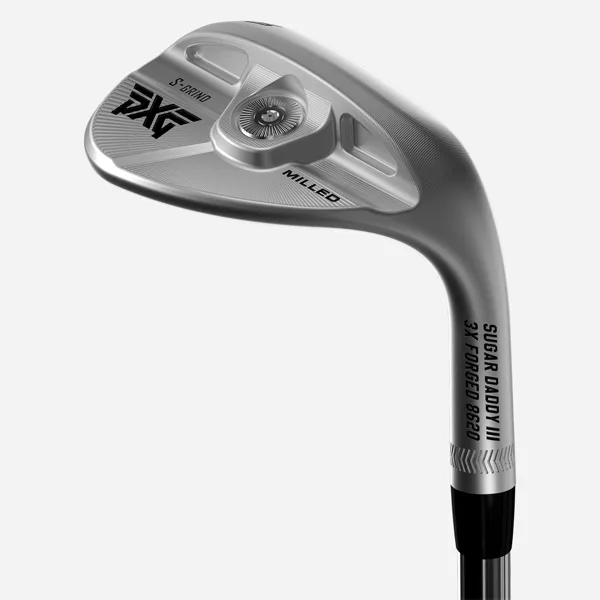
PXG 0311 Sugar Daddy III Wedge
PXG's fully-milled, triple-forged premium wedge — Precision Weighting Technology and the highest-spinning grooves the company has produced deliver class-leading feel and elite spin, earning a spot on the 2025 Golf Digest Hot List. A premium price and a slim three-grind matrix temper the value, but across 15 sources the short-game performance is genuinely top-tier.
We may earn a commission if you buy through this link — it never affects our scores or the price you pay.
The consensus
The PXG 0311 Sugar Daddy III is the third generation of PXG's fully-milled wedge line, launched publicly on August 7, 2024 as part of the brand's GEN7 family and earning a spot on the 2025 Golf Digest Hot List. Across 15 sources spanning expert reviews, equipment testing, forum chatter and retail feedback, the verdict is remarkably consistent: this is one of the best-feeling and highest-spinning wedges on the market. The head is forged three times from soft 8620 carbon steel and then 100% CNC milled to its final shape — no stamping, no hand grinding — which delivers the tight grain structure, exacting consistency and premium feel that reviewers from Plugged In Golf to GolfMagic singled out as class-leading for 2024.
Where sources agree most strongly: feel, spin and craftsmanship. The milled grooves — wider with tighter spacing, which PXG calls its highest-spinning and most consistent ever — generate elite, repeatable spin that reviewers reported holds up impressively from the rough as well as the fairway. The Precision Weighting Technology adds a genuine point of difference, with a rear weight adjustable in 2-gram increments during a fitting plus a milled cavity that raises MOI for a touch more forgiveness than a traditional blade wedge. Three sole grinds — the versatile S (10° bounce, every loft), the wider hi-toe BP (12°, 54–60°) and the narrow C (7°, 58–60°) — cover the main turf conditions, and MyGolfSpy flagged the BP as a standout for wet, lush lies.
Where the consensus fractures: value and fitting breadth. At $299.99 for Satin Chrome and $349.99 for the Xtreme Dark DLC finish, the Sugar Daddy III sits at the top of the market — about £100 more than a Vokey, by GolfMagic's measure — and several reviewers framed the appeal as part performance, part image, questioning whether the gap over cheaper Cleveland, TaylorMade and Vokey wedges is justified. Two structural knocks recur: the slim matrix of just three grinds and roughly 12 configurations (with no true gap or pitching wedge below 50°) against Vokey's 27, and a Satin Chrome finish that several testers found marks after a single round. The honest placement is a clear notch below the mainstream premium leaders on value and versatility — but for a feel-and-spin-first player committing to a fitting, the Sugar Daddy III is genuinely top-tier short-game hardware, and the $200 price cut from the Sugar Daddy II makes it more reachable than ever.
PXG's fully-milled, triple-forged premium wedge — Precision Weighting Technology and the highest-spinning grooves the company has produced deliver class-leading feel and elite spin, earning a spot on the 2025 Golf Digest Hot List. A premium price and a slim three-grind matrix temper the value, but across 15 sources the short-game performance is genuinely top-tier.
Category ratings
What the community loves
Feel is the headline. The Sugar Daddy III is forged three times from soft 8620 carbon steel and then 100% CNC milled down to its final shape, and reviewers were near-unanimous that the result is exceptional — GolfMagic called them “the best feeling wedges we have tested in 2024,” and Plugged In Golf described “a feel that mixes soft and solid in an extraordinary way.” National Club Golfer summed it up as a “soft, buttery feel” with subtle, precise feedback on exactly where you caught the strike. For a player who buys wedges on touch and feedback, this is as good as it gets.
PXG poured its R&D into the grooves: wider grooves with tighter spacing, milled rather than stamped, which the company calls the highest-spinning, most consistent groove it has ever produced. The payoff reviewers reported is spin that holds up not just from clean fairway lies but impressively from the rough — Golf Monthly noted full shots from up to 70 yards out of both the fairway and the rough reacted similarly on the green. Worldwide Golf put it plainly: “these wedges spin for fun and are right up there with other Tour-performing wedges.” The gain is in repeatability across lies, not just a single peak number.
A large weight near the CG on the back of the head can be adjusted in 2-gram increments during a fitting, letting a fitter dial in head and swing weight for a given player — a level of personalization no mainstream wedge offers off the rack. Just as importantly, the milled cavity and variable-depth sole ports redistribute mass to raise MOI: Plugged In Golf credited the design with “more forgiveness” than a traditional blade wedge, a rare claim in a category built almost entirely around feel over stability.
Where the Sugar Daddy II looked overtly technical, the III reads as a classic, compact, premium wedge — undercut milling windows, radiating lines on the back flange and ultra-fine milling on the sole that several reviewers called mesmerizing. Golf Monthly described a “classic profile at address” with “refined premium looks” and rated it a clear “step up from the previous generation both in terms of looks and performance.” The 100%-milled construction (no stamping, no hand grinding) means every head holds the same exact specs.
At $299.99 for Satin Chrome, the Sugar Daddy III lands roughly $200 below the Sugar Daddy II's launch price, which Plugged In Golf flagged as a meaningful part of the appeal — the same fully-milled, made-to-order PXG build at a price closer to (if still above) the mainstream premium field. It also earned a place on the 2025 Golf Digest Hot List, and MyGolfSpy singled out the wider-soled BP grind as a standout for wet conditions in its 2025 testing.
What to watch out for
Even at the reduced $299.99 (Satin Chrome) / $349.99 (Xtreme Dark) pricing, the Sugar Daddy III sits at the top of the market — GolfMagic noted it runs roughly £100 more than a Titleist Vokey, and the consensus verdict from value-minded reviewers is that the performance gap over cheaper Cleveland, TaylorMade and Vokey wedges doesn't fully justify the premium. Worldwide Golf was blunt that the “major appeal is image,” framing it as “a must-have for the 'golf baller'” more than a value buy. A three-wedge set runs close to $900–1,050.
This is the recurring performance caveat. The Sugar Daddy III offers just three grinds — S (10° bounce, all lofts), BP (12° bounce, 54–60°) and C (7° bounce, 58–60° only) — across roughly 12 loft/bounce configurations, and the loft range stops at 50° with no true gap or pitching wedges below it. Both Golf Monthly and National Club Golfer flagged the “limited grind and bounce options,” a clear disadvantage against Vokey's 27-strong fitting matrix for players who want to fine-tune turf interaction.
Multiple reviewers were disappointed by how fast the Satin Chrome scuffs and marks — Golf Monthly listed “chrome coating wears easily” as an outright con and noted marking after a single 18-hole round. For a wedge at this price, the cosmetic durability lagged expectations. The darker Xtreme Dark DLC finish (a $50 upcharge) holds up better but isn't immune to bunker wear.
The Precision Weighting mechanism and busier cavity divide opinion — Worldwide Golf found the technical look “too fussy” and preferred classic styling, and GolfMagic felt “there are better looking wedges on the market in 2024” with too much branding. The same reviewers noted the head can feel too light in hand until the back weight is properly dialed in, which means the club really wants a fitting to perform its best rather than an off-the-rack purchase.
Is it right for your game?
What real people are saying
13 quotes from across the web, grouped by 6 themes. Click a theme to read the individual quotes.
Specifications
Available shafts (no upcharge)
Premium shafts available at additional cost: Graphite Design Tour AD VF, Tour AD UB, Tour AD DI
All sources analyzed
This review synthesizes opinions from 15 independent sources. Every claim on this page can be traced back to its original source. No manufacturer relationship or compensation.
The consensus score is built in four layers: raw source collection, normalization to a 0-10 scale, credibility-weighted combination, and quality adjustments.
Expert reviews (35% weight) are scored from language intensity and any numerical ratings provided. Data-driven testing (25%) converts product rank within the test group to a percentile score. Forum posts (30%) are AI-classified by sentiment, weighted by substantiveness. Retail reviews (10%) convert 5-star ratings with a 0.75x credibility discount to correct for systematic inflation.
Three quality adjustments are then applied: a source diversity bonus (up to +0.3 for coverage across all source types), a conflict penalty (up to -0.3 when sources strongly disagree), and recency weighting (recent reviews weighted higher than older ones).