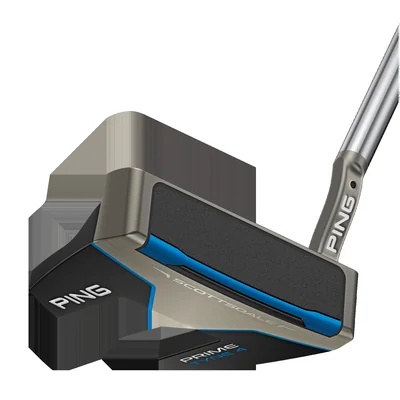
PING Scottsdale Prime Tyne 4 Putter
MyGolfSpy's third-ranked mallet for 2025 — a twin-fork design with Pebax insert and high MOI that dominates mid-to-long range putting, built for golfers with a strong arc stroke.
We may earn a commission if you buy through this link — it never affects our scores or the price you pay.
The consensus
The PING Scottsdale Prime Tyne 4 is the third-ranked mallet putter in MyGolfSpy's 2025 Most Wanted testing and a Golf Digest Hot List selection. Across 10 sources spanning independent robot data, expert reviews, forum users, and retail feedback, the consensus is that this twin-fork mallet delivers exceptional stability and mid-to-long range performance at a price that significantly undercuts the premium competition. It is a targeted design built for golfers with strong arc strokes who want maximum forgiveness in a distinctive mallet shape.
Where sources agree most strongly: forgiveness, feel, and medium-to-long range putting. MyGolfSpy measured -8.7 and -10.5 PuttView HCP scores on medium and long putts respectively, meaning arc-stroke golfers who face lots of lag putts will see measurable improvement. The Pebax face insert — the same technology across the entire Scottsdale line — delivers a soft, consistent roll with no hot spots, and was rated among the highest for sound and feel in the mallet category. The twin-fork design pushes weight to the perimeter for up to 11% higher MOI than the PLD Milled equivalent, and Plugged In Golf noted that short putts felt almost hard to miss thanks to the resulting stability.
Where the consensus fractures: stroke compatibility and aesthetics. MyGolfSpy explicitly warned that the heel-shafted hosel design is built for strong arc strokes — golfers with straight-back or slight-arc strokes should look elsewhere. The twin-fork silhouette also divides opinion, with some GolfWRX users finding it visually distracting compared to more traditional mallet shapes. Short putt performance, while competent, doesn't separate from the pack the way mid-to-long range does. But for the target golfer — mid-to-high handicap with a rotational stroke — the Prime Tyne 4 offers top-three mallet performance at $269.99, roughly $100-$150 less than competing premium options.
MyGolfSpy's third-ranked mallet for 2025 — a twin-fork design with Pebax insert and high MOI that dominates mid-to-long range putting, built for golfers with a strong arc stroke.
Category ratings
What the community loves
MyGolfSpy ranked the Prime Tyne 4 as the third-best mallet putter for 2025, behind only the Wilson Infinite Buckingham and Runner Mallet. The data-driven ranking validates what golfers feel on the green: this is one of the most effective mallets available at any price, with particularly strong results on medium and long putts.
Where the Prime Tyne 4 separates from the competition is on medium and long putts. MyGolfSpy measured a -8.7 PuttView HCP on medium putts and -10.5 on long putts — meaning golfers with arc strokes who frequently face lag putts will see measurable improvement. This is a putter built for the 15-to-40-foot range.
The signature twin-fork shape pushes weight to the perimeter, creating exceptionally high moment of inertia for a mid-sized mallet. Combined with the lightweight Pebax insert that frees up discretionary weight, the Prime Tyne 4 achieves up to 11% higher MOI than the PLD Milled equivalent, resulting in noticeably less face twist on mishits.
The same Pebax face insert technology used across the Scottsdale line delivers a soft, consistent roll with no hot spots. The temperature-stable material performs identically in cold morning rounds and hot afternoon sessions. MyGolfSpy rated it among the highest in their sound and feel evaluations.
Like all Scottsdale models, the Prime Tyne 4 comes in well below competing premium mallets. The Odyssey Ai-ONE, TaylorMade TP Hydro Blast, and Spider Tour range from $350 to $400+. For the third-ranked mallet in independent testing, the price-to-performance ratio is hard to beat.
What to watch out for
The small slant hosel creates a heel-shafted configuration designed specifically for strong arc strokes. MyGolfSpy explicitly warned: skip it if you need a face-balanced, straight-back feel. Golfers with slight arc or SBST strokes should look at other Scottsdale models with different hosel configurations.
The Tyne 4's distinctive twin-fork silhouette doesn't appeal to everyone. Some GolfWRX users found the shape distracting at address compared to more traditional mallet profiles. If you prefer a clean, rounded mallet look, the Scottsdale Craz-E or competing mallets may suit your eye better.
While the Prime Tyne 4 excels from medium and long range, it doesn't separate from the pack on short putts inside 8 feet. MyGolfSpy's data showed competent but not elite short-range numbers, meaning golfers who primarily miss short putts may not see the differentiation they expect.
The contrasting alignment line in the back cavity is clean and effective, but it's a single sight line rather than the multi-line or geometric alignment systems found on some competing mallets. Golfers who rely heavily on elaborate alignment aids may find the minimalist approach insufficient.
Is it right for your game?
The Prime Tyne 4 consistently ranks among MyGolfSpy's top mallet performers in objective data testing, which has driven significant community interest despite the unconventional tyne design. Forum consensus is clear: this putter overperforms its $270 price point. The main barrier to adoption is purely visual — players who can accept the tyne profile at address report exceptional performance.
What real people are saying
14 quotes from across the web, grouped by 6 themes. Click a theme to read the individual quotes.
Specifications
Available shafts (no upcharge)
Premium shafts available at additional cost: Graphite Design Tour AD VF, Tour AD UB, Tour AD DI
All sources analyzed
This review synthesizes opinions from 10 independent sources. Every claim on this page can be traced back to its original source. No manufacturer relationship or compensation.
The consensus score is built in four layers: raw source collection, normalization to a 0-10 scale, credibility-weighted combination, and quality adjustments.
Expert reviews (35% weight) are scored from language intensity and any numerical ratings provided. Data-driven testing (25%) converts product rank within the test group to a percentile score. Forum posts (30%) are AI-classified by sentiment, weighted by substantiveness. Retail reviews (10%) convert 5-star ratings with a 0.75x credibility discount to correct for systematic inflation.
Three quality adjustments are then applied: a source diversity bonus (up to +0.3 for coverage across all source types), a conflict penalty (up to -0.3 when sources strongly disagree), and recency weighting (recent reviews weighted higher than older ones).