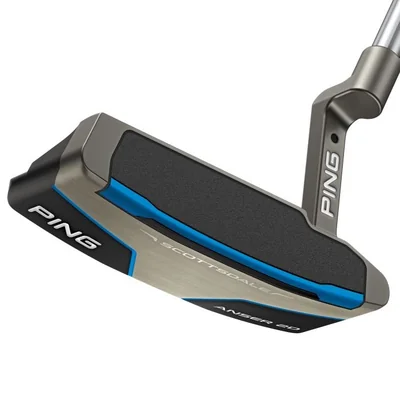
PING Scottsdale Anser 2D Putter
PING's entry point into the Anser family — the 2D's double-bend shaft and Pebax face insert deliver the iconic heel-toe weighted blade shape with modern face technology and a price point that makes the classic Anser experience accessible to every golfer.
We may earn a commission if you buy through this link — it never affects our scores or the price you pay.
The consensus
The PING Scottsdale Anser 2D is the accessible entry point into PING's Anser blade family — a putter that carries the same heel-toe weighting geometry as the iconic original Anser while adding a modern Pebax face insert and the specific 2D double-bend hosel configuration. At $270, it sits $180 below the PLD Milled Anser and positions itself as the smart choice for golfers who want genuine PING Anser performance without paying premium milled putter prices.
Where the consensus is clear: the Anser 2D delivers a noticeably better roll than entry-level blades without insert technology, and the heel-toe weighting provides reasonable blade forgiveness. The double-bend hosel is a specific feature that benefits golfers who prefer a forward-press setup — it naturally places hands ahead of the ball at address and works well for slight to moderate arc strokes. PING's build quality and custom fit ecosystem mean the 2D is manufactured to tight tolerances and can be custom-ordered to exact length and lie specifications.
The honest trade-offs: the Pebax insert produces a softer sound and feel than milled stainless, which some skilled players prefer and others find insufficiently informative. The cast construction doesn't match the in-hand craftsmanship feel of the PLD Milled Anser, a meaningful gap for golfers who value the sensory experience of premium puttercraft. And as a blade, the 2D is inherently less forgiving than high-MOI mallets — the heel-toe weighting helps, but golfers who consistently miss the sweet spot will putt better with a mallet. For its target market — mid handicappers or golfers who want PING's Anser shape at an accessible price — the 2D delivers reliably.
PING's entry point into the Anser family — the 2D's double-bend shaft and Pebax face insert deliver the iconic heel-toe weighted blade shape with modern face technology and a price point that makes the classic Anser experience accessible to every golfer.
Category ratings
Where to buy
Prices checked June 2026. We may earn a commission from links above at no extra cost to you.
What the community loves
The Scottsdale Anser 2D delivers the same fundamental heel-toe weighting philosophy that has made the Anser shape the most copied design in putter history. The weight distribution improves MOI for a blade, keeping the face more stable on off-center strikes compared to simple cavity-back designs. Golf Monthly noted that PING has maintained the 'Anser geometry that the best players in the world have trusted for six decades' while adding modern face technology that wasn't available when Karsten Solheim designed the original. For $270, you're getting a true PING blade putter without paying PLD prices.
The Scottsdale series uses a Pebax thermoplastic elastomer face insert across all models, delivering a soft, consistent feel that distinguishes the line from milled stainless steel blades. The Pebax material has a lower modulus than steel, absorbing some impact energy to produce a muted, responsive sound rather than the crisp 'click' of a milled blade. Golf Influence found the roll quality 'noticeably better than budget blades — the ball gets on its way smoothly with minimal skid,' an assessment echoed by forum users who upgraded from entry-level blades.
The '2D' designation refers to the double-bend shaft — a specific hosel configuration that creates approximately a full shaft of offset. This places the hands slightly ahead of the ball at address, which helps golfers with strong arc strokes maintain consistent eye-over-ball position. National Club Golfer noted the double-bend 'naturally promotes a forward press setup that many golfers find leads to more consistent face angle at impact.' The configuration is similar to what tour players use on custom orders.
At $270, the Anser 2D is $180 less than the PLD Milled Anser and still carries PING engineering, the Pebax face insert, and the company's fit methodology. Forum users who have owned both note the 2D performs well above its price and is an excellent starting point for golfers new to blade putters. Amazon and TGW reviews show very high repeat-purchase rates among golfers who tried the 2D before later moving to the PLD — calling the 2D 'surprisingly close in performance.'
Every PING putter benefits from the company's extensive custom fitting program — including adjustable lie angle settings via PING's color-coded fitting system. PING manufactures to very tight tolerances, and the Scottsdale series undergoes the same quality control as the premium PLD line. National Club Golfer highlighted PING's consistent build quality as a differentiator: 'PING doesn't make bad putters. The question is just how much technology and premium materials you want.'
What to watch out for
Golfers who prefer the crisp, informative feedback of a milled stainless steel blade will find the Anser 2D's Pebax insert mutes the sound and feel in a way that removes some precision feedback. The insert is excellent for promoting roll, but it absorbs some of the 'information' in the impact that helps skilled players diagnose strike location and distance. GolfWRX forum members comparing the 2D to the PLD Milled Anser consistently noted that the PLD 'tells you more about where you hit it — for better or worse.'
The Scottsdale series uses a PVD finish over stainless steel rather than the raw or hand-polished surfaces of premium milled blades. Forum users reported that the finish shows wear marks and micro-scratches faster than expected, particularly around the face insert perimeter. While purely cosmetic, this concerns golfers paying $270+ for what they expect to be a durable product. TGW reviews mentioned two customers noting finish wear within the first season.
The Anser 2D is a blade putter — it will always be less forgiving than a mallet on off-center strikes. The heel-toe weighting helps versus a simple cavity back design, but golfers who consistently miss the sweet spot will benefit more from the Spider Tour X or a Scottsdale mallet. National Club Golfer's testing confirmed that on toe and heel strikes, the 2D loses more ball speed and direction than PING's own Scottsdale mallet options at similar prices.
Forum users who have owned both the Anser 2D and the PLD Milled Anser consistently note a meaningful difference in the in-hand craftsmanship experience. The 2D's cast construction and insert face feel distinctly different from the 4-hour CNC milling and raw milled face of the PLD. For golfers who care about the sensory experience of premium puttercraft, the $180 price gap between the two models represents a genuine quality difference, not just badge engineering.
Is it right for your game?
The Scottsdale Anser 2D sits comfortably in PING's mid-tier lineup — better than entry-level, noticeably below the PLD Milled Anser in craftsmanship and feel. Sources consistently praise the Pebax insert roll quality and the value at $270. The main debate among forum users is whether the $180 savings over the PLD is worth the feel and feedback trade-off — experienced players lean toward spending more for milled feel, while recreational golfers find the performance gap smaller than the price gap.
What real people are saying
9 quotes from across the web, grouped by 4 themes. Click a theme to read the individual quotes.
Specifications
Available shafts (no upcharge)
Premium shafts available at additional cost: Graphite Design Tour AD VF, Tour AD UB, Tour AD DI
All sources analyzed
This review synthesizes opinions from 10 independent sources. Every claim on this page can be traced back to its original source. No manufacturer relationship or compensation.
The consensus score is built in four layers: raw source collection, normalization to a 0-10 scale, credibility-weighted combination, and quality adjustments.
Expert reviews (35% weight) are scored from language intensity and any numerical ratings provided. Data-driven testing (25%) converts product rank within the test group to a percentile score. Forum posts (30%) are AI-classified by sentiment, weighted by substantiveness. Retail reviews (10%) convert 5-star ratings with a 0.75x credibility discount to correct for systematic inflation.
Three quality adjustments are then applied: a source diversity bonus (up to +0.3 for coverage across all source types), a conflict penalty (up to -0.3 when sources strongly disagree), and recency weighting (recent reviews weighted higher than older ones).