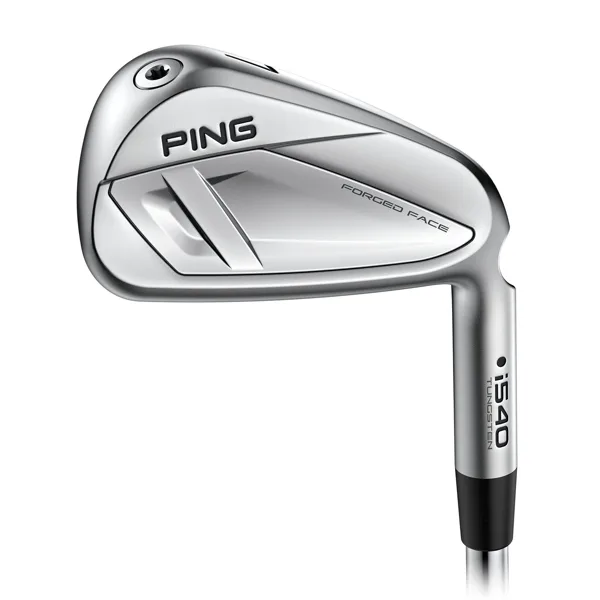
Ping i540 Irons
Ping's 2026 players-distance iron pairs a forged, 9%-thinner maraging-steel face with new inR-Air airbag technology to deliver some of the most explosive ball speed in the category, wrapped in a far sleeker shape than the i530 — earning a Golf Digest Hot List Silver Medal, with the loud impact sound and strong lofts the main points of debate.
We may earn a commission if you buy through this link — it never affects our scores or the price you pay.
The consensus
The Ping i540 is the 2026 successor to the i530 and Ping's headline entry in the players-distance iron category, and across 14 sources spanning expert reviews, robot-style data testing, forum chatter, and retail feedback the verdict is clear: this is one of the longest, fastest irons in its class, held back from the very top of our rankings only by a loud impact sound and a few practical caveats. It earned a Silver Medal on the 2026 Golf Digest Hot List, a 4.5/5 from Today's Golfer and a 5-star score from National Club Golfer, and MyGolfSpy went as far as to crown it 'The King of Distance.' The core engineering story is a forged, variable-thickness maraging-steel face that is 9% thinner than the i530's, freed to flex by Ping's new inR-Air airbag, with tungsten weighting and an i-Beam internal structure doing the work on launch and forgiveness.
Where sources agree most strongly: distance, launch, looks, and forgiveness. The ball speed is genuinely class-leading, and crucially the i540 pairs it with a high peak height and steep descent angle, so the ball stops on greens despite strong lofts — the exact problem most distance irons fail to solve. Reviewers were also relieved by the aesthetics; the i540 sheds the bulk of the i530 for a slimmer topline and a clean covered-cavity shape that Plugged In Golf said reads closer to a blade than to the players-distance iron it really is. And for a compact head it holds ball speed and line on mishits well, with long irons that testers repeatedly called easy to launch.
Where the consensus fractures: sound, lofts, consistency, and price. The most-repeated knock by far is the impact sound — the Golf Digest panel, Today's Golfer, and others found it loud and high-pitched, and Golf Monthly judged the feel slightly firmer than the i530, even though the inR-Air system noticeably softens what a hollow-body iron would otherwise sound like. The strong lofts (a 42-degree pitching wedge) raise gapping questions and demand attention to the bottom of the set, and MyGolfSpy's robot data was the dissenting voice, flagging larger ball-speed, carry, spin, and dispersion deltas than the headline distance implies — meaning real distance control leans on a proper fitting. At $235 per iron it also sits at the top of the category, above cross-shops like the Titleist T250, Srixon ZXi5, and Mizuno Pro 245, and a few reviewers felt the gains over the i530 were incremental. But for the mid-handicapper who wants explosive, green-holding distance in a shape that finally looks the part, the i540 is one of the most compelling players-distance irons of 2026 — and Ping's class-leading fitting depth lets a good fitter tune around its quirks.
Ping's 2026 players-distance iron pairs a forged, 9%-thinner maraging-steel face with new inR-Air airbag technology to deliver some of the most explosive ball speed in the category, wrapped in a far sleeker shape than the i530 — earning a Golf Digest Hot List Silver Medal, with the loud impact sound and strong lofts the main points of debate.
Category ratings
What the community loves
Distance is the defining trait of the i540, and reviewers were near-unanimous that it sits at the very top of the players-distance category for speed. The forged, variable-thickness C300 maraging-steel face is 9% thinner than the i530's, letting it flex like a metalwood at the top rail and sole, and Ping's new inR-Air airbag lets the face bend freely while filtering out harsh frequencies. MyGolfSpy crowned it 'The King of Distance' and said it demolishes the field for raw distance, while GolfMagic called it one of the hottest players' distance irons it has ever tested.
The most important trick for a strong-lofted iron is getting the ball to come down softly, and the i540 does it. Tungsten weighting in the 4-7 irons lowers and shifts the CG, producing a high peak height and a steep descent angle that holds greens. Today's Golfer described the combination of speed, height, and stopping power as extremely impressive, and called the launch tour-level despite the strong lofts. Several reviewers noted the high flight solves the bounce-out problem that plagues many distance irons.
For a club that looks this compact, the i540 retains a lot of ball speed and line on off-center strikes. The i-Beam internal structure and perimeter tungsten keep MOI high, and reviewers repeatedly noted minimal distance loss on toe and heel misses. Plugged In Golf said improved forgiveness and a more consistent ball flight are where the i540 really shines, and National Club Golfer noted that even on poor strikes it didn't drop many yards. The long irons in particular were praised as easy to launch and reliable off the tee.
The i530 was widely seen as bulky; the i540 is not. Reviewers welcomed the slimmer topline, the cleaner covered-cavity shaping, and a look Plugged In Golf said reads closer to a blade than to the players-distance iron it actually is. Golf Monthly called the aesthetic a lovely blend of clean and sleek, and Independent Golf Reviews said it looks amazing from every angle. The modern, IDI-driving-iron-inspired silhouette is a clear part of the appeal.
The forged face and the inR-Air TPU insert do real work softening what could have been a harsh, hollow-body sensation. Plugged In Golf found the feel devoid of harsh feedback or vibration even on poor strikes, and Golf Monthly praised the consistent gapping and refined wedge shaping. On top of that, Ping's fitting depth is unmatched in the category: standard, Power Spec, and Retro Spec lofts, plus 11 no-upcharge shaft options and Ping's color-code lie system let a fitter dial the set to the player.
What to watch out for
Almost every outlet flagged the sound. The Golf Digest Hot List panel singled out that several testers found the impact sound too loud, Today's Golfer warned the high-pitched note may bother some golfers, and Golf Monthly went further, judging the feel slightly harsher than the previous i530. The inR-Air system is specifically designed to filter frequencies, and for many it works — but a real subset of reviewers still found the i540 louder and firmer than they wanted from a Ping iron.
The i540 is built strong — the pitching wedge is 42 degrees and the 7-iron is 29 — and that draws the usual caveats. National Club Golfer noted the strong standard lofts, and Today's Golfer warned the powerful performance could create gapping issues at the bottom of the set, often requiring matching utility and gap wedges. Traditionalists who value standard loft gapping will want to fit the Retro Spec option, and the strong lofts make honest comparisons to softer-lofted players irons tricky.
MyGolfSpy's testing was the dissenting data point: while the i540 led the field on raw distance, it struggled relative to peers on ball-speed deltas, carry deltas, backspin deltas, and dispersion — meaning the headline distance comes with more shot-to-shot variance, and dialing in distance control will lean on a proper fitting. Reviewers also agreed the i540 is built for speed, not shot-shaping; players who like to work the ball or flight it down will find it less manipulable than a true players iron.
At $235 per iron in steel ($250 graphite, roughly $1,499 for a standard seven-piece set), the i540 is priced at the top of the category — above the Titleist T250, Srixon ZXi5, and Mizuno Pro 245 that reviewers repeatedly named as cross-shops. Golfalot questioned whether the premium justifies the incremental gains over the 2024 i530, and several testers noted the long irons carry a slight rightward/offset bias that better players may notice at address.
Is it right for your game?
What real people are saying
16 quotes from across the web, grouped by 6 themes. Click a theme to read the individual quotes.
Specifications
Available shafts (no upcharge)
Premium shafts available at additional cost: Graphite Design Tour AD VF, Tour AD UB, Tour AD DI
All sources analyzed
This review synthesizes opinions from 14 independent sources. Every claim on this page can be traced back to its original source. No manufacturer relationship or compensation.
The consensus score is built in four layers: raw source collection, normalization to a 0-10 scale, credibility-weighted combination, and quality adjustments.
Expert reviews (35% weight) are scored from language intensity and any numerical ratings provided. Data-driven testing (25%) converts product rank within the test group to a percentile score. Forum posts (30%) are AI-classified by sentiment, weighted by substantiveness. Retail reviews (10%) convert 5-star ratings with a 0.75x credibility discount to correct for systematic inflation.
Three quality adjustments are then applied: a source diversity bonus (up to +0.3 for coverage across all source types), a conflict penalty (up to -0.3 when sources strongly disagree), and recency weighting (recent reviews weighted higher than older ones).