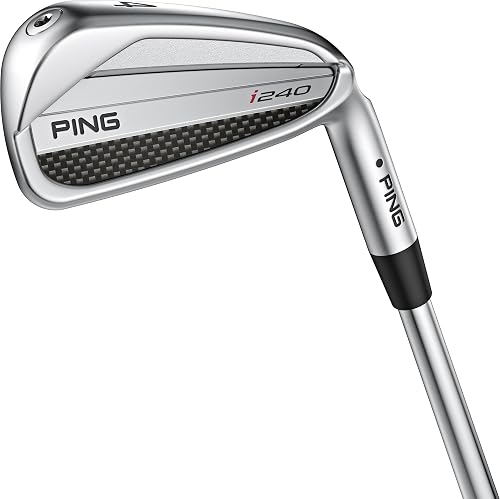
Ping i240 Irons
Ping's most forgiving players iron yet — a 431 stainless cavity-back whose weight-saving multi-material badge delivers class-leading dispersion, a higher and softer-landing flight, and genuinely improved feel over the i230, earning a 2026 Golf Digest Hot List Silver Medal and broad praise across 15 sources as the ideal bridge from game-improvement to a true player's club.
We may earn a commission if you buy through this link — it never affects our scores or the price you pay.
The consensus
The Ping i240 is the successor to the much-loved i230 and the most forgiving iron in Ping's players line, sitting deliberately between a true player's iron and a players-distance iron. Across 15 sources spanning expert reviews, robot-style and launch-monitor testing, forum communities, and retail feedback, the consensus is strongly positive: this is one of the best all-around players irons of its generation. It earned a Silver Medal on Golf Digest's 2026 Hot List, a perfect 5/5 from National Club Golfer, and 4.5/5 from Today's Golfer, with reviewers repeatedly singling out its blend of compact, confidence-inspiring looks and surprising mishit forgiveness. The engineering story is a lighter multi-material cavity badge — about 8.5 grams lighter than the i230's — that frees weight to lower the CG and push MOI higher.
Where sources agree most strongly: forgiveness, launch, and improved feel. Reviewers were consistently surprised by how tightly the i240 groups off-center strikes for a head this size — National Club Golfer measured exceptionally tight front-to-back dispersion even on mishits, and Ping claims an 11% reduction over the i230. The lowered CG makes this Ping's highest-launching players iron, producing steep, green-holding landing angles, while a return to fewer, wider grooves (a tour-staff request) recovers fairway spin and the Hydropearl 2.0 finish helps it hold in the wet. A deeper activated-elastomer insert noticeably softened impact: Golf Monthly's tester said the softness took him by surprise, and Plugged In Golf described center strikes as not quite the buttery forged sound, but not far from it.
Where the consensus has nuance: feel, looks, and the upgrade case. Because it is a cast 431 stainless head rather than a forged blade, a minority of forum users — and Golf Digest's Hot List panel — found the face firmer than they'd like, making centered contact harder to sense. The busier carbon-fiber badge and red i branding divide opinion, with Golf Monthly and Today's Golfer noting that the redesign may not please the low-handicap purists who loved the cleaner i230. And the gains over the i230 are concentrated on mishits: Golfalot, the most reserved source, found no meaningful long-iron carry improvement and some ball-speed inconsistency. At roughly $217 per club it is a premium cast iron. But for the improving mid-handicapper or the better player who wants real forgiveness without abandoning a clean, workable head, the i240 is about as complete and easy-to-recommend a players iron as Ping has built.
Ping's most forgiving players iron yet — a 431 stainless cavity-back whose weight-saving multi-material badge delivers class-leading dispersion, a higher and softer-landing flight, and genuinely improved feel over the i230, earning a 2026 Golf Digest Hot List Silver Medal and broad praise across 15 sources as the ideal bridge from game-improvement to a true player's club.
Category ratings
What the community loves
The single most consistent praise across every source. A lighter multi-material badge frees up roughly 8.5 grams of discretionary weight, which Ping pushed low and to the perimeter to raise MOI and tighten dispersion (Ping claims an 11% reduction over the i230). National Club Golfer measured incredibly tight front-to-back dispersion even on mishits, and Today's Golfer noted that the old high-toe Ping miss simply didn't punish the way it used to. For a head this compact, reviewers were repeatedly surprised at how well off-center strikes held their line and stayed airborne.
A deeper, injection-molded activated elastomer insert and a refined badge gave the i240 a softer, more communicative impact than its predecessor. Golf Monthly's tester said the softness of impact took him by surprise, and most reviewers described center strikes as a solid, slightly soft thud that is never harsh or hollow. Plugged In Golf called it not quite the buttery forged sound, but not far from it, and noted clear audible feedback that tells you when you've missed.
The lowered CG produces Ping's highest launch in a players model, with steep, green-holding landing angles that reviewers loved for attacking pins on firm courses. Ping also returned to fewer, wider grooves at the request of its tour staff to recover spin from the fairway, and the Hydropearl 2.0 finish helps spin hold up in the wet. Golf Sidekick framed the payoff plainly: more greens held, fewer approaches skipping through the back.
Despite the added forgiveness, the i240 keeps a controlled top line, modest offset and a compact blade length that reviewers said sits beautifully behind the ball without looking bulky. Golf Monthly noted it sits extremely well at address, enticing you to hit it. A softened leading edge and well-judged bounce earned praise for clean, nimble turf interaction from a range of lies.
The i240 deliberately sits between a players iron and a players-distance iron, which reviewers repeatedly called the perfect transition set for the aspiring player. Standard, Power Spec (stronger, lower spin) and Retro Spec (classic, weaker) loft options plus Ping's enormous no-upcharge shaft matrix mean it can be dialed in for almost any swing, and the build is available in 10 color codes.
What to watch out for
Feel is improved but it is still a cast 431 stainless head, not a forged blade, and a vein of criticism runs through the coverage. Golf Digest's Hot List panel flagged the face as unusually firm, making it hard to sense centered contact, and a subset of forum and Reddit users agreed it lacks the buttery softness some expect from a player's iron. Most reviewers still rate the feel highly for a cast iron, but it won't satisfy everyone coming from a forged set.
The multi-material cavity badge with its carbon-fiber inlay and the red i branding struck several reviewers as busier and less sleek than the clean i230 and i210. Golf Monthly found the badge overly decorative, Golf Sidekick said the aesthetic is the one thing that might give a vain golfer pause, and Today's Golfer openly questioned whether the redesign risks alienating the low-handicap purists who loved the older, more understated look.
When you flush it, the i240 and i230 perform almost identically; the real gains show up on mishits. Golfalot was the most reserved source, reporting no meaningful long-iron carry improvement and some ball-speed inconsistency across the set, and concluding that the looks and feel changes didn't tempt its (former tour pro) tester into the bag. For well-fit i230 owners with sharp grooves, the upgrade case is incremental rather than transformative.
At roughly $217 per club with a stock steel shaft (about $232 with graphite), a standard 7-piece set lands near $1,499 — firmly at the premium end for a cast iron. MyGolfSpy and Golf Sidekick both flagged the cost relative to competitors, and several forged players-distance and players sets deliver comparable performance for less.
Is it right for your game?
What real people are saying
17 quotes from across the web, grouped by 6 themes. Click a theme to read the individual quotes.
Specifications
Available shafts (no upcharge)
Premium shafts available at additional cost: Graphite Design Tour AD VF, Tour AD UB, Tour AD DI
All sources analyzed
This review synthesizes opinions from 15 independent sources. Every claim on this page can be traced back to its original source. No manufacturer relationship or compensation.
The consensus score is built in four layers: raw source collection, normalization to a 0-10 scale, credibility-weighted combination, and quality adjustments.
Expert reviews (35% weight) are scored from language intensity and any numerical ratings provided. Data-driven testing (25%) converts product rank within the test group to a percentile score. Forum posts (30%) are AI-classified by sentiment, weighted by substantiveness. Retail reviews (10%) convert 5-star ratings with a 0.75x credibility discount to correct for systematic inflation.
Three quality adjustments are then applied: a source diversity bonus (up to +0.3 for coverage across all source types), a conflict penalty (up to -0.3 when sources strongly disagree), and recency weighting (recent reviews weighted higher than older ones).