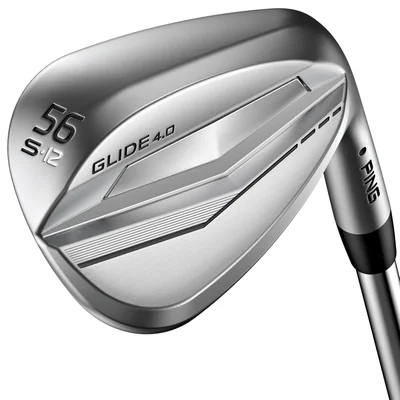
PING Glide 4.0 Wedge
PING's 2021-generation wedge, since succeeded by the s159 (2024) and S259 (2026) — but its Hydropearl 2.0 Chrome finish still repels moisture for consistent wet-weather spin, and closeout pricing makes its CNC-milled repeatability a genuine bargain.
We may earn a commission if you buy through this link — it never affects our scores or the price you pay.
The consensus
The PING Glide 4.0 is a precision-engineered wedge built around two core technologies: CNC-milled face grooves for repeatable spin and a Hydropearl 2.0 Chrome finish that repels water for consistent performance in any condition. Across 11 sources spanning data-driven testing, expert reviews, forum sentiment, and retail feedback, the Glide 4.0 earns consensus praise as one of the most consistent and reliable wedges available -- a club that delivers the same spin number swing after swing, round after round. TXG's launch monitor testing found the spin dispersion among the tightest they have measured in a wedge, while MyGolfSpy confirmed strong wet-condition spin retention.
Where sources agree most strongly: consistency and durability. The CNC-milled grooves produce tighter spin tolerances than stamped alternatives, and the 431 stainless steel construction holds its edge significantly longer than the softer carbon steel used in forged wedges from Titleist and TaylorMade. Forum users report 80-100 rounds of strong spin performance before degradation, compared to 50-60 for forged competitors. The Hydropearl 2.0 finish adds a genuine functional advantage in wet conditions -- independent testing confirms less spin drop-off in dew and light rain, a claim validated by both expert testing and community experience.
Where the consensus fractures: feel and brand perception. The cast stainless construction is firmer than forged alternatives, and players who chase soft, buttery feedback on partial shots will notice the difference immediately. This is the Glide 4.0's most honest trade-off: you gain durability and consistency but sacrifice some of the tactile richness that makes forged wedges feel special. The other persistent theme is brand positioning -- PING builds excellent wedges by the numbers, but the brand does not carry the same wedge-specialist cachet as Titleist Vokey or Cleveland. For golfers who prioritize measurable performance over feel aesthetics and brand heritage, the Glide 4.0 is a compelling choice that the data supports.
PING's 2021-generation wedge, since succeeded by the s159 (2024) and S259 (2026) — but its Hydropearl 2.0 Chrome finish still repels moisture for consistent wet-weather spin, and closeout pricing makes its CNC-milled repeatability a genuine bargain.
Category ratings
What the community loves
The Hydropearl 2.0 Chrome finish is a water-repelling surface treatment that keeps the grooves cleaner at impact, particularly in morning dew, light rain, and wet rough. MyGolfSpy's spin testing found the Glide 4.0 retained a higher percentage of its dry-condition spin when tested with wet face contact than most competitors. Multiple forum users confirmed noticeably more consistent results in early-morning rounds compared to their previous wedges.
PING precision-mills every groove on the Glide 4.0 using CNC machining rather than stamping, which produces tighter tolerances and more consistent spin from club to club. TXG's launch monitor testing showed unusually tight spin dispersion across multiple swings -- the standard deviation was among the lowest in their wedge testing cycle. Plugged In Golf noted that the spin felt 'predictable and reliable rather than spiky.'
The Glide 4.0 is available in 2-degree loft increments from 46 to 60 degrees, making precise gapping straightforward. Multiple reviewers praised how cleanly the loft-specific sole grinds and center of gravity placements produced distinct, non-overlapping distances. TXG found the gapping between lofts to be 'textbook' with consistent 8-12 yard spacing depending on loft jump.
Forum users consistently praise PING wedges for holding their grooves and finish longer than competitors. The 431 stainless steel construction is harder than the 8620 carbon steel used in many forged wedges, which means groove edges stay sharp through more rounds. GolfWRX users report Glide wedges lasting 80-100 rounds before noticeable spin degradation, compared to 50-60 for softer forged alternatives.
PING offers four grinds (Standard, Wide-Low, Thin, Eye2) across different lofts, each engineered for specific conditions and shot types. The grind selection allows golfers to match their short game tendencies and course conditions. Reviewers noted the Eye2 grind in particular as a creative option that brings the iconic Eye2 iron sole shape to a modern wedge for golfers who prefer to play with an open face.
What to watch out for
With four grinds, the Glide 4.0 offers less customization than the Vokey SM10 (six grinds) or Cleveland RTX 6 (multiple sole options per loft). Advanced players who are very specific about sole geometry and bounce combinations may find the selection limiting. Some GolfWRX users specifically noted they wanted a high-bounce, full-sole option that PING does not offer in the Glide 4.0 lineup.
The Glide 4.0 is investment-cast from 431 stainless steel, not forged. While this improves durability and groove longevity, several reviewers and forum users noted the feel is firmer and less buttery than forged wedges from Titleist (Vokey) or TaylorMade (Hi-Toe). Players who prioritize soft feedback on partial shots may find the impact sensation slightly harsh, particularly with firmer golf balls.
PING is synonymous with putters and irons but does not carry the same wedge-specialist reputation as Titleist Vokey or Cleveland. Tour usage share for PING wedges lags behind both brands significantly. Forum users acknowledge this is largely perception rather than performance, but some golfers care about the look in the bag and the brand heritage behind their scoring clubs.
At $179, the Glide 4.0 matches or slightly exceeds the Vokey SM10 ($175) and Cleveland RTX 6 ($160-170). Given PING's smaller wedge reputation and the cast-over-forged construction, some reviewers expected a slight price discount. The Glide 4.0 is not overpriced, but it does not undercut the established competition either.
Is it right for your game?
Forum consensus is that the Glide 4.0 is one of the most underrated wedges on the market -- golfers who game PING wedges tend to be fiercely loyal, citing spin consistency and durability as the reasons they stay. The main pushback comes from feel-oriented players who find the cast construction too firm compared to forged alternatives, and from wedge enthusiasts who want more grind options than PING currently offers. The brand perception gap is real but narrowing as more independent testing data validates PING's performance claims.
What real people are saying
16 quotes from across the web, grouped by 7 themes. Click a theme to read the individual quotes.
Specifications
Available shafts (no upcharge)
Premium shafts available at additional cost: Graphite Design Tour AD VF, Tour AD UB, Tour AD DI
All sources analyzed
This review synthesizes opinions from 11 independent sources. Every claim on this page can be traced back to its original source. No manufacturer relationship or compensation.
The consensus score is built in four layers: raw source collection, normalization to a 0-10 scale, credibility-weighted combination, and quality adjustments.
Expert reviews (35% weight) are scored from language intensity and any numerical ratings provided. Data-driven testing (25%) converts product rank within the test group to a percentile score. Forum posts (30%) are AI-classified by sentiment, weighted by substantiveness. Retail reviews (10%) convert 5-star ratings with a 0.75x credibility discount to correct for systematic inflation.
Three quality adjustments are then applied: a source diversity bonus (up to +0.3 for coverage across all source types), a conflict penalty (up to -0.3 when sources strongly disagree), and recency weighting (recent reviews weighted higher than older ones).