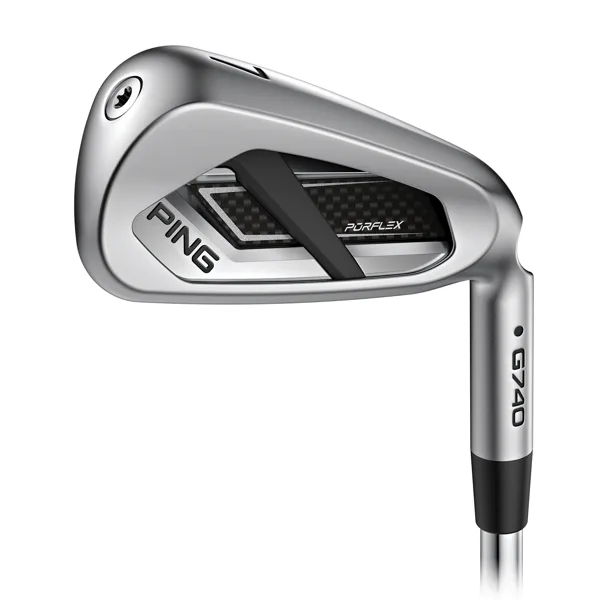
Ping G740 Irons
Ping's most forgiving iron yet — a 2026 Golf Digest Hot List Gold medalist in the super game-improvement class that makes effortless launch, class-leading ball speed, and high-MOI forgiveness its whole reason for being, in exchange for a chunky profile, low spin, and limited workability.
We may earn a commission if you buy through this link — it never affects our scores or the price you pay.
The consensus
The Ping G740, released March 10, 2026, is the most forgiving iron Ping makes and the company's flagship super game-improvement model, replacing the well-regarded G730 at the maximum-help end of a 2026 lineup that runs from the Blueprint and i-series players irons through the G440 to this. Across 14 sources spanning expert reviews, robot-style data testing, forum communities, and retail feedback, the verdict is consistent: this is one of the easiest-to-hit, longest, most forgiving irons on the market, and Golf Digest backed that up with a Gold medal on its 2026 Hot List and a top-five performance nod for high-handicap players. It is a specialist tool that does its one job exceptionally well.
Where sources agree most strongly: launch, forgiveness, distance, and turf interaction. A sole 22% wider than the G440, a 3% longer blade, a thicker topline, and a low, deep CG combine to make getting the ball airborne feel effortless and to hold ball speed on off-center hits, while the standard lie sits a degree more upright to help fight the slice. A thin, flexible 17-4 stainless face plus strong lofts make it the distance leader of its class — MyGolfSpy called it the undisputed distance winner, and one Golfalot tester was stunned by his own 6-iron numbers. The wide, dual-camber sole glides through the turf, and the new three-piece PurFlex cavity badge gives it a crisper, more pleasant impact and a more premium look than the outgoing G730.
Where the consensus has nuance: looks, feel, spin, and value. Reviewers were unanimous that the G740 is big, thick, and offset-heavy — Golfalot's line was you can't disguise what these clubs are — and a non-starter for better players who want a compact head, feedback, or workability. The distance comes from low spin and strong lofts, a trade-off that can cost stopping power into greens; MyGolfSpy's robot testing pointedly concluded that while the G740 conquered the distance hill, its accuracy and forgiveness left something to be desired, making a proper fitting more important than usual. And at roughly $202.50 per club it is nearly forged-iron money for a game-improvement set, with little reason for G730 owners to upgrade. But for the high-handicapper, slower swinger, or improving golfer it is built for — the player who wants effortless height, maximum forgiveness, and more distance with less effort — the G740 is as good as ultra-forgiving irons get, which is exactly why it sits a notch below the more universally playable G440 and i240 on this list rather than alongside the tour irons.
Ping's most forgiving iron yet — a 2026 Golf Digest Hot List Gold medalist in the super game-improvement class that makes effortless launch, class-leading ball speed, and high-MOI forgiveness its whole reason for being, in exchange for a chunky profile, low spin, and limited workability.
Category ratings
Where to buy
What the community loves
This is the G740's defining trait across every review. A wider, dual-camber sole, a thicker topline, and a low, deep center of gravity make getting the ball in the air feel nearly automatic, even for slow swing speeds and players who struggle to flight their long irons. Plugged In Golf described them as super easy to hit with effortless launch, and National Club Golfer found the design promoted a higher launch effortlessly. For the golfer this iron is built for, that ease is the whole point.
Forgiveness is the headline act. The sole is 22% wider and the blade 3% longer than the G440, with a thicker topline pushing perimeter weighting outward to raise MOI and hold ball speed on mishits. National Club Golfer found the forgiveness top-tier, with ball-speed retention strong on toe and heel misses; reviewers consistently reported that mishits lose surprisingly little ball speed and stay on line. Ping also set the standard lie 1 degree more upright to help fight the slice that plagues this iron's target player.
A thinner, more flexible 17-4 stainless face plus strong lofts make the G740 one of the fastest, longest irons in the super game-improvement category. MyGolfSpy named it the distance winner of the class, and Golfalot's tester was stunned by his own numbers off a 6-iron. Plugged In Golf estimated 10-15 yards more than traditional irons. For a golfer chasing yardage and the confidence of reaching longer par 4s, the distance is genuinely transformative.
The wide, dual-camber sole earned praise for gliding through the turf and resisting digging, which matters for the steeper, less-grooved swings common among higher handicappers. National Club Golfer highlighted excellent turf interaction for steeper swingers, and Plugged In Golf noted the wide sole minimizes divots. It is a forgiving sole that flatters a wide range of strikes and conditions.
Ping's three-piece PurFlex cavity badge dampens vibration to deliver a crisper, more pleasant impact than past game-improvement irons, and the Hydropearl 2.0 finish reads as more muted and premium than the outgoing G730. Golfalot noted the improved feel in the scoring irons and the more refined aesthetic, and National Club Golfer praised the PurFlex badge for the sound at impact. It earned a Gold medal on Golf Digest's 2026 Hot List as one of the best super game-improvement irons of the year.
What to watch out for
Reviewers were unanimous that the G740 is a big, thick-topline, long-bladed iron with plenty of offset that can look like a hybrid-iron crossover at address. Golfalot put it bluntly: you can't disguise what these clubs are. Several testers noted a visible bulge in the long irons. Better players and anyone who values a clean, compact look should steer toward the i240, i530, or i540 instead.
The distance comes from strong lofts and a hot, low-spinning face, and that trade-off has consequences. MyGolfSpy's robot testing concluded the G740 conquered the distance hill but left accuracy and forgiveness wanting, and several reviewers flagged that the low spin and gamed-up lofts can hurt stopping power into greens and punish inconsistent strikers. Getting properly fit (Power Spec, Standard, or Retro Spec lofts) matters more here than usual.
The PurFlex badge improves things, but this is still a firm, slightly hollow-feeling iron, and the wide sole masks where you struck the ball. GolfMagic noted a definite hollowness to the impact sensation that is par for the course in this category. Golfalot found the long irons less impressive in feel than the scoring clubs. Players who want shot-shaping feedback won't get much of it.
At roughly $202.50 per club in steel (about $1,400 for a seven-club set) and $217.50 in graphite, the G740 is nearly as expensive as higher-end forged players irons, which several reviewers flagged as a tough value proposition for the beginners and improvers it targets. Golf Monthly also noted only minimal performance gains for existing G730 owners, so there's little reason to upgrade a current set.
Is it right for your game?
What real people are saying
13 quotes from across the web, grouped by 6 themes. Click a theme to read the individual quotes.
Specifications
Available shafts (no upcharge)
Premium shafts available at additional cost: Graphite Design Tour AD VF, Tour AD UB, Tour AD DI
All sources analyzed
This review synthesizes opinions from 14 independent sources. Every claim on this page can be traced back to its original source. No manufacturer relationship or compensation.
The consensus score is built in four layers: raw source collection, normalization to a 0-10 scale, credibility-weighted combination, and quality adjustments.
Expert reviews (35% weight) are scored from language intensity and any numerical ratings provided. Data-driven testing (25%) converts product rank within the test group to a percentile score. Forum posts (30%) are AI-classified by sentiment, weighted by substantiveness. Retail reviews (10%) convert 5-star ratings with a 0.75x credibility discount to correct for systematic inflation.
Three quality adjustments are then applied: a source diversity bonus (up to +0.3 for coverage across all source types), a conflict penalty (up to -0.3 when sources strongly disagree), and recency weighting (recent reviews weighted higher than older ones).