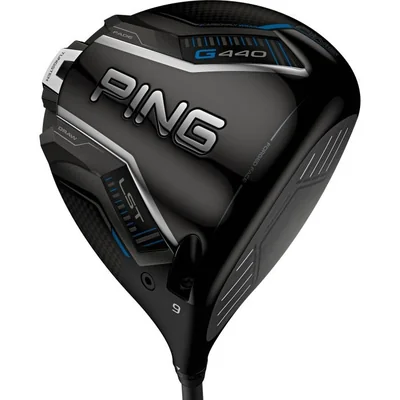
Ping G440 LST Driver
The most forgiving low-spin driver in golf. MyGolfSpy ranked it 3rd overall in their 2025 Most Wanted test -- 7th for distance, 3rd for forgiveness -- with a carry loss delta of just 6.3 yards on mishits, better than the G440 Max.
We may earn a commission if you buy through this link — it never affects our scores or the price you pay.
The consensus
The Ping G440 LST is a low-spin driver that has no business being this forgiving. Across 10 sources -- 7 expert reviewers, MyGolfSpy's robot testing, GolfWRX forum users, and Golf Galaxy retail reviews -- the consensus is clear: this is the best low-spin driver of 2025, and it might be the most well-rounded driver in the entire G440 lineup. MyGolfSpy ranked it 3rd overall in their 2025 Most Wanted Driver test, ahead of many flagship game-improvement models.
The headline data point comes from Golf Digest's robot testing: the G440 LST recorded a carry loss delta of just 6.3 yards on mishits -- better than the G440 Max, the SFT, and even the ultra-stable G430 Max 10K from the previous generation. At 95 mph, it was the single most forgiving driver tested in 2025. This is the first time a low-spin driver has taken the forgiveness crown from a Max-labeled model. Plugged In Golf's Matt Saternus summed it up simply: if you want lower spin but refuse to give up forgiveness, hit this first.
Where critics push back: Golf Monthly found no real tangible improvements over the G430 LST in measured performance. If you're already gaming a G430 LST and hitting it well, the upgrade case is slim. And at $599, you're paying full price for the latest Ping technology when the Titleist GT3 -- a comparable players driver -- is available at $449. But if you're in the market for a new driver and you swing it fast enough to benefit from lower spin, the G440 LST should be at the top of your fitting list.
The most forgiving low-spin driver in golf. MyGolfSpy ranked it 3rd overall in their 2025 Most Wanted test -- 7th for distance, 3rd for forgiveness -- with a carry loss delta of just 6.3 yards on mishits, better than the G440 Max.
Category ratings
What the community loves
The defining story of the G440 LST. MyGolfSpy's robot testing recorded a carry loss delta of just 6.3 yards on mishits -- better than the G440 Max, the SFT, and even the ultra-stable G430 Max 10K. Golf Digest's robot testing confirmed the G440 LST was the most forgiving driver at 95 mph in 2025. This is the first year a low-spin driver has taken the forgiveness crown over Max-labeled models.
Multiple sources highlight the G440 LST's extremely tight shot area and ball speed consistency. Testers saw tight standard deviations shot-to-shot on ball speed, and misses stayed remarkably straight for a low-spin head. Plugged In Golf noted it found the most fairways despite not producing the fastest ball speeds.
Ping has historically been criticized for driver acoustics, but the G440 LST changes the conversation. Multiple reviewers called it the best-sounding Ping driver ever and one of the best-sounding drivers of 2025 period. The sound is described as a muted, powerful mid-bass impact that's quieter than competitors but deeply satisfying.
The LST delivers 200-400 RPM less spin than the G440 Max, translating to a penetrating ball flight that maximizes carry and total distance for faster swingers. MyGolfSpy ranked it 7th for distance out of 37 drivers tested. Golfstead noted ball speed gains of about 1 mph over the G430 LST, which at high swing speeds can translate to 5-10 extra yards.
The 29-gram rear weight can be positioned in draw, neutral, or fade settings, giving fitters a meaningful tuning lever beyond the adjustable hosel. Today's Golfer called it one of the most adaptable LST drivers Ping has ever produced. The hosel adds plus/minus 1.5 degrees of loft adjustment across 8 positions.
Reviewers consistently noted that the G440 LST is not a players-only club. Today's Golfer stated it feels significantly easier to handle than previous Ping LST models. Golfstead argued its forgiveness makes it viable even for some higher handicappers who need spin reduction. MyGolfSpy ranked it as the second-best driver for low swing speeds in 2025.
What to watch out for
Golf Monthly found no real tangible or measurable improvements over the G430 LST in their testing, with performance described as very similar and only a slight increase in launch. If you're already gaming a G430 LST, the upgrade case is weak unless the improved sound and face retention on low strikes matter to you.
While the LST's overall forgiveness data is stellar, Plugged In Golf noted that the G440 Max will hold ball speed better on truly bad mishits. The LST's advantage shows on slight misses, but it still drops more speed than the Max on extreme off-center contact. If you don't need spin reduction, the Max remains the safer choice.
At $599 MSRP, the G440 LST sits at the standard premium driver price point. With previous-generation competitors like the Titleist GT3 available at $449, budget-conscious golfers face a significant price premium for the latest Ping technology.
The G440 LST's smaller 450cc head looks compact and players-esque at address, which inspires confidence in better players but may appear undersized to golfers accustomed to 460cc game-improvement drivers. The blue colorway on the carbon crown is also subjective -- some love it, others find it unnecessary.
Is it right for your game?
Every source agrees: the G440 LST is the most forgiving low-spin driver in golf. The only real debate is whether it's a meaningful upgrade over the G430 LST -- Golf Monthly says no, while Today's Golfer and the robot data suggest meaningful improvements in sound, face retention on low strikes, and CG positioning. If you're buying new, the answer is simple. If you're upgrading, test both.
What real people are saying
27 quotes from across the web, grouped by 9 themes. Click a theme to read the individual quotes.
Specifications
Available shafts (no upcharge)
Premium shafts available at additional cost: Graphite Design Tour AD VF, Tour AD UB, Tour AD DI
All sources analyzed
This review synthesizes opinions from 10 independent sources. Every claim on this page can be traced back to its original source. No manufacturer relationship or compensation.
The consensus score is built in four layers: raw source collection, normalization to a 0-10 scale, credibility-weighted combination, and quality adjustments.
Expert reviews (35% weight) are scored from language intensity and any numerical ratings provided. Data-driven testing (25%) converts product rank within the test group to a percentile score. Forum posts (30%) are AI-classified by sentiment, weighted by substantiveness. Retail reviews (10%) convert 5-star ratings with a 0.75x credibility discount to correct for systematic inflation.
Three quality adjustments are then applied: a source diversity bonus (up to +0.3 for coverage across all source types), a conflict penalty (up to -0.3 when sources strongly disagree), and recency weighting (recent reviews weighted higher than older ones).