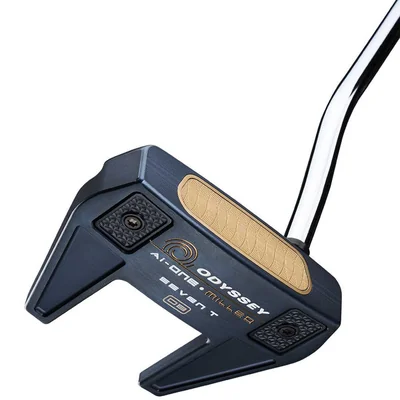
Odyssey Ai-One Milled Seven T Putter
The premium milled fang-style mallet that combines 100% CNC-machined 303 stainless steel with Odyssey's AI-designed titanium insert — stunning to look at and measurably more consistent, though the price premium over the standard Ai-One demands justification.
We may earn a commission if you buy through this link — it never affects our scores or the price you pay.
The consensus
The Odyssey Ai-One Milled Seven T is the premium tier of Odyssey's AI-insert putter line, featuring a 100% CNC-milled 303 stainless steel body with a milled titanium AI-designed insert. The Seven T uses the classic fang shape — a familiar design for golfers who have played Scotty Cameron Futuras or Ping Tynes — with a navy blue PVD finish that National Club Golfer called absolutely stunning. Odyssey claims the milled titanium insert delivers putts that finish 10% closer to the hole on average compared to traditional milled putters, with lag putting improved by up to 20%. It earned a Golf Digest Hot List selection and strong reviews across 11 sources.
Where sources agree most strongly: construction quality, feel, and AI-insert performance. Bang Average Golf described the strike sound as excellent with putts always going the right distance. GolfMagic confirmed true roll from across the entire face. The firmer, more responsive feel of the milled titanium insert specifically appeals to golfers who find standard insert putters too soft — Plugged In Golf recommended the Milled version for golfers who prefer a traditional milled putter sensation. The interchangeable sole weights (5-20g) allow precise customization of head weight and swing feel, and the Stroke Lab SL 90 counterbalanced shaft helps smooth tempo.
Where the consensus fractures: price and forgiveness trade-offs. At $349.99, the Milled Seven T costs $70 more than the standard Ai-One and enters Scotty Cameron territory. Plugged In Golf made an important distinction: the standard Ai-One with its White Hot insert is actually more forgiving on mishits than the Milled version. The titanium insert delivers better feel but sacrifices some of the mishit tolerance. For mid-to-high handicappers, this is a meaningful trade-off — the standard version may be the smarter choice. But for low handicappers and feel-first players who want a premium milled putter with AI-enhanced consistency, the Seven T represents one of the best options in its class.
The premium milled fang-style mallet that combines 100% CNC-machined 303 stainless steel with Odyssey's AI-designed titanium insert — stunning to look at and measurably more consistent, though the price premium over the standard Ai-One demands justification.
Category ratings
What the community loves
The 100% CNC-milled 303 stainless steel body is the standout physical attribute. National Club Golfer called the navy blue PVD finish absolutely stunning behind the ball. The champagne-colored insert contrasts beautifully with the dark body. Bang Average Golf noted it feels like a genuinely premium product from the moment you pick it up. This is a putter that looks and feels worth the investment.
The milled titanium Ai-One insert uses AI-generated contours to normalize ball speed across the face. Odyssey claims putts finish 10% closer to the hole on average compared to traditional milled putters, with lag putting improved by up to 20%. Today's Golfer confirmed the technology works, praising the ability to cut three-putt percentage. GolfMagic reported true roll from across the entire face.
The Seven T features the iconic fang design with what National Club Golfer called unbelievably square lines. The white alignment lines on top contrast well against the navy head, making alignment intuitive. The familiar shape will be immediately comfortable for golfers transitioning from other fang-style putters (Scotty Cameron Futura, Ping Tyne).
Unlike the standard Ai-One with its White Hot insert, the Milled version uses a titanium insert that produces a slightly firmer, more responsive feel. Bang Average Golf described the strike sound as excellent, with putts always seeming to go the right distance. Plugged In Golf noted the firmer feel is ideal for golfers who prefer a more traditional milled putter sensation.
Removable sole weights in 5g, 10g, 15g, and 20g allow golfers to dial in head weight precisely. Combined with the Stroke Lab SL 90 shaft, this gives fitters meaningful control over the overall balance and swing weight without needing a completely new putter.
What to watch out for
The Milled Seven T costs $70 more than the standard Ai-One and enters Scotty Cameron territory. Multiple reviewers questioned whether the milled construction and titanium insert justify the premium for average golfers. The standard Ai-One with its White Hot insert may actually be more forgiving, making the Milled version a luxury rather than a performance necessity.
Plugged In Golf specifically noted that while the Milled version is impressive, the standard Ai-One putters are actually more forgiving. The titanium insert provides better feel but at the expense of some of the White Hot urethane's mishit tolerance. This is a meaningful trade-off for mid-to-high handicappers choosing between the two lines.
The Seven T's dual-fang design with multiple alignment lines creates a complex visual at address. Some GolfWRX forum members found the shape too busy compared to simpler mallet designs. Golfers who prefer clean, single-line alignment may find the Seven T visually distracting.
Is it right for your game?
The Milled Seven T sits at the top of the Odyssey lineup — premium milled construction with the AI face insert. Community consensus is that this delivers feel and performance that genuinely justifies the step up from standard Ai-One models. The central question most buyers grapple with is whether the feel improvement over the standard Ai-One Eleven is worth the price premium. For feel-oriented players, the answer is usually yes.
What real people are saying
14 quotes from across the web, grouped by 6 themes. Click a theme to read the individual quotes.
Specifications
Available shafts (no upcharge)
Premium shafts available at additional cost: Graphite Design Tour AD VF, Tour AD UB, Tour AD DI
All sources analyzed
This review synthesizes opinions from 11 independent sources. Every claim on this page can be traced back to its original source. No manufacturer relationship or compensation.
The consensus score is built in four layers: raw source collection, normalization to a 0-10 scale, credibility-weighted combination, and quality adjustments.
Expert reviews (35% weight) are scored from language intensity and any numerical ratings provided. Data-driven testing (25%) converts product rank within the test group to a percentile score. Forum posts (30%) are AI-classified by sentiment, weighted by substantiveness. Retail reviews (10%) convert 5-star ratings with a 0.75x credibility discount to correct for systematic inflation.
Three quality adjustments are then applied: a source diversity bonus (up to +0.3 for coverage across all source types), a conflict penalty (up to -0.3 when sources strongly disagree), and recency weighting (recent reviews weighted higher than older ones).