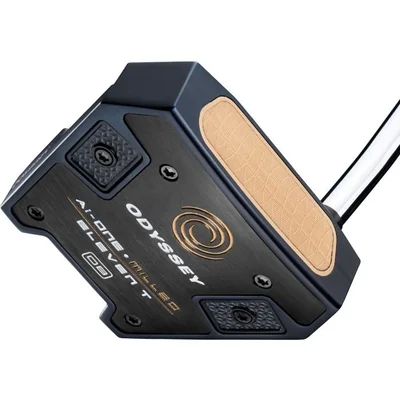
Odyssey Ai-One Eleven Putter
The high-MOI mallet that took on the Spider and won the tour count war — Odyssey's AI-designed White Hot insert delivers measurably better distance control on mishits, wrapped in a stability-focused shape that suits slight-arc strokes.
We may earn a commission if you buy through this link — it never affects our scores or the price you pay.
The consensus
The Odyssey Ai-One Eleven is a high-MOI mallet putter featuring the brand's AI-designed face insert technology. The insert combines a White Hot urethane striking surface with an AI-contoured aluminum backer that normalizes ball speed across the face, with Odyssey claiming putts finish 21% closer to the hole on off-center strikes. The Eleven head shape — originally designed to compete with TaylorMade's Spider Tour — delivers maximum stability through an oversized footprint, lightweight core, and strategic perimeter weighting. With 52 PGA Tour players using Odyssey putters in 2025, the brand remains the most popular putter choice at the highest level.
Where sources agree most strongly: the AI insert technology delivers real results. Plugged In Golf confirmed measurably tighter distance dispersion on mishits. Today's Golfer praised the White Hot insert as offering an excellent blend of short putt feel with longer putt firmness. The triple sightline alignment system draws consistent praise for setup confidence, and the Stroke Lab SL 90 shaft with counterbalance weighting helps smooth out tempo. At $279.99, the Ai-One Eleven significantly undercuts the TaylorMade Spider ZT ($399.99), Scotty Cameron ($449+), and even Odyssey's own Milled versions ($349.99+), making it one of the strongest value propositions in the premium putter market.
Where opinions diverge: the insert feel. Some GolfWRX forum members found the aluminum-backed insert slightly different from the original White Hot feel they expected, particularly compared to fully milled alternatives. The Eleven's large head shape is also polarizing — it provides stability but may look oversized to golfers who prefer compact profiles. The moderate toe hang means it suits slight-arc strokes specifically; SBST players should consider the Double Bend version, and strong-arc players should look elsewhere entirely. But for the target audience — mid-to-high handicappers with a slight arc who want tour-level technology at a reasonable price — the Ai-One Eleven is one of the best values in putters today.
The high-MOI mallet that took on the Spider and won the tour count war — Odyssey's AI-designed White Hot insert delivers measurably better distance control on mishits, wrapped in a stability-focused shape that suits slight-arc strokes.
Category ratings
What the community loves
The headline technology genuinely works. Odyssey's AI-contoured aluminum backer underneath the White Hot urethane normalizes ball speed across the face, with the company claiming putts finish 21% closer to the hole on off-center strikes. Plugged In Golf confirmed measurably tighter distance dispersion on mishits. The Hackers Paradise found the overall package cohesive and performance-validated, not just marketing.
The Ai-One insert retains the soft, responsive White Hot feel that has made Odyssey putters the most popular on tour for decades. Multiple reviewers praised the blend of soft impact with enough firmness for distance control. The feel is immediately recognizable to anyone who has used a White Hot putter, reducing the adjustment period compared to switching from another brand.
The Eleven head shape delivers maximum stability with an oversized footprint, lightweight core, and strategic perimeter weighting. The three sightlines highlight impact position and ball extremities for confident alignment. Golf Monthly praised it as one of the best putters for maximum stability in a shape that remains pleasing to look at.
Odyssey is the most-used putter brand on the PGA Tour, with 52 players carrying Odyssey putters in 2025. The Eleven shape was specifically designed to compete with the Spider Tour for tour count supremacy. Chris Kirk won The Sentry with an Ai-One putter, validating the technology at the highest level.
At $279.99, the Ai-One Eleven undercuts most premium putters including the Spider ZT ($399.99), Scotty Cameron ($449+), and even the Ai-One Milled version ($349.99). For the AI-insert technology and Stroke Lab shaft, the standard Ai-One line offers genuine performance-per-dollar value.
What to watch out for
The aluminum-backed insert produces a slightly different feel compared to the original White Hot. Some GolfWRX forum members found the feel less pure than a fully milled or traditional insert putter. Players transitioning from Scotty Cameron or other milled putters may notice the difference, though most reviewers found the feel pleasant.
The Eleven is a large, visually imposing mallet. Golfers who prefer compact, blade-like profiles may find the head size overwhelming at address. The Hackers Paradise noted that the stability benefits come at the cost of the traditional, understated aesthetic that some golfers prefer.
The Eleven features moderate toe hang, making it best suited for slight-arc strokes. Straight-back, straight-through putters should look at face-balanced or zero-torque alternatives, while strong-arc players may find it insufficiently responsive to their face rotation through impact.
Is it right for your game?
The Ai-One Eleven's high-MOI design and AI insert generate strong consensus on forgiveness performance — this is one of the most forgiving mallets at any price point. The main community debate is around the bulky visual profile versus the Spider Tour. Players who don't mind the look consistently report high satisfaction; those who find it distracting at address tend to look elsewhere.
What real people are saying
13 quotes from across the web, grouped by 6 themes. Click a theme to read the individual quotes.
Specifications
Available shafts (no upcharge)
Premium shafts available at additional cost: Graphite Design Tour AD VF, Tour AD UB, Tour AD DI
All sources analyzed
This review synthesizes opinions from 11 independent sources. Every claim on this page can be traced back to its original source. No manufacturer relationship or compensation.
The consensus score is built in four layers: raw source collection, normalization to a 0-10 scale, credibility-weighted combination, and quality adjustments.
Expert reviews (35% weight) are scored from language intensity and any numerical ratings provided. Data-driven testing (25%) converts product rank within the test group to a percentile score. Forum posts (30%) are AI-classified by sentiment, weighted by substantiveness. Retail reviews (10%) convert 5-star ratings with a 0.75x credibility discount to correct for systematic inflation.
Three quality adjustments are then applied: a source diversity bonus (up to +0.3 for coverage across all source types), a conflict penalty (up to -0.3 when sources strongly disagree), and recency weighting (recent reviews weighted higher than older ones).