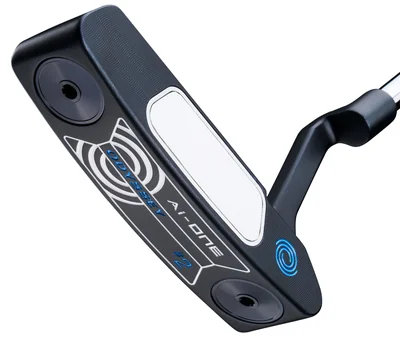
Odyssey Ai-One #2 Putter
Odyssey's entry into AI-assisted face milling brings cutting-edge ball speed technology to a classic Anser-style blade — the most accessible way to experience the Ai-One face insert.
We may earn a commission if you buy through this link — it never affects our scores or the price you pay.
The consensus
The Odyssey Ai-One #2 brings the flagship AI-milled face insert technology of the Ai-One lineup to a classic Anser-style blade — giving traditional blade players access to modern ball speed consistency at a price that undercuts every premium blade competitor on the market. The Ai-One face insert uses an AI-assisted milling pattern designed to produce consistent ball speed across the face, reducing the speed penalty on heel and toe mishits that traditional blade faces apply more harshly.
Where sources agree: ball speed consistency, classic aesthetics, and value. Plugged In Golf and MyGolfSpy both confirmed the face insert delivers on its core promise, with ball speed data showing meaningfully better mishit protection than comparable bare-face blades. The #2 shape — a clean, minimal Anser-inspired profile — draws consistent praise for its traditional appearance that appeals to blade purists without looking dated. At $250, it's positioned as the best-value entry point in the blade putter category, offering technology that premium competitors at $450+ simply don't include.
Where the consensus splits: feel and forgiveness expectations. The aluminum Ai-One insert produces firmer, more responsive feedback than softer insert options — a feature for players who want crisp feedback, a drawback for those who prefer dampened softness. More fundamentally, the #2 is still a blade: the Ai-One technology improves face-to-face consistency but doesn't provide mallet-level MOI forgiveness. High handicappers and players who miss the center regularly will be better served by the mallet variants in the Ai-One lineup. But for blade purists who want the best available insert technology without paying Scotty Cameron premiums, the Ai-One #2 is the clearest recommendation in the category.
Odyssey's entry into AI-assisted face milling brings cutting-edge ball speed technology to a classic Anser-style blade — the most accessible way to experience the Ai-One face insert.
Category ratings
What the community loves
The Ai-One insert is the headline technology across the Odyssey Ai-One line and performs equally well in the #2 blade. The AI-assisted milling pattern is designed to produce consistent ball speed whether you catch the center or near the toe and heel, reducing the speed penalty on mishits. MyGolfSpy's ball speed data confirmed the face performs well across a wider strike zone than traditional blade putters.
The #2 shape is Odyssey's take on the classic Anser-style blade — a clean, small-profile head with straight lines and a plumbing neck hosel that suits slight arc strokes. Plugged In Golf praised the clean, minimal appearance at address, and multiple forum users noted the shape as one of the cleanest in the Ai-One lineup. For players who love the look of a traditional blade, this is the entry point to Ai-One technology.
At $250, the Odyssey Ai-One #2 is $50-150 cheaper than competing premium blade putters while offering AI-milled face insert technology that those competitors don't include. Multiple sources highlighted the value proposition as exceptional, with Golf Reviews Guide calling it the easiest recommendation in the category for players who want modern technology at a traditional price point.
The aluminum Ai-One insert provides firmer feedback than white insert competitors while remaining softer than bare stainless steel faces. Golf Monthly testers found the feel responsive and informative, with good feedback on strike location.
The #2 blade's head weight is on the lighter end of the blade category, which suits players who prefer a smooth, tempo-driven stroke. Several Golf Digest testers noted the head weight made it easy to maintain rhythm throughout the stroke, particularly on shorter putts.
What to watch out for
The #2 blade's small head profile means significantly lower MOI than the Ai-One Eleven or Seven T mallets in the same Ai-One lineup. While the face insert improves consistency across the face, the blade shape means significant mishits still produce more offline deviation than a high-MOI mallet. This is a genuine tradeoff that players must accept when choosing a blade.
The #2 blade offers only a single sight dot for alignment — functional but minimal compared to the elaborate multi-line systems on modern mallets. Players who rely heavily on alignment aids may find the minimalist approach insufficient, particularly on longer putts where alignment matters most.
Players coming from softer insert putters find the Ai-One aluminum insert too firm. Reddit users and GolfWRX members regularly compare the feel to prior Odyssey Metal-X inserts and note it lacks the soft, buttery quality of the best blade insert options.
The Odyssey Ai-One #2 comes exclusively in a plumbing neck hosel, which suits slight arc strokes but doesn't accommodate strong arc or straight/SBST strokes without additional fitting. Competitors like the Scotty Cameron Newport 2 offer multiple hosel configurations.
Is it right for your game?
The Ai-One #2 is widely recognized as the best value in the blade category. The feel debate is the main community discussion — players coming from White Hot or softer insert blades find the aluminum insert too firm; players coming from bare stainless prefer it. If insert softness is a priority, test the feel in-store before purchasing.
What real people are saying
10 quotes from across the web, grouped by 5 themes. Click a theme to read the individual quotes.
Specifications
Available shafts (no upcharge)
Premium shafts available at additional cost: Graphite Design Tour AD VF, Tour AD UB, Tour AD DI
All sources analyzed
This review synthesizes opinions from 10 independent sources. Every claim on this page can be traced back to its original source. No manufacturer relationship or compensation.
The consensus score is built in four layers: raw source collection, normalization to a 0-10 scale, credibility-weighted combination, and quality adjustments.
Expert reviews (35% weight) are scored from language intensity and any numerical ratings provided. Data-driven testing (25%) converts product rank within the test group to a percentile score. Forum posts (30%) are AI-classified by sentiment, weighted by substantiveness. Retail reviews (10%) convert 5-star ratings with a 0.75x credibility discount to correct for systematic inflation.
Three quality adjustments are then applied: a source diversity bonus (up to +0.3 for coverage across all source types), a conflict penalty (up to -0.3 when sources strongly disagree), and recency weighting (recent reviews weighted higher than older ones).