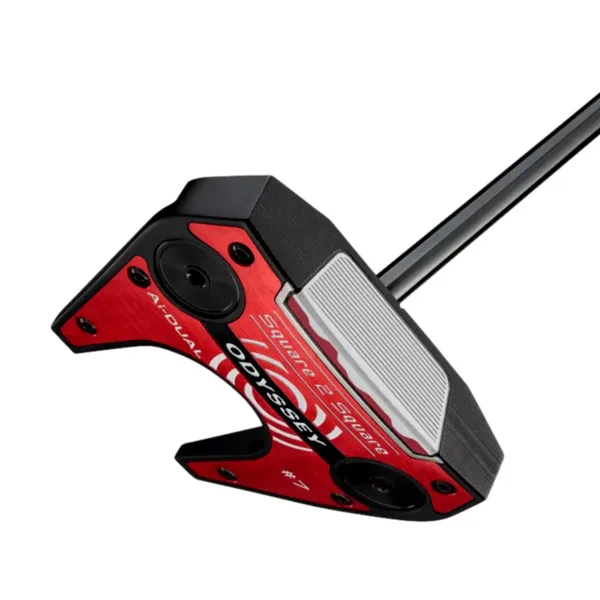
Odyssey Ai-DUAL Square 2 Square #7 Putter
Odyssey's 2026 zero-torque #7 — MyGolfSpy's top-ranked zero-torque putter of the year, pairing the iconic fang-mallet shape with a new dual-layer Ai-DUAL insert for class-leading consistency, held back only by a firmer feel and a divisive stock grip.
We may earn a commission if you buy through this link — it never affects our scores or the price you pay.
The consensus
The Odyssey Ai-DUAL Square 2 Square #7 is the 2026 successor to Odyssey's zero-torque line — a center-shafted, toe-up mallet wearing the most familiar fang shape in putting and the brand's new dual-layer Ai-DUAL urethane insert. Its strongest credential is independent data: in MyGolfSpy's testing it finished first of 26 zero-torque putters, posting the field's best handicap-adjusted result and a make rate near 49%, and the outlet named it the best zero-torque putter of 2026. Across 11 sources spanning MyGolfSpy's data, expert reviews, forum sentiment, and retail feedback, the #7 earns consensus as one of the most consistent zero-torque putters available — placing it just below the established L.A.B. Golf models in our putter rankings, ahead of the prior-generation Ai-ONE Jailbird.
Where sources agree most strongly: stability, roll, and value. The Square 2 Square design positions the shaft axis directly beneath the center of gravity with 2° of built-in forward press, so the face stays square through the stroke without manipulation — the core zero-torque benefit, and the reason the #7 tests so consistently from short to long range. The new Ai-DUAL insert (a soft outer layer over a firmer inner layer) paired with a steeper 19° Forward Roll groove draws praise for an earlier, more positive roll than the Ai-ONE it replaces. And at $399.99, it is priced in line with premium rivals like the L.A.B. DF3 (from $399 stock / $499 custom) while out-testing the field, with the broadly liked #7 shape making it the most approachable entry into zero-torque putting.
Where the consensus fractures: feel, the grip, and real-world distance control. The #7 is the firmest of the Ai-DUAL inserts — a higher-pitched impact some testers liked and others found flat, and notably firmer than the milled S2S Tri-Hot #7 it is often confused with. The stock reverse-taper grip drew the sharpest criticism of all, with The Club House calling it 'horrible' and expecting many buyers to swap it. And there is a genuine conflict in the coverage: MyGolfSpy's data rated the #7 the best zero-torque putter for long putts, yet hands-on testing found its pace control fell off beyond about nine feet — suggesting distance control is more fit- and stroke-dependent than the lab numbers imply. The bright near-white insert face and length-only customization round out the caveats. For mid-to-high handicappers with straight or slight-arc strokes who want proven zero-torque consistency in a classic shape — and who don't mind changing the grip — the Ai-DUAL S2S #7 is among the best in its class.
Odyssey's 2026 zero-torque #7 — MyGolfSpy's top-ranked zero-torque putter of the year, pairing the iconic fang-mallet shape with a new dual-layer Ai-DUAL insert for class-leading consistency, held back only by a firmer feel and a divisive stock grip.
Category ratings
What the community loves
In MyGolfSpy's robot-and-human zero-torque testing, the Ai-DUAL S2S #7 finished first of 26 zero-torque putters, posting the field's best PuttView Handicap (a reported -8.1) and a make rate near 49%. It is the rare putter that backs its marketing with independent data, and MyGolfSpy named it the best zero-torque putter for 2026 outright. The performance held up across short, medium, and long putts — a level of measured consistency no other zero-torque model matched in that test.
The modern center-shafted build places the shaft axis directly beneath the head's center of gravity, so the putter rests toe-up (a '90° up' configuration) and resists opening or closing through the stroke. A 2° built-in forward press (paired with a reverse-taper grip to neutralize the hands) preset the shaft lean. The net effect, reviewers agree, is a putter that genuinely wants to return square — the defining benefit of the zero-torque category and the biggest reason the #7 putts so consistently.
The headline upgrade over the previous Ai-ONE platform is the dual-layer urethane Ai-DUAL insert — a soft outer layer over a firmer inner layer — designed to normalize ball speed across the face while a deeper Forward Roll Design groove sloped 19° off vertical gets the ball rolling end-over-end sooner. Odyssey says it ran more than 15,000 AI iterations and 72 physical prototypes to land on it. Reviewers describe a noticeably more positive, topspin-forward roll than the Ai-ONE insert it replaces.
Where the Jailbird-style zero-torque models polarize golfers with bold striping, the #7 wins on familiarity — it is one of the most recognizable mallet shapes in golf, and its fang wings frame the ball for centered contact. The Club House noted it was easy to align using the leading edge and top line without distraction. For golfers curious about zero-torque but unwilling to game an unconventional-looking head, the #7 is the most approachable entry point in the lineup.
At $399.99 (with $349.99 intro pricing at launch), the Ai-DUAL S2S #7 is priced in line with premium zero-torque rivals like the L.A.B. Golf DF3 (from $399 stock / $499 custom) while delivering the category's top tested results — plus a well-padded magnetic-closure headcover and Odyssey's usual fit and finish. It is not the bargain the prior-generation Ai-ONE Jailbird was at around $350, but reviewers consistently framed it as solid value for a tour-pedigree zero-torque putter that out-tested the field.
What to watch out for
The single most-repeated criticism. The stock Odyssey S2S Reverse Taper grip is engineered to neutralize the hands for the zero-torque setup, but The Club House called it 'horrible' and 'like a severe reverse taper' that killed feel in the swing. Several reviewers expect buyers to immediately swap it — an added cost (roughly £30 / $35) that partly erases the value advantage and undercuts the out-of-the-box experience.
Feel is the Ai-DUAL line's weak point. The #7 head is the firmest of the Ai-DUAL insert putters, producing a higher-pitched sound that some testers found gave better feedback and others described as flat or dead. Crucially, this is the insert #7, not the milled S2S Tri-Hot #7 that reviewers praised for soft feel — buyers cross-shopping the two should not assume they feel alike. Players accustomed to a soft milled or White Hot impact may find this insert too firm.
A genuine conflict in the coverage: MyGolfSpy's data crowned the #7 the best zero-torque putter for long putts, yet The Club House found pace control deteriorated meaningfully beyond about nine feet and would not unseat its gamer on lag putts. The takeaway is that distance control on this putter appears stroke- and fit-dependent — strong in controlled testing, but not universally so on the course.
The bright urethane insert reads as a near-white face at address that several reviewers flagged as distracting — if you dislike the look of a white putter face, this is not your putter. Customization is also limited largely to length (33–35"), with none of the head colors, alignment-aid choices, or shaft menus that rivals like L.A.B. offer, and it is right-handed only. The #7 also does not carry the new ½-ball alignment graphic found on some siblings.
Is it right for your game?
What real people are saying
12 quotes from across the web, grouped by 6 themes. Click a theme to read the individual quotes.
Specifications
Available shafts (no upcharge)
Premium shafts available at additional cost: Graphite Design Tour AD VF, Tour AD UB, Tour AD DI
All sources analyzed
This review synthesizes opinions from 11 independent sources. Every claim on this page can be traced back to its original source. No manufacturer relationship or compensation.
The consensus score is built in four layers: raw source collection, normalization to a 0-10 scale, credibility-weighted combination, and quality adjustments.
Expert reviews (35% weight) are scored from language intensity and any numerical ratings provided. Data-driven testing (25%) converts product rank within the test group to a percentile score. Forum posts (30%) are AI-classified by sentiment, weighted by substantiveness. Retail reviews (10%) convert 5-star ratings with a 0.75x credibility discount to correct for systematic inflation.
Three quality adjustments are then applied: a source diversity bonus (up to +0.3 for coverage across all source types), a conflict penalty (up to -0.3 when sources strongly disagree), and recency weighting (recent reviews weighted higher than older ones).