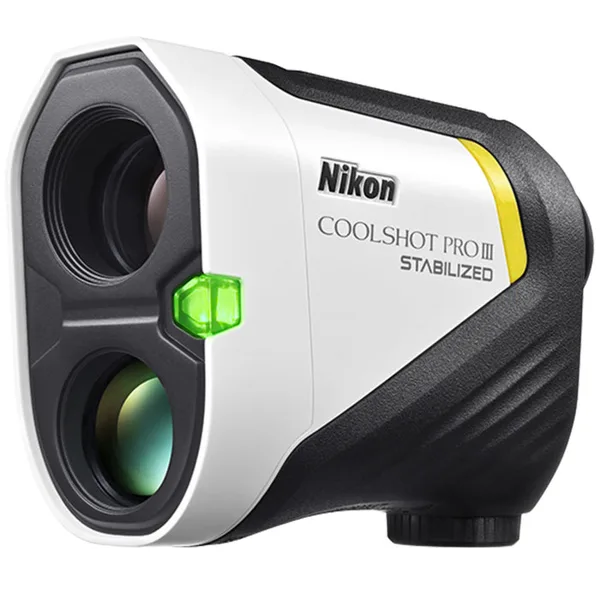
Nikon Coolshot Pro III Stabilized Laser Rangefinder
The successor to Nikon's acclaimed Pro II Stabilized and, by broad agreement, the best 'pure' laser rangefinder you can buy — a tool that wins on optics, speed and the one feature no rival matches: gyro image stabilization that holds the reticle dead-still on the flag. A 0.1-second HYPER READ (Nikon's fastest ever, ~3x the Pro II), the clearest glass in the category, and a DUAL LOCKED ON QUAKE green-ring-plus-vibration lock make it a joy to use, and MyGolfSpy named it a 'Best Barebones' pick in its 2026 test (tied fourth overall). The trade-off is right there in the award name: at $529.95 it deliberately skips the magnet, Bluetooth, app and wind data that the do-everything flagships pile on — so it earns a strong consensus from 11 sources, with the recurring caveat that the jump over the Pro II is mostly polish, not new capability.
We may earn a commission if you buy through this link — it never affects our scores or the price you pay.
The consensus
The Nikon Coolshot Pro III Stabilized is the successor to the much-loved Pro II Stabilized, and across the review landscape it carries a clear reputation: the best 'pure' laser rangefinder you can buy. Announced in January 2025 at a $529.95 MSRP, it doubles down on the three things Nikon does better than anyone — optics, speed and gyro image stabilization — rather than chasing the feature stack of the do-everything flagships. The defining trick is the stabilization: press the button and an optical lens-shift system steadies the view so the reticle sits dead-still on the flag, a capability no Bushnell, Garmin or budget rival can match. Synthesized from 11 sources spanning independent testing, expert review, forum consensus and retail feedback, it earns a strong consensus score — with MyGolfSpy naming it a 'Best Barebones' pick in its 2026 test, where it finished tied for fourth overall.
Where the sources agree most strongly: stabilization, speed, optics and confidence. The new HYPER READ returns a number in 0.1 seconds — the fastest in the COOLSHOT series and roughly three times quicker than the Pro II — which Golfers Authority's Paul Liberatore says 'fundamentally changes how you use a rangefinder.' Reviewers near-unanimously rate the 6x multilayer-coated glass as the clearest, sharpest view in golf, and the upgraded DUAL LOCKED ON QUAKE pairs a green visual ring with a vibration pulse so you know you've locked the flag and not the trees behind it. Add accuracy that tracks name-brand rivals to within a yard, genuine waterproofing, tournament-legal switchable slope with an external Actual Distance Indicator light, and a 5-year warranty that doubles most competitors, and Plugged In Golf's Matt Meeker summed up the verdict by putting it 'straight into my bag.'
Where the consensus is honest about limits: the 'barebones' positioning and the price. The Pro III deliberately omits the magnetic cart mount, Bluetooth, app and wind data that the $599 flagships are built around — that's precisely why MyGolfSpy filed it under 'Best Barebones,' and it's a poor fit for the cart rider who wants a 'plays-like' number that folds in wind. The other recurring caveat is that it refines the Pro II more than it reinvents it: faster reads, a better display and the QUAKE cue, but the same core stabilization and feature set for about $130 more, which Under Par Reviews warns 'may not justify the price increase for all golfers' — and a below-par case plus a slightly fiddly menu round out the small knocks. But for the golfer who wants the steadiest, clearest, fastest pure laser in the game — and who'll actually lean on the stabilization and the optics — the Pro III is exactly what its reviews say it is: the best at the one thing a rangefinder is supposed to do.
The successor to Nikon's acclaimed Pro II Stabilized and, by broad agreement, the best 'pure' laser rangefinder you can buy — a tool that wins on optics, speed and the one feature no rival matches: gyro image stabilization that holds the reticle dead-still on the flag. A 0.1-second HYPER READ (Nikon's fastest ever, ~3x the Pro II), the clearest glass in the category, and a DUAL LOCKED ON QUAKE green-ring-plus-vibration lock make it a joy to use, and MyGolfSpy named it a 'Best Barebones' pick in its 2026 test (tied fourth overall). The trade-off is right there in the award name: at $529.95 it deliberately skips the magnet, Bluetooth, app and wind data that the do-everything flagships pile on — so it earns a strong consensus from 11 sources, with the recurring caveat that the jump over the Pro II is mostly polish, not new capability.
Category ratings
What the community loves
Stabilization is the Pro III's reason to exist, and it remains the single biggest differentiator in the laser-rangefinder market. Press the button and an optical lens-shift system steadies the view, so the reticle sits dead-still on the flag instead of dancing with your pulse or the wind. Every reviewer who picks one up leads with it: Plugged In Golf's Matt Meeker says 'the image appears stable regardless of unit movement from shaky hands or blustery winds,' and Under Par Reviews calls it 'the primary reason to choose Nikon over any competitor.' For anyone with a tremor, cold hands, competition nerves, or a long carry to a distant flag, it turns a fiddly lock into a one-press certainty.
The headline upgrade over the Pro II is raw speed: Nikon's HYPER READ returns a number in 0.1 seconds, the fastest in the COOLSHOT series and roughly three times quicker than the Pro II's already-snappy 0.3. In hand it feels instant — point, press, done, with no hunting. Golfers Authority's Paul Liberatore put it bluntly: 'that 0.1-second HYPER READ isn't just marketing fluff; it fundamentally changes how you use a rangefinder,' and Plugged In Golf rated it 'as fast as any rangefinder I've tested.' For a tool whose whole job is a quick yardage, this is best-in-class.
Nikon's optical heritage shows. Reviewers repeatedly single out the 6x view through the multilayer-coated 21mm glass as the brightest and sharpest of any rangefinder they've tested, paired with a high-contrast OLED red display that stays legible against trees, sky and overcast alike. Under Par Reviews praises the 'exceptional optical clarity and sharpest viewing experience,' and side-by-side owners say competitors 'look smudged by comparison.' The stabilization compounds it — a steady, crystal-clear image makes acquiring a low-contrast or distant flag genuinely easy.
Nikon upgraded its target-confirmation system from the Pro II's LOCKED ON ECHO to DUAL LOCKED ON QUAKE: when First Target Priority confirms you've ranged the flag and not the trees behind it, you get both a green visual ring and a tactile vibration pulse. Reviewers love the double cue — Golfers Authority calls the speed-plus-stabilization-plus-QUAKE combination 'a rangefinder experience that's genuinely different,' and it removes the second-guessing that plagues cheaper units around a pin set against a tree line.
The Pro III feels like a precision instrument: a compact, light (7.2 oz) rubber-armored body, genuine waterproofing (submersible to 1m for 10 minutes) and fogproof construction, and tournament-legal slope via Nikon's ID (Incline/Decline) Technology with an external Actual Distance Indicator LED so officials can see slope is off. Two practical wins reviewers keep flagging: accuracy that tracks name-brand rivals to within a yard in side-by-side play, and Nikon's 5-year warranty — double the 2-year coverage of most competitors, which reframes the price as a buy-once purchase.
What to watch out for
The Pro III is a pure laser and nothing more, which is exactly why MyGolfSpy filed it under 'Best Barebones.' There is no magnetic cart mount (Nikon omits it by design to avoid interfering with the gyro), no Bluetooth, no companion app, and no wind data — the very features the $599 do-everything flagships are built around. For the cart rider who wants the unit snapped to the rail and a 'plays-like' number that folds in wind and temperature, this isn't that tool, and reviewers are upfront that the spec sheet is thinner than the price suggests.
The most-cited value knock: the Pro II Stabilized was already excellent, and the Pro III refines rather than reinvents it. You get faster reads, a better display and the QUAKE vibration cue, but the same core stabilization, optics class and feature set — for about $130 more. Under Par Reviews' verdict captures it: the improvements 'may not justify the $130 price increase for all golfers.' If you already own a Pro II, the upgrade case is genuinely weak.
At $529.95 the Pro III sits firmly in flagship territory, and reviewers note you can get the same within-a-yard accuracy and a confident pin-lock from far cheaper rivals — Nikon's own Coolshot 20-series, the Bushnell Tour V6 family, or budget brands — if you don't specifically need the stabilization and optics. It's a 'serious golfer' purchase: Golfers Authority flatly says it's 'not for the person who plays five times a year.' The view and the steady image are worth paying for, but only if you'll actually use them.
The small stuff. Multiple reviewers call out the supplied carrying case as cheap and below-par for a $500-plus device, and Plugged In Golf found the menu navigation 'slightly unintuitive,' enough to need the manual to change modes the first time. Battery life is also merely good (about 2,700 measurements on a CR2) rather than class-leading. None of it undermines the core experience, but at this price the accessories and onboarding could be sharper.
Is it right for your game?
What real people are saying
10 quotes from across the web, grouped by 5 themes. Click a theme to read the individual quotes.
Specifications
All sources analyzed
This review synthesizes opinions from 11 independent sources. Every claim on this page can be traced back to its original source. No manufacturer relationship or compensation.
The consensus score is built in four layers: raw source collection, normalization to a 0-10 scale, credibility-weighted combination, and quality adjustments.
Expert reviews (35% weight) are scored from language intensity and any numerical ratings provided. Data-driven testing (25%) converts product rank within the test group to a percentile score. Forum posts (30%) are AI-classified by sentiment, weighted by substantiveness. Retail reviews (10%) convert 5-star ratings with a 0.75x credibility discount to correct for systematic inflation.
Three quality adjustments are then applied: a source diversity bonus (up to +0.3 for coverage across all source types), a conflict penalty (up to -0.3 when sources strongly disagree), and recency weighting (recent reviews weighted higher than older ones).