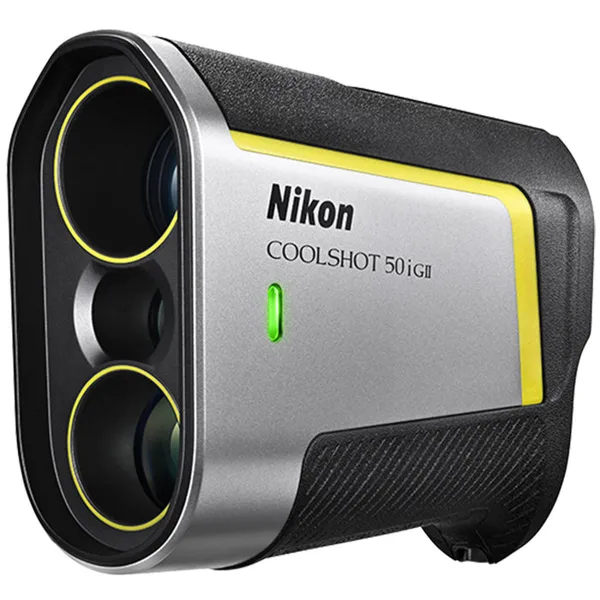
Nikon Coolshot 50i GII Laser Rangefinder
The value standout of the premium tier. Nikon's 2025 successor to the Coolshot 50i pairs the brightest, clearest optics in its price class with the genuinely useful stuff — accurate-to-a-yard ranging, ID slope, DUAL LOCKED ON QUAKE pin confirmation, a strengthened cart magnet, and a 5-year warranty that doubles the category norm — for $249.95, well under the flagships. It earns a strong consensus from ~11 sources as the rangefinder most golfers can actually justify buying, with the honest caveats that its pin-lock isn't as instantly decisive as a Bushnell's, it skips the image stabilization of Nikon's pricier Pro line, and its feature set sticks to the basics.
We may earn a commission if you buy through this link — it never affects our scores or the price you pay.
The consensus
The Nikon Coolshot 50i GII is the value benchmark of the premium rangefinder tier. Announced in January 2025 as a ground-up redesign of the original Coolshot 50i, it keeps the formula simple and does it well: Nikon's bright, high-contrast 6x optics, accurate-to-a-yard ranging, ID (Incline/Decline) slope, a DUAL LOCKED ON QUAKE pin-lock that confirms the flag with both a red indicator and a vibration pulse, a strengthened built-in cart magnet, and a new red internal OLED display. Across roughly 11 sources spanning expert review, head-to-head testing, forum sentiment, and retail feedback, it earns a strong consensus as the rangefinder most golfers can actually justify buying — built around a single, repeated theme: premium feel and performance without premium pricing, at $249.95.
Where sources agree most strongly: optics, accuracy, the magnet, and value. Nikon's glass is the unanimous standout — Birdie Report calls the view 'bright, crisp, and easy to read,' and Golf Monthly's Joel Tadman found it 'very easy to see the pin in different light conditions,' the kind of clarity rivals at this price can't match. Plugged In Golf's Matt Meeker reported the readings were 'never more than a yard difference when compared to other name brand, well regarded laser rangefinders,' and praised a magnet 'strong enough that I don't worry about the unit falling off the cart.' MyGolfSpy features it as a 2026 value pick, and the 5-year warranty — double the category's typical two years — repeatedly comes up as a tiebreaker against pricier rivals.
Where the consensus is honest about limits: speed, stabilization, and feature breadth. The pin-lock is reliable but not the most decisive in the category — Birdie Report notes a Bushnell still 'feels more automatic when the background is messy,' and the 50i GII trails Nikon's own Hyper Read Pro models on raw speed. It also forgoes image stabilization (the lightweight body can waver on long locks in wind) and the comprehensive 'plays-like' brains of the flagships: there's slope, but no wind, temperature, barometric compensation, or app connectivity. Plugged In Golf adds that the slope toggle is simple enough to bump on accidentally in a tournament. But for the golfer who wants excellent optics, trustworthy yardages, and the on-course essentials — and who'd rather not pay flagship money for features they may rarely use — the 50i GII is exactly what its reception says it is: the smart-money pick.
The value standout of the premium tier. Nikon's 2025 successor to the Coolshot 50i pairs the brightest, clearest optics in its price class with the genuinely useful stuff — accurate-to-a-yard ranging, ID slope, DUAL LOCKED ON QUAKE pin confirmation, a strengthened cart magnet, and a 5-year warranty that doubles the category norm — for $249.95, well under the flagships. It earns a strong consensus from ~11 sources as the rangefinder most golfers can actually justify buying, with the honest caveats that its pin-lock isn't as instantly decisive as a Bushnell's, it skips the image stabilization of Nikon's pricier Pro line, and its feature set sticks to the basics.
Category ratings
What the community loves
Optics are the 50i GII's calling card, and the one thing every reviewer agrees Nikon does better than anyone at this price. The 6x view through 22mm multi-coated glass is bright, crisp, and high-contrast, and the red internal OLED reticle stays legible in flat light, glare, and overcast alike — Birdie Report calls the view 'bright, crisp, and easy to read,' and Golf Monthly's Joel Tadman found it 'very easy to see the pin in different light conditions.' For a tool whose whole job is acquiring a small flag against a busy background, the glass is a genuine, repeatable advantage.
Where it counts, the number is trustworthy. Plugged In Golf's Matt Meeker reported the readings were 'never more than a yard difference when compared to other name brand, well regarded laser rangefinders,' and Nikon rates the unit to ±1 yard inside 100 yards. First Target Priority biases the reading to the closest object so you lock the flag, not the trees behind it. You don't sacrifice the core accuracy by stepping down from a flagship — you sacrifice some speed and polish.
The GII's redesign made the built-in magnet noticeably stronger than the original 50i's, and reviewers single it out as a standout practical feature. Meeker noted 'the magnet [is] strong enough that I don't worry about the unit falling off the cart,' and Tadman called the original's mount 'incredibly strong.' At 7.2 oz (without battery) the body is lighter than most premium lasers, which makes it an easy grab-and-go for walkers as well as the cart crowd it's clearly built around — B&H flatly calls it 'likely the go-to option' for the dedicated cart golfer.
The feature set is focused, not bare. ID (Incline/Decline) Technology gives a 'plays-like' distance for uphill and downhill shots and toggles off — with an external indicator so playing partners can see tournament mode is engaged. DUAL LOCKED ON QUAKE confirms the flag with both a red LOCKED ON indicator and a short vibration pulse, so you get tactile certainty you've grabbed the pin. Reviewers describe the slope as straightforward and reliable; as Tadman put it, the unit 'does the basics quickly and accurately.'
This is the dimension that defines the 50i GII. At $249.95 it undercuts the Bushnell and Garmin flagships by $150-$350 while delivering Nikon optics, name-brand accuracy, slope, and a strong magnet — and it backs all of it with a 5-year warranty, double the 2-year coverage most rangefinders carry. MyGolfSpy features it as a 2026 value pick, and Birdie Report sums up the consensus: the Bushnell may be a touch more polished, but the Nikon is 'the one more golfers can justify buying.'
What to watch out for
The most consistent knock is speed-and-certainty. The lock is reliable but, against a messy background or when you're trying to grab a number fast, it doesn't feel as automatic as a Bushnell Tour V6 — Birdie Report notes the Bushnell 'feel[s] more automatic when the background is messy,' and Plugged In Golf found the 50i 'quick, but not nearly as fast as' Nikon's own Hyper Read-equipped Pro models. For most golfers the gap is small; for someone obsessive about instant, first-try locks, it's noticeable.
Stepping down from Nikon's Coolshot Pro line means giving up image stabilization, the feature that steadies the view for shaky hands and long-range locks. Reviewers flag its absence directly, and Golf Monthly notes the lightweight design can compromise hold steadiness in the wind — the same low weight that makes it easy to carry makes it a little harder to keep a distant flag pinned in the reticle. It's a real trade for the lower price, not a free lunch.
The 50i GII does distance and slope well, and that's the extent of it. There's no wind speed/direction, no temperature or barometric 'plays-like' compensation, and no app connectivity — the comprehensive 'plays-like' engines on flagship units are simply not here. That focus is part of why it's affordable and easy to use, but the golfer who wants every variable folded into the number won't find it, and reviewers are clear this is a do-the-essentials device rather than a do-everything one.
Plugged In Golf cautions that the slope on/off toggle is almost too simple — an accidental bump could leave slope on in a tournament round — and that the settings menu isn't especially intuitive without the manual. It's also IPX4 rainproof rather than fully waterproof, so it shrugs off a shower but isn't built to be submerged. And while the value is excellent, $249.95 is still real money for a device that does one thing; the budget shopper who only wants a raw number can spend far less.
Is it right for your game?
What real people are saying
10 quotes from across the web, grouped by 5 themes. Click a theme to read the individual quotes.
Specifications
All sources analyzed
This review synthesizes opinions from 11 independent sources. Every claim on this page can be traced back to its original source. No manufacturer relationship or compensation.
The consensus score is built in four layers: raw source collection, normalization to a 0-10 scale, credibility-weighted combination, and quality adjustments.
Expert reviews (35% weight) are scored from language intensity and any numerical ratings provided. Data-driven testing (25%) converts product rank within the test group to a percentile score. Forum posts (30%) are AI-classified by sentiment, weighted by substantiveness. Retail reviews (10%) convert 5-star ratings with a 0.75x credibility discount to correct for systematic inflation.
Three quality adjustments are then applied: a source diversity bonus (up to +0.3 for coverage across all source types), a conflict penalty (up to -0.3 when sources strongly disagree), and recency weighting (recent reviews weighted higher than older ones).