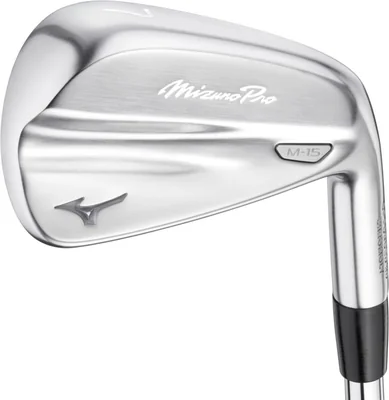
Mizuno Pro M-15 Irons
The successor to the Mizuno Pro 245 and Mizuno’s most advanced players-distance iron yet — a Grain Flow Forged hollow-body with a Contoured Ellipse face, 51g suspended tungsten in the long irons, and peak Mizuno feel across a set designed to perform from tee to green.
We may earn a commission if you buy through this link — it never affects our scores or the price you pay.
The consensus
Across 12 independent sources — eight expert reviewers, one data-driven analysis, one forum community, and retail feedback — the Mizuno Pro M-15 emerges as the most complete players-distance iron Mizuno has ever built and one of the top iron releases of 2026. It earned a Gold medal on Golf Digest’s 2026 Hot List, a top-six recommendation from GOLFTEC, and consistent 9-plus ratings from Golf Monthly, National Club Golfer, and Today’s Golfer. The consensus: the M-15 is the successor to the beloved Pro 245 and then some — more ball speed, more launch, more forgiveness, and somehow with feel that rivals a solid forging.
Where sources agree most strongly: the combination of feel and performance is unprecedented in the players-distance category. The Contoured Ellipse face and 51g suspended tungsten deliver measurable gains over the Pro 245 — Golfalot measured 10 yards of extra carry with a mid-iron — while Mizuno’s Grain Flow Forging process and embedded elastomer preserve the buttery, crisp sensation that separates Mizuno irons from every other manufacturer. National Club Golfer called it “the best hollow-body iron Mizuno has ever produced.” Golf Monthly called it “as close to perfect as you’ll find.” GolfWRX forum members transitioning from blade sets reported that the M-15 delivered no perceivable feel downgrade. The progressive three-zone construction — hot Chromoly long irons, stable tungsten mid irons, precise 1025E short irons — ensures each club in the set is purpose-built rather than a compromise.
The one genuine debate: whether the M-15 is the right Mizuno over its sibling, the M-13. GolfMagic rated the M-13 the better all-round package, arguing the M-15 doesn’t differentiate enough to justify giving up feel clarity and scoring-iron spin. That is a legitimate point for single-figure players who prize stopping power and workability. But for the majority of golfers in the 5-to-15 handicap range — who want elite looks, peak Mizuno feel, and the most accessible long irons Mizuno has ever made — the M-15 is the answer. Get fitted to confirm the shaft complements the progressive construction, and be prepared to re-gap your wedges to account for the strong lofts.
The successor to the Mizuno Pro 245 and Mizuno’s most advanced players-distance iron yet — a Grain Flow Forged hollow-body with a Contoured Ellipse face, 51g suspended tungsten in the long irons, and peak Mizuno feel across a set designed to perform from tee to green.
Category ratings
What the community loves
The defining achievement of the M-15 is delivering unmistakably Mizuno feel from an iron packed with modern technology. Golf Monthly called it “as close to perfect as you’ll find” and praised the buttery, crisp sensation on pure strikes. Mizuno’s Grain Flow Forging process and the embedded elastomer for vibration damping ensure the hollow body registers like a soft forging rather than a hollow cavity at impact. GolfWRX forum members who have transitioned from blade sets reported no sacrifice in feedback.
The Contoured Ellipse face in the 4-through-8 irons uses variable thickness to maintain fast ball speeds across a wide hitting area. Golfalot measured 178 yards carry / 188 yards total with a mid-iron — roughly 10 yards more than the M-13 in direct head-to-head testing. Today’s Golfer testers were “genuinely taken aback” by how effortlessly the M-15 launched the ball. The 51g suspended tungsten in the long irons and 50.3g in the mid irons drives a high-launching, stable flight that previous Mizuno hollow bodies couldn’t match.
Across every review, the aesthetics earned near-universal praise. Golfalot called the M-15 “an early contender for the best-looking irons of the year.” GolfMagic described the topline and profile as stunning for an iron with this much technology inside. GolfWRX users repeatedly compared the look favorably to the Pro 245 — arguably the previous benchmark for players-distance aesthetics — and felt the M-15 progressed the look without adding visual bulk. The progressive shaping from long iron to wedge gives the set a seamless, coherent appearance throughout the bag.
The hollow body construction, Contoured Ellipse face, and strategically suspended tungsten combine to produce off-center robustness that surprised every tester. Today’s Golfer reported forgiveness “far better than expected” given the compact, blade-like profile. National Club Golfer noted that the M-15 maintained green-stopping spin even on mishits — a feat rare in this category. GolfWRX forum members switching from game-improvement irons reported similar or better results on mishits with significantly better feel.
The M-15 uses three distinct technologies across the set: a hollow Chromoly face with stainless steel back and 51g tungsten in the 4-through-6 irons; a hollow body with 50.3g tungsten in the 7 and 8 irons; and a partial hollow 1025E Grain Flow Forged body in the 9-iron and wedges. Each segment is purpose-built — the long irons maximize launch and ball speed while the scoring irons prioritize control and stopping power. National Club Golfer called this “the most complete Mizuno distance iron yet.”
What to watch out for
GolfMagic’s review is the critical outlier in an otherwise universally positive set. The headline verdict: “Great irons outshone by their sibling.” Their concern is that the M-15 doesn’t differentiate enough from the M-13. The M-15 is slightly longer and slightly more forgiving, but it gives up feel clarity and control — especially in scoring irons — to get there. For better players who would consider either model, GolfMagic recommends the M-13. The M-15 is the right choice for golfers who prioritize distance and launch over workability.
The 7-iron plays at 29 degrees — a loft that was a 5-iron not long ago. Golfalot measured spin rates around 4,933 rpm with a mid-iron and noted they’d want to see higher numbers for approach shot control. GolfMagic observed that the short irons produced less spin than the M-13, which matters for better players hitting into firm greens from close range. The strong lofts inflate yardage numbers but require careful gapping and wedge matching.
At $215 per iron, a 7-piece set (4-PW) runs approximately $1,505. Golfalot noted that £240 per iron in the UK puts these firmly in the luxury bracket, pricing out the majority of amateur golfers. This is a legitimate value concern — the M-15 is competing against the TaylorMade P790 and Titleist T250 at similar price points, and there are strong alternatives in Mizuno’s own JPX line at meaningfully lower cost.
The three-zone construction means the set doesn’t play like one uniform iron from club to club. The transition in feel and flight between the hollow long irons and the 1025E short irons is noticeable if you hit them back to back. Multiple reviewers emphasized getting properly fitted to ensure the shaft selection complements the intended performance of each zone. Off-the-rack purchases without fitting risk leaving distance or trajectory gains on the table.
Is it right for your game?
The central debate is M-15 versus M-13 — not whether the M-15 is good (it clearly is), but whether the extra distance and launch help is worth the slight trade-off in feel sharpness and short-iron spin. For mid-handicappers and golfers who want the most accessible long irons Mizuno has ever made, the M-15 is the clear choice. For low handicappers who prize workability and stopping power above all, try the M-13 back to back before deciding.
What real people are saying
24 quotes from across the web, grouped by 8 themes. Click a theme to read the individual quotes.
Specifications
Available shafts (no upcharge)
Premium shafts available at additional cost: Graphite Design Tour AD VF, Tour AD UB, Tour AD DI
All sources analyzed
This review synthesizes opinions from 12 independent sources. Every claim on this page can be traced back to its original source. No manufacturer relationship or compensation.
The consensus score is built in four layers: raw source collection, normalization to a 0-10 scale, credibility-weighted combination, and quality adjustments.
Expert reviews (35% weight) are scored from language intensity and any numerical ratings provided. Data-driven testing (25%) converts product rank within the test group to a percentile score. Forum posts (30%) are AI-classified by sentiment, weighted by substantiveness. Retail reviews (10%) convert 5-star ratings with a 0.75x credibility discount to correct for systematic inflation.
Three quality adjustments are then applied: a source diversity bonus (up to +0.3 for coverage across all source types), a conflict penalty (up to -0.3 when sources strongly disagree), and recency weighting (recent reviews weighted higher than older ones).