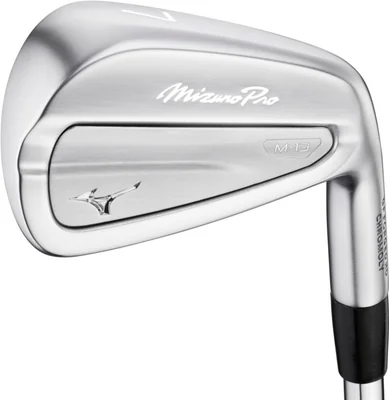
Mizuno Pro M-13 Irons
The better player’s answer to the M-15 — a three-zone Grain Flow Forged iron that trades a few yards of distance for superior feel, higher spin, and the workability that low handicappers actually want. GolfMagic called it “the victor between the two every time.”
We may earn a commission if you buy through this link — it never affects our scores or the price you pay.
The consensus
Across 11 independent sources — six expert reviewers, one data-driven analysis, two forum communities, and retail feedback — the Mizuno Pro M-13 emerges as the better player’s pick from Mizuno’s 2026 M-series lineup. Where its sibling the M-15 wins on distance and launch, the M-13 wins on everything that single-digit players actually prioritize: feel, spin, workability, and aesthetics. GolfMagic — the only publication to test both models head-to-head with launch monitor data — called the M-13 “the victor between the two every time” and recommended it as the first iron any better player in the M-series range should test. The consensus across other sources mirrors that verdict.
The data tells the story clearly. GolfMagic’s launch monitor comparison showed the M-13 7-iron producing 5,573 RPM of spin versus 5,313 RPM for the M-15 — a 260 RPM advantage that translates to more stopping power on approach shots. In the 9-iron, the gap was even more striking: 6,584 RPM for the M-13 versus 7,925 RPM for the M-15. The M-15 is longer in the long irons (157 yards carry versus 150 on the 5-iron), but the M-13 was essentially identical in the 7-iron (136 vs. 135 yards carry). GolfMagic called the distance differences “negligible” in real-world play — and for better players, the spin advantage in short irons easily outweighs a few yards of 5-iron carry. The feel story is equally clear: Golf Monthly gave the M-13 a 4.5/5 and specifically praised the consistent sensation across the three construction zones as “one of the great achievements of the design.” GolfMagic called it potentially the best-feeling iron of 2026.
Who this iron is for, and who it’s not for: the M-13 is built exclusively for 0-12 handicap players who can deliver a consistent, ball-first strike. The compact head, minimal offset, and absence of tungsten weighting reward precision and punish mishits more than the M-15. Golfers in the 13-20 handicap range who want the Mizuno Pro aesthetic should look at the M-15 instead. Those who need maximum forgiveness or launch assistance should consider the JPX 925 Hot Metal Pro. But for the skilled amateur who wants to shape shots, stop the ball on firm greens, and feel every strike — including the ones that aren’t perfect — the M-13 is the most compelling players iron Mizuno has launched in years. Get fitted on a launch monitor to confirm the shaft complements the construction, and re-gap your wedges to account for the slightly stronger lofts versus what you may be replacing.
The better player’s answer to the M-15 — a three-zone Grain Flow Forged iron that trades a few yards of distance for superior feel, higher spin, and the workability that low handicappers actually want. GolfMagic called it “the victor between the two every time.”
Category ratings
What the community loves
The defining achievement of the M-13 is feel — and every source agrees it delivers. GolfMagic’s Georgina Black wrote that the clubs “feel absolutely gorgeous throughout the set, delivering that trademark soft, responsive Mizuno feel their clubs are legendary for.” Golf Monthly gave the feel a 4.5/5 rating and called the consistent sensation across three distinct construction zones “one of the great achievements of the design.” The copper underlay beneath the nickel chrome finish and Harmonic Impact Technology tune each zone to vibrate at the same frequency, so the transition from a Chromoly long iron to a 1025 Elite short iron feels seamless rather than jarring.
The M-13’s most decisive advantage over its sibling: measurably higher spin rates, especially in the scoring irons. GolfMagic’s head-to-head data showed 5,573 RPM from the M-13 7-iron versus 5,313 RPM from the M-15 — a 260 RPM advantage. The gap widened dramatically in short irons: the M-13 9-iron produced 6,584 RPM against the M-15’s 7,925 RPM. For better players hitting into firm greens, that spin advantage means the difference between holding the flag and running through the back. This is the attribute that GolfMagic cited in naming the M-13 “the victor between the two every time.”
Golf Monthly praised the Mizuno aesthetic as “getting better with each generation,” noting the M-13 presents a thinner topline and more compact heel profile than the M-15 — the look that low-handicap players demand at address. The progressive shaping through the set gives the M-13 a coherent, blade-like appearance from bag to grass without any of the visual bulk that signals forgiveness technology inside. Multiple reviewers noted the Triple Cut Sole sits flush and clean at address, hiding its turf-interaction role entirely.
The M-13’s three-zone construction is deliberately biased toward feel and control over maximum ball speed. The Micro-Slot design in the mid irons (6-8) keeps the face 0.3mm thinner than the previous generation for controlled ball speed rather than explosive distance — and the 1025 Elite single-piece short irons are purpose-built for shot-shaping and trajectory control. GolfMagic noted the M-13 felt “more responsive and workable” than the M-15 on side-by-side testing, with clearly readable feedback on draws and fades. Reviewers who tested both models consistently described the M-13 as the choice for players who want to actually move the ball.
Golf Monthly identified the Triple Cut Sole as a standout pro, calling the ground engagement “consistent across all lies and turf conditions.” The design features sharper leading edges and beveled trailing relief that glides through the turf rather than digging, while the added bounce (increased from the Pro 243 predecessor) protects against fat contact. This turf interaction technology was one of only three named pros in Golf Monthly’s review — a publication that typically focuses its praise on feel and performance.
The M-13 uses three distinct technologies across the set: Pocket Cavity Grain Flow Forged (Chromoly 4120 + 431 stainless steel) in the 4-5 irons for strength and ball speed; Micro-Slot Grain Flow Forged (4115 Chromoly face + 431 stainless) in the 6-8 irons for controlled face flex and feel consistency; and one-piece 1025 Elite Grain Flow Forged in the 9-iron through gap wedge for maximum precision and stopping power. Each zone is engineered for a specific function rather than being a blanket compromise. MyGolfSpy praised Mizuno for producing a set where the long iron, mid iron, and short iron experiences are all distinctly purposeful.
What to watch out for
The M-13’s only clearly quantified weakness versus its sibling. GolfMagic’s data showed the M-15 outpacing the M-13 in the long irons: 157 yards carry vs. 150 yards on the 5-iron (7 yards), and 157 vs. 150 total carry advantage. In the mid irons the gap essentially disappeared (M-13 7-iron: 136 yards; M-15: 135 yards). GolfMagic concluded the differences are “negligible” and “generally come down to a matter of a few yards” in real-world play. Still, golfers who specifically need more help in the long irons should factor this in.
Golf Monthly flagged this as a genuine concern: the M-13’s performance numbers are “virtually identical to its predecessor.” This matters most for golfers upgrading from the Pro 243 who expect measurable gains. The Contoured Ellipse Face is 35% thinner than the Pro 243 and produces more ball speed, but the overall distance profile of the M-13 is conservative compared to the M-15’s hot Chromoly construction. Golfers in the 243 already may find the upgrade hard to justify on performance alone without hearing a clear launch-monitor benefit.
At $215 per iron ($1,505 for a 7-piece 4-PW set), the M-13 sits in the same price band as the Titleist T100, TaylorMade P7MC, and Callaway Apex MB. Golfalot noted the price is steep for an iron whose primary differentiator is feel rather than distance. The JPX 925 Hot Metal Pro offers comparable yardage at meaningfully lower cost — the M-13 commands a premium purely for the forging quality, feel, and aesthetic that better players pay for.
The M-13 is built for 0-10 handicappers who can deliver consistent ball striking. The compact head, minimal offset, and absence of tungsten weighting mean mishits are punished more harshly than on the M-15 or any game-improvement option. Golfers who need launch assistance, wider soles, or visual confidence from a larger head should look elsewhere in the Mizuno lineup. The M-13 does not pretend to be anything other than a skilled player’s iron.
Is it right for your game?
GolfWRX members who have gamed both the M-13 and the M-15 consistently land on the M-13 as the iron they would put in play for competition — the feel sharpness and scoring-iron stopping power is that clearly better for serious players. The Pro 225 comparison comes up constantly in forum threads: the consensus is that the M-13 is a meaningful upgrade in face consistency and dispersion, not just a cosmetic refresh. The most debated matchup outside the M-series is the Srixon ZXi7, which sits at a similar price point and earns equally strong praise in the players cavity-back category — ZXi7 owners point to its forgiveness edge, while M-13 owners cite Mizuno's feel quality and turf interaction as decisive. Both are excellent; the M-13 versus ZXi7 decision comes down to feel preference, and fitting time with both back-to-back is worth the investment.
What real people are saying
21 quotes from across the web, grouped by 8 themes. Click a theme to read the individual quotes.
Specifications
Available shafts (no upcharge)
Premium shafts available at additional cost: Graphite Design Tour AD VF, Tour AD UB, Tour AD DI
All sources analyzed
This review synthesizes opinions from 11 independent sources. Every claim on this page can be traced back to its original source. No manufacturer relationship or compensation.
The consensus score is built in four layers: raw source collection, normalization to a 0-10 scale, credibility-weighted combination, and quality adjustments.
Expert reviews (35% weight) are scored from language intensity and any numerical ratings provided. Data-driven testing (25%) converts product rank within the test group to a percentile score. Forum posts (30%) are AI-classified by sentiment, weighted by substantiveness. Retail reviews (10%) convert 5-star ratings with a 0.75x credibility discount to correct for systematic inflation.
Three quality adjustments are then applied: a source diversity bonus (up to +0.3 for coverage across all source types), a conflict penalty (up to -0.3 when sources strongly disagree), and recency weighting (recent reviews weighted higher than older ones).