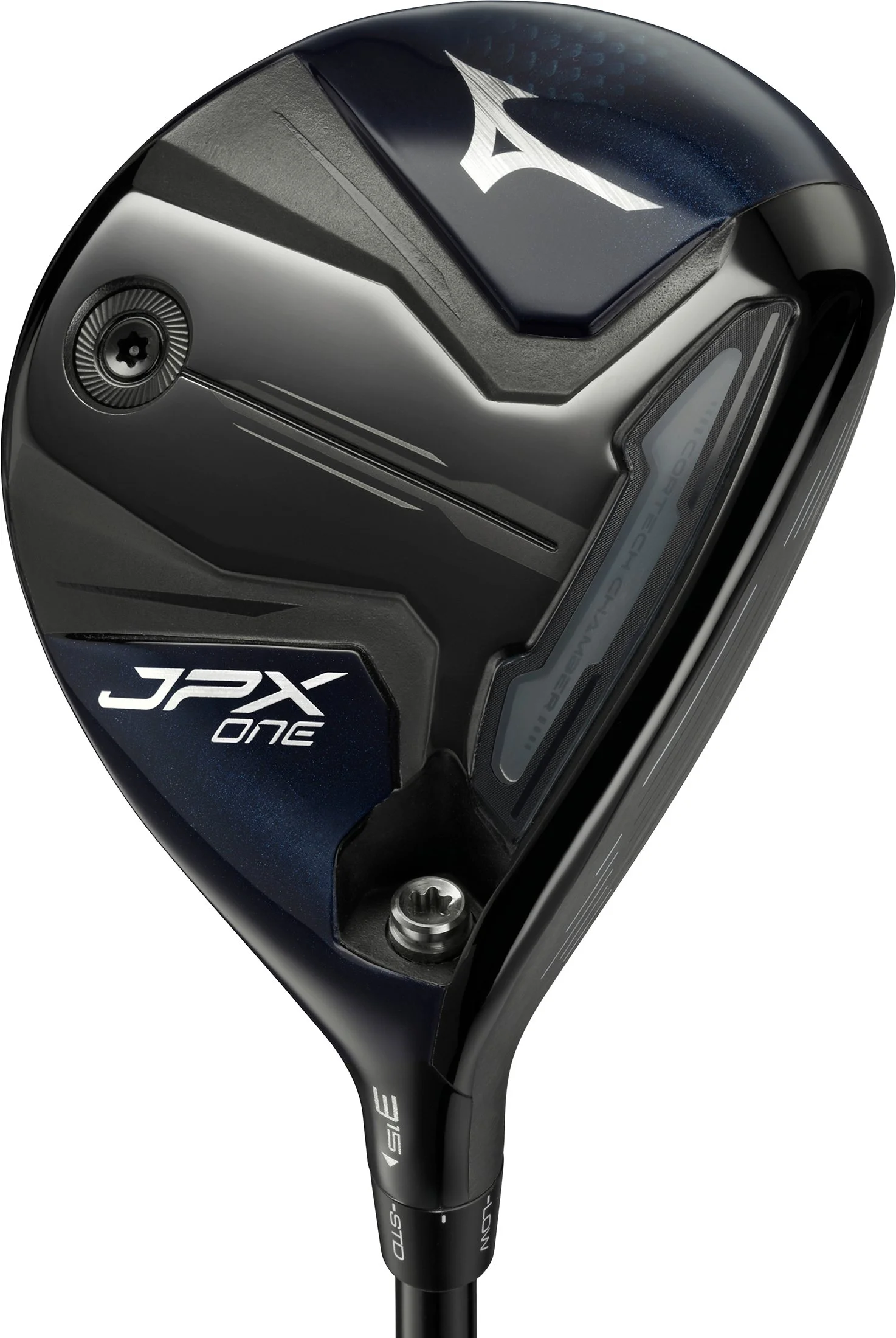
Mizuno JPX ONE Fairway Wood
Mizuno's most forgiving fairway wood ever — Today's Golfer called it a 'consistency machine' they'd game 'without hesitation,' and the Speed Bevel sole earned universal praise for turf interaction, making it the accuracy-first pick at $350.
We may earn a commission if you buy through this link — it never affects our scores or the price you pay.
The consensus
The Mizuno JPX ONE is the quiet achiever in the 2026 fairway wood class. Today's Golfer titled their review 'Ignoring the Mizuno JPX ONE fairway wood would be a big mistake,' and their tester said he'd game it 'without hesitation.' The re-engineered CORTECH Chamber pairs a dense stainless-steel weight with elastomeric TPU to increase face flex across the entire hitting surface, while the MAS1C forged maraging steel face delivers an 18% wider high-COR zone versus the prior ST-Z generation. MOI is up 12%, and the wrap-around carbon composite crown saves 20+ grams to lower the center of gravity for easier, higher launch.
Where the JPX ONE truly separates itself is turf interaction and forgiveness. The all-new Speed Bevel sole uses a blunted leading edge that reduces turf drag by approximately 22%, earning Golf Monthly's specific praise for 'superb turf interaction.' National Club Golfer measured an average ball speed of 143 mph (peak 146 mph) and noted that 'mishits rarely went far offline and ball speed held up well across the face.' The Quick Switch Adapter offers 4 degrees of loft adjustability across 8 settings, and the five-model lineup (3W, 3T Tour Spoon, 5W, 7W, 9W) covers every long-game gapping scenario from 15 to 24 degrees.
The honest trade-off is distance. Golf Monthly's testing showed 249 yards carry and 154.4 mph ball speed — 7 yards and 3.4 mph behind the PXG Lightning Tour in the same test — and spin sits above 3,500 rpm, which creates a higher, softer flight that's harder to control in wind. Golf Monthly's verdict: 'Solid yet unspectacular.' For golfers chasing maximum yardage and penetrating flight, the Qi4D or G440 Max will outperform the JPX ONE. But for the larger population of golfers who prioritize forgiveness, launch confidence, and feel — especially mid-to-high handicappers and slower swing speeds — the JPX ONE delivers Mizuno's signature quality at $350, undercutting most flagship competitors by $50–230.
Mizuno's most forgiving fairway wood ever — Today's Golfer called it a 'consistency machine' they'd game 'without hesitation,' and the Speed Bevel sole earned universal praise for turf interaction, making it the accuracy-first pick at $350.
Category ratings
What the community loves
The composite crown lowers CG, the CORTECH Chamber boosts face flex, and the result is a ball that climbs quickly with consistent height and soft landings. Today's Golfer praised the 'effortless launch' and National Club Golfer noted 'higher spin rates made the club extremely easy to launch and control with barely any sidespin.'
MOI increased up to 12% versus the predecessor ST-Z models. The MAS1C face has an 18% wider high-COR area. Today's Golfer called it a 'consistency machine' and National Club Golfer said 'mishits rarely went far offline and ball speed held up well across the face.' Multiple reviewers called it one of the most forgiving fairway woods tested.
The blunted leading edge glides through turf effortlessly, making it playable from tight lies, rough, and fairway equally. Golf Reviews Guide reports turf drag reduced by 22%. Golf Monthly specifically listed 'superb turf interaction' as a headline pro. Today's Golfer: 'gliding through the turf effortlessly.'
Internal acoustic ribbing tunes the impact sound. The MAS1C maraging face delivers a 'crisp, familiar strike' with 'decent feedback on off-center hits.' The distinctly Mizuno feel meets expectations for brand loyalists.
Black and chrome sole detailing with subtle blue carbon crown. The JPX logo alignment aid on top is 'really easy to align at address.' Golf365 praised the 'striking yet simple looks' that offer 'a very confidence-inspiring address.'
What to watch out for
Golf Monthly measured 249 yards carry and 154.4 mph ball speed — 7 yards and 3.4 mph behind the PXG Lightning Tour in the same test. National Club Golfer averaged 143 mph (peak 146 mph). The JPX ONE is reliable but cannot match the longest fairway woods in the category.
Spin sits just over the 3,500 rpm mark — notably higher than low-spin competitors. Golf Monthly noted a 'towering, yet weak flight that was fairly difficult to control when testing outdoors, particularly when the wind picked up.' For distance-chasing golfers, this is a real limitation.
Today's Golfer noted the stock shaft creates higher than ideal spin and recommended custom shaft fitting for spin management. Golfers with faster swing speeds may want to explore aftermarket shaft options to bring spin down.
Golf Monthly noted the 'gloss navy carbon crown lacks broad appeal compared to black alternatives.' Some forum users prefer a fully matte black crown like competitors offer. The blue tint is subtle but noticeable.
Is it right for your game?
GolfWRX reception has been warm but tempered — Mizuno loyalists love the feel and build quality, but the forum consensus is that it's a forgiveness-first club rather than a distance weapon. The 7-wood has generated particular excitement, with Golf365's reviewer putting it straight in his bag. The brand recognition gap versus TaylorMade, Callaway, and PING means the JPX ONE gets overlooked, but those who try it tend to stick with it.
What real people are saying
9 quotes from across the web, grouped by 5 themes. Click a theme to read the individual quotes.
Specifications
Available shafts (no upcharge)
Premium shafts available at additional cost: Graphite Design Tour AD VF, Tour AD UB, Tour AD DI
All sources analyzed
This review synthesizes opinions from 11 independent sources. Every claim on this page can be traced back to its original source. No manufacturer relationship or compensation.
The consensus score is built in four layers: raw source collection, normalization to a 0-10 scale, credibility-weighted combination, and quality adjustments.
Expert reviews (35% weight) are scored from language intensity and any numerical ratings provided. Data-driven testing (25%) converts product rank within the test group to a percentile score. Forum posts (30%) are AI-classified by sentiment, weighted by substantiveness. Retail reviews (10%) convert 5-star ratings with a 0.75x credibility discount to correct for systematic inflation.
Three quality adjustments are then applied: a source diversity bonus (up to +0.3 for coverage across all source types), a conflict penalty (up to -0.3 when sources strongly disagree), and recency weighting (recent reviews weighted higher than older ones).