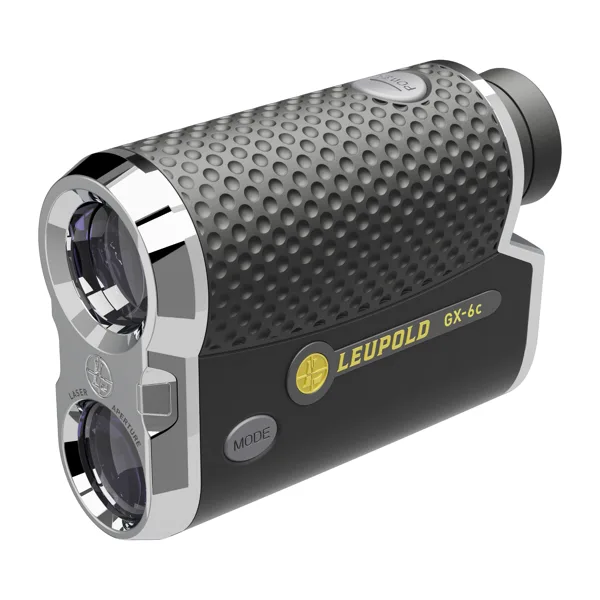
Leupold GX-6c Golf Rangefinder
The flagship of Leupold's compact GX 'c' lineup and one of only a handful of golf lasers with true built-in image stabilization — a gyro-steadied reticle that freezes the view and makes locking the flag feel effortless, even with shaky hands or in the wind. Pair that with a fast lock, a bright red TOLED display, the Club Selector club-recommendation feature, and Leupold's small, premium, lifetime-guaranteed build, and the GX-6c is a genuine premium contender. The honest catch from the category's toughest tester (MyGolfSpy): it's fast and reassuring but 'wasn't as accurate as some other rangefinders' in the test — but here's the headline for 2026: it's routinely on sale for around $199.99 — roughly a third of its $599.99 list — and at that price a true image-stabilized premium rangefinder is one of the best deals in golf, accuracy nitpick and all.
We may earn a commission if you buy through this link — it never affects our scores or the price you pay.
The consensus
The Leupold GX-6c is the flagship of Leupold's compact GX 'c' lineup and one of the very few golf lasers built around true image stabilization. A gyro system steadies both the view and the laser so the reticle 'freezes' onto the flag the moment you range — the single feature that separates it from the rest of the Leupold line (the otherwise-identical GX-5c) and from most of the category. Around that signature trick sits Leupold's full stack: a fast PinHunter 3 / Flag Lock / Prism Lock acquisition system, True Golf Range (TGR) slope, the Club Selector club-recommendation feature, a bright red TOLED display, and a small, weather-sealed, lifetime-guaranteed body. Across eleven sources — anchored by MyGolfSpy, the category's most rigorous tester, plus expert blogs, forum owners and retail feedback — it earns a strong premium consensus, a step below the Bushnell Pro X3+ benchmark.
Where sources agree most strongly: stabilization, speed, size and build. MyGolfSpy found the GX-6c 'very fast at finding the target,' and noted the 'stabilization fills you with confidence that you're shooting the flag'; Breaking Eighty describes the viewfinder freezing onto the pin and rates the effect alongside the Nikon Coolshot Stabilized. Reviewers repeatedly flag how compact and light it is next to do-everything flagships, the crisp red TOLED display, and the value of Club Selector — which The Golfin Guy calls its favorite feature for letting you 'program your club distances directly into the device.' Leupold's optics heritage and lifetime guarantee turn many reviews into a buy-once argument.
Where the consensus is honest about limits: accuracy, price and a couple of missing conveniences. The most important caveat comes straight from the gold-standard test — MyGolfSpy reported the GX-6c 'wasn't as accurate as some other rangefinders we tested,' so on the headline dimension it's good rather than class-leading, and the more precise Bushnell Pro X3 sits at the same $599.99 price. The GX-6c also skips the vibration pin-lock and integrated magnet that rivals include (it confirms with a beep and a visual Flag Lock ring and ships with a Kydex case), and at full MSRP the value is awkward when the GX-5c offers everything but stabilization for $100 less — though heavy real-world discounting closes much of that gap. For the golfer who specifically wants a steady, stabilized view in a compact premium package, the GX-6c is a genuinely distinctive choice; for the buyer who just wants the single most accurate number for the money, it isn't the category's top pick.
The flagship of Leupold's compact GX 'c' lineup and one of only a handful of golf lasers with true built-in image stabilization — a gyro-steadied reticle that freezes the view and makes locking the flag feel effortless, even with shaky hands or in the wind. Pair that with a fast lock, a bright red TOLED display, the Club Selector club-recommendation feature, and Leupold's small, premium, lifetime-guaranteed build, and the GX-6c is a genuine premium contender. The honest catch from the category's toughest tester (MyGolfSpy): it's fast and reassuring but 'wasn't as accurate as some other rangefinders' in the test — but here's the headline for 2026: it's routinely on sale for around $199.99 — roughly a third of its $599.99 list — and at that price a true image-stabilized premium rangefinder is one of the best deals in golf, accuracy nitpick and all.
Category ratings
What the community loves
Image stabilization is the GX-6c's headline trick and the one thing that sets it apart from the rest of the Leupold lineup (and most of the category). A gyro system steadies both the view and the laser so the reticle 'freezes' onto the flag the instant you range — Breaking Eighty describes the viewfinder locking up and holding on the pin, and rates it right alongside the Nikon Coolshot Stabilized. For anyone whose hands aren't rock-steady, or who plays in wind, it genuinely removes the wobble that makes distant or tucked pins hard to acquire. Outside of a couple of stabilized rivals, no other premium laser at this price offers it.
Speed is the other half of the GX-6c's in-hand appeal. MyGolfSpy — the category's most rigorous tester — found it 'very fast at finding the target,' and with the stabilized reticle holding steady the lock feels immediate and reassuring rather than a game of chasing the flag. PinHunter 3 plus Flag Lock work to grab the stick and ignore the trees behind it, and Prism Lock adds an audible alert on prism-equipped flags. The whole experience is quick and low-drama.
At roughly 4.0 x 1.6 x 2.9 inches and about 7.9 ounces, the GX-6c is noticeably smaller and lighter than the do-everything flagships it competes with — reviewers repeatedly note Leupold's GX units are more compact than a Bushnell Pro X3 or Cobalt Q6. It's weather-sealed, fog-proof and shock-resistant, and it's backed by Leupold's lifetime guarantee from a brand that's built optics since 1907. The Golfin Guy's takeaway is blunt: 'no one has a reputation or longevity like Leupold.' It's a buy-once piece of kit for the walker who doesn't want a brick in the bag.
The GX-6c carries Leupold's whole stack: True Golf Range (TGR) slope that factors incline, decline, altitude and temperature; PinHunter 3, Prism Lock, Flag Lock, Scan Mode and Fog Mode; and Club Selector, which lets you program your own carry distances so the device recommends a club for the 'plays-like' number. TGR and Club Selector toggle off cleanly, making the unit USGA-conforming for tournament play under the Local Rule. The Golfin Guy singles out Club Selector as a favorite — 'it allows you to program your club distances directly into the device.'
The GX-6c uses a bright red TOLED display (an orangish-red font and reticle) with selectable reticles, and reviewers consistently find it crisp and easy to read across flat light, glare and overcast — a clear step up from the LCD screens on Leupold's lower-tier and entry models. Combined with the stabilized, high-light-transmission optics, the view is one of the unit's quiet strengths.
What to watch out for
For a tool whose entire job is a trustworthy number, the most important caveat is the one MyGolfSpy delivered directly: the GX-6c 'wasn't as accurate as some other rangefinders we tested.' Leupold advertises ±1-yard precision via its DNA (Digitally Enhanced Accuracy) engine and the display reads to a tenth of a yard, and it's plenty accurate for golf — but the most precise units in the category, the Bushnell Pro X3 chief among them, edged it in head-to-head testing. At this price, being merely 'good' rather than class-leading on the headline dimension is the GX-6c's biggest weakness.
At a $599.99 MSRP the GX-6c lists with the most expensive lasers in golf, and on paper the value math looks awkward: the GX-5c is the same rangefinder minus image stabilization for $100 less, and the Bushnell Pro X3 costs the same while testing more accurate. In practice, though, almost nobody pays list — the GX-6c is an established model now heavily discounted (Leupold's own site has run it at $199.99, and street prices sit around $200–300), which flips the value case strongly in its favor. Pay full freight and you're buying stabilization and the Leupold name at a premium; at street money it's a stabilized flagship for a value price.
Leupold's GX units don't buzz when they grab the pin — confirmation is an audible beep plus the visual Flag Lock ring around the reticle, not the vibration pulse Bushnell's JOLT owners come to rely on, which some players miss in noisy or hurried situations. The GX-6c also lacks an integrated magnetic cart mount: it ships with a Kydex case rather than a BITE-style magnet, so cart riders who want to snap the unit to the frame need an aftermarket case. Neither is a dealbreaker, but both are conveniences rivals include.
The optics run 6x through a 22mm objective — fine and clear, but a notch below the 7x of some premium rivals for picking out a distant low-contrast flag. Getting the most out of Club Selector means taking time to program your carry distances, a small setup hurdle, and reviewers note Leupold simply has less mainstream visibility than Bushnell or Garmin, so demo units and in-store familiarity can be harder to come by. Minor frictions, but worth knowing before you commit.
Is it right for your game?
What real people are saying
12 quotes from across the web, grouped by 6 themes. Click a theme to read the individual quotes.
Specifications
All sources analyzed
This review synthesizes opinions from 11 independent sources. Every claim on this page can be traced back to its original source. No manufacturer relationship or compensation.
The consensus score is built in four layers: raw source collection, normalization to a 0-10 scale, credibility-weighted combination, and quality adjustments.
Expert reviews (35% weight) are scored from language intensity and any numerical ratings provided. Data-driven testing (25%) converts product rank within the test group to a percentile score. Forum posts (30%) are AI-classified by sentiment, weighted by substantiveness. Retail reviews (10%) convert 5-star ratings with a 0.75x credibility discount to correct for systematic inflation.
Three quality adjustments are then applied: a source diversity bonus (up to +0.3 for coverage across all source types), a conflict penalty (up to -0.3 when sources strongly disagree), and recency weighting (recent reviews weighted higher than older ones).