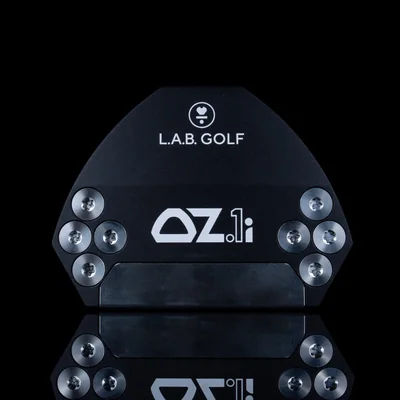
L.A.B. Golf OZ.1i Putter
MyGolfSpy's top-ranked zero-torque putter for 2025 with the best PuttView Handicap of any category winner — a high-MOI mallet with a stainless steel insert that finally makes Lie Angle Balance technology look conventional.
We may earn a commission if you buy through this link — it never affects our scores or the price you pay.
The consensus
The L.A.B. Golf OZ.1i is the putter that finally brings Lie Angle Balance technology to the mainstream. Developed in part with Adam Scott, the half-moon mallet shape looks more like a conventional putter than any previous LAB model, while the 303 stainless steel face insert — a LAB first — provides the firmer, faster feel that traditional putter users expect. In MyGolfSpy's 2025 Most Wanted putter test, the OZ.1i posted a PuttView Handicap of -7.6 — the strongest scoring performance of any category winner, beating the top blade, the top mallet, and every other zero-torque putter tested. It was the top performer on short putts and finished inside the top three on long putts, with a best-in-class average leave distance of 0.59 feet.
Where sources agree: the technology works, the insert is a meaningful upgrade, and the shape is finally accessible. Plugged In Golf found that hitting your intended line becomes automatic once you stop trying to manipulate the putter, and GolfWRX member testers called the stainless insert 'a HUGE improvement' over previous aluminum-face LAB models. Golf Monthly rated it 4.9 out of 5 and praised how the half-moon body sits beautifully behind the ball, calling it the LAB putter that may finally tempt skeptics into trying zero-torque technology. Golf Digest placed the OZ.1i on its 2025 Hot List as a Top 5 performer for low handicaps, and Independent Golf Reviews called it 'the hottest putter in golf' — not just in popularity, but on the greens.
Where the honest trade-offs remain: the adaptation period, the fitting requirement, and the price. Zero-torque putting requires 1-3 weeks to fully adapt, and the putter must be properly fitted to work as intended — this is not a grab-it-off-the-rack purchase. At $499 for the stock model and $599+ for custom builds, the OZ.1i is premium-priced with longer lead times than major OEM competitors. The technology specifically addresses grip-tension-related putting problems; golfers whose issues stem from path mechanics or green reading may not see improvement. But for the player willing to commit — especially one who suspects grip tension is costing strokes — the OZ.1i has the strongest data-backed case of any putter on the market in 2025.
MyGolfSpy's top-ranked zero-torque putter for 2025 with the best PuttView Handicap of any category winner — a high-MOI mallet with a stainless steel insert that finally makes Lie Angle Balance technology look conventional.
Category ratings
What the community loves
The OZ.1i posted a PuttView Handicap of -7.6, the strongest scoring performance of any category winner in MyGolfSpy's 2025 Most Wanted putter test — beating the best blade, the best mallet, and every other zero-torque putter tested. It was the top performer on short putts (-8.1) and finished inside the top three on long putts (-8.7), with a best-in-class average leave distance of 0.59 feet. This is not just the best zero-torque putter — the data says it is the most complete putter tested in 2025.
The OZ.1i is L.A.B. Golf's first putter with a face insert, and it represents a meaningful upgrade over the brand's previous aluminum-face designs. The 303 stainless steel insert provides a firmer, more responsive feel with noticeably faster ball speeds. GolfWRX member testers called the insert 'a HUGE improvement' over previous models. Independent Golf Reviews noted the stainless insert transfers more energy into each putt, and the reviewer 'never left a putt short' during testing. The result is a putter that feels more like a conventional premium mallet while retaining all the zero-torque benefits.
The OZ.1i's half-moon mallet shape, developed in part with Adam Scott, is the closest any LAB putter has come to looking like a traditional mallet. Golf Monthly praised how the body sits 'beautifully behind the ball,' and multiple sources noted this is the LAB putter that will finally tempt golfers who were put off by the unconventional aesthetics of previous models like the MEZZ.1 or DF series. The shape provides real visual confidence at address.
Like all LAB putters, the OZ.1i is 100% Lie Angle Balanced — the head's center of gravity sits directly below the shaft axis at address, so the face remains neutral to grip pressure. Plugged In Golf found that hitting your line becomes automatic once you stop trying to manipulate the putter, and the forgiveness in the OZ.1i is excellent: small misses have almost no effect on the final result. MyGolfSpy's data confirmed LAB putters produce the lowest face angle deviation at impact of any putter technology tested.
Custom-order OZ.1i putters offer 31 front alignment aid options, 22 rear alignment aid options, and 8 head color choices — totaling over 5,400 possible configurations. The putter is also available in 0-degree or 2-degree shaft lean, with standard, counterbalanced, arm-lock, and sweeper length configurations. No other putter on the market offers this level of personalization for alignment and setup preferences.
What to watch out for
Zero-torque putting requires golfers to fundamentally change how they hold and stroke the putter. The design works by neutralizing grip pressure, which means players conditioned to manipulate the face through impact will initially struggle. Multiple GolfWRX testers documented 1-3 weeks of worse putting before improvement. Plugged In Golf emphasized that the putter 'must be fit to work as intended' — buying one off the shelf without understanding the LAB setup process defeats the purpose.
The OZ.1i stock model is $499, with custom builds starting at $599. Lead times of 1-2 weeks for stock and 2-4 weeks for custom are longer than walking into a store with a Scotty Cameron or Spider. Golf Monthly specifically noted longer lead times as a con. Retail availability is growing but still limited compared to major OEM putters — many golf shops do not stock LAB putters for demo or fitting.
The LAB system neutralizes face angle variation caused by grip pressure, but it does nothing for path issues, green reading, or speed control problems unrelated to grip tension. Forum members who expected the OZ.1i to fix all their putting woes were sometimes disappointed when their underlying stroke mechanics remained unchanged. The putter is transformative for the right problem, but it is not a universal fix.
While the half-moon shape is more conventional than previous LAB models, the weight distribution, shaft angle, and overall profile are still noticeably different from traditional mallets. The 0-degree shaft lean option helps but does not fully eliminate the visual difference. Golfers deeply attached to conventional putter aesthetics may still find it unsettling at address, despite the improvements.
Is it right for your game?
The OZ.1i is L.A.B. Golf's most accessible mallet — same zero-torque philosophy as the DF3 at a lower price point, in a mid-mallet format. Community consensus is strongly positive, particularly around how the angularly adjustable hosel accommodates different setup preferences without requiring professional fitting. The main debate: is the torque-free concept genuinely performance-improving for most golfers, or is it more of an engineering curiosity? Forum users who've switched from conventional putters to L.A.B. designs tend to be evangelists, but the evidence base is smaller than for established brands.
What real people are saying
14 quotes from across the web, grouped by 6 themes. Click a theme to read the individual quotes.
Specifications
Available shafts (no upcharge)
Premium shafts available at additional cost: Graphite Design Tour AD VF, Tour AD UB, Tour AD DI
All sources analyzed
This review synthesizes opinions from 12 independent sources. Every claim on this page can be traced back to its original source. No manufacturer relationship or compensation.
The consensus score is built in four layers: raw source collection, normalization to a 0-10 scale, credibility-weighted combination, and quality adjustments.
Expert reviews (35% weight) are scored from language intensity and any numerical ratings provided. Data-driven testing (25%) converts product rank within the test group to a percentile score. Forum posts (30%) are AI-classified by sentiment, weighted by substantiveness. Retail reviews (10%) convert 5-star ratings with a 0.75x credibility discount to correct for systematic inflation.
Three quality adjustments are then applied: a source diversity bonus (up to +0.3 for coverage across all source types), a conflict penalty (up to -0.3 when sources strongly disagree), and recency weighting (recent reviews weighted higher than older ones).