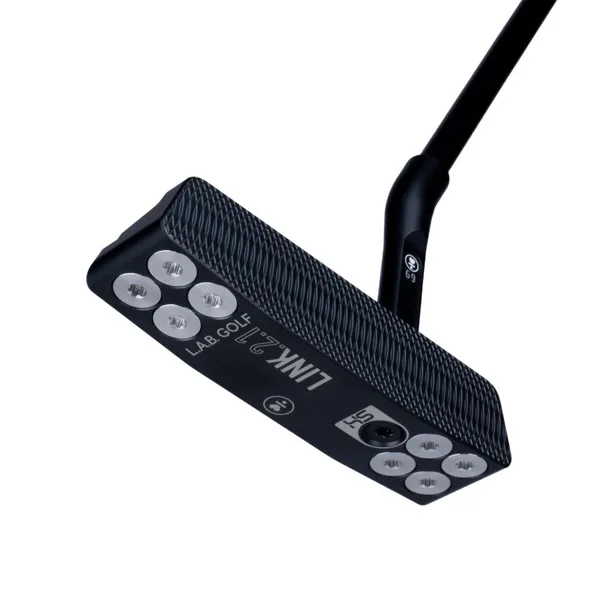
L.A.B. Golf LINK.2.1 Putter
L.A.B. Golf's first heel-shafted traditional blade — the brand's zero-torque Lie Angle Balance technology finally wrapped in a classic Anser-style shape, 100% CNC-milled from 303 stainless steel with a deep flymill face and black PVD finish.
We may earn a commission if you buy through this link — it never affects our scores or the price you pay.
The consensus
The L.A.B. Golf LINK.2.1 is the brand's first heel-shafted, traditional-blade putter — the closest L.A.B. has ever come to a classic Anser shape — and it carries the company's whole pitch in one club: take the patented Lie Angle Balanced (zero-torque) technology that keeps the face square through the stroke, and finally put it in a head that looks normal at address. Released April 23, 2026 at $499 stock (custom from $599), it has been reviewed across roughly 14 sources spanning expert outlets, quantified testing blogs, forum sentiment, and retail. The consensus is strongly positive but genuinely mixed at the edges, landing it at 8.8 — just below L.A.B.'s own DF3 (9.1) and OZ.1i (9.0) mallets and the PING Prime Tyne 4 (8.9), and level with the TaylorMade Spider Tour V (8.8).
Where sources agree most strongly: looks, face control, and feel. Plugged In Golf called it 'the most un-L.A.B. Golf L.A.B. Golf putter' — a compliment about how conventional it sets up — and nearly every reviewer praised how square the face returns and how consistently the ball starts on line, the core payoff of the zero-torque design. The new deep 'flymill' 303 stainless face is rated the best-feeling LINK yet, with a soft, muffled strike, and the heavy D9 head is credited with fixing L.A.B.'s long-standing lag-putting knock: even The Club House, the one reviewer who didn't get along with it, conceded pace control beat other L.A.B. putters he'd tried.
Where the consensus fractures: forgiveness, distance from range, and price. The slim blade gives up MOI relative to L.A.B.'s DF3, OZ, and MEZZ mallets — reviewers call it more forgiving than a standard Anser but caution against frequent off-center contact — and several still wanted more help on long putts than a mallet demands. Feedback is one-dimensional (great on center, vague on the misses), the onset and heel-shafted shaft lean look awkward to some at address, and at least one reviewer declined to recommend it outright. At $499 stock and $599+ for the customs that show the putter at its best, it's an expensive, niche buy. The verdict: for the player who wanted L.A.B.'s technology without the spaceship looks — or who fights face rotation and start line — the LINK.2.1 is a genuinely compelling, premium answer; for a golfer chasing maximum forgiveness or effortless lag pace, an L.A.B. mallet or a high-MOI design is the smarter spend.
L.A.B. Golf's first heel-shafted traditional blade — the brand's zero-torque Lie Angle Balance technology finally wrapped in a classic Anser-style shape, 100% CNC-milled from 303 stainless steel with a deep flymill face and black PVD finish.
Category ratings
What the community loves
The LINK.2.1 is the first heel-shafted putter in the LINK family and the closest L.A.B. has ever come to a classic Anser-style blade. It keeps the brand's patented Lie Angle Balanced (zero-torque) design — the face stays square through the stroke regardless of length, lie, head weight, shaft, or grip — but wraps it in a compact, narrow-body shape that looks normal at address. Plugged In Golf called it 'the most un-L.A.B. Golf L.A.B. Golf putter,' and that is exactly the point: it is built for players who wanted the technology without the spaceship looks.
Across nearly every review, the standout on-course trait is how easily the face returns to square and how repeatably the ball starts on its intended line. Golfers Authority described 'mallet-like stability in a compact blade design,' and Love Live Golf praised its 'calm authority' on putts inside six feet. For players who fight face rotation or struggle to start putts on line, the zero-torque design is the genuine performance differentiator.
The LINK.2.1 swaps L.A.B.'s older grooved/insert faces for a deep 'flymill' 303 stainless face, and reviewers consistently rate it the best-feeling LINK yet. Plugged In Golf said it 'feels sensational' on center strikes — a soft, muffled 'tock' — while MyGolfSpy noted the deep milling makes the head both feel and look more traditional. The 100% CNC-milled construction and black PVD finish read as legitimately premium.
A common knock on L.A.B.'s lighter zero-torque putters has been lag-putting feel. The LINK.2.1's hefty D9 swing weight directly addresses it: Plugged In Golf, whose biggest weakness with previous L.A.B. models was distance control, found the heavier head meaningfully improved lag putting, and The Club House — despite an otherwise critical review — agreed pace control was 'better than I have experienced with some other L.A.B. putters.'
Even the stock putter ($499) can be specced to the player, and the custom program (from $599) opens up a level of fitting rare in putters: 15 front and 8 rear alignment-mark choices, multiple head weights, and premium shaft upgrades from ACCRA, GEARS, Diamana, and TPT on top of the stock steel. Lie Angle Balance is preserved across every configuration, so fitting changes never compromise the zero-torque behavior.
What to watch out for
The trade for the slim blade footprint is MOI. Reviewers were clear that the LINK.2.1 is more tolerant than a standard Anser blade but meaningfully less forgiving than the DF3, OZ, or MEZZ mallets. Plugged In Golf said small misses are manageable but regular off-center contact 'isn't advisable.' Golfers who choose L.A.B. specifically for maximum stability give some of it up here for the looks.
Even with the heavier D9 head, multiple reviewers needed more input on longer putts than they would with a mallet. Love Live Golf said lag putting 'demands noticeably more golfer input,' and several testers rated distance control from range as the putter's relative weak spot. It is better than past L.A.B. blades, but it is not an effortless-pace tool.
Feel discrimination is one-dimensional: center strikes feel sensational, but reviewers found it hard to tell the difference between the various mishits. Golf Monthly and The Club House both flagged that the onset, shaft lean, and heel-shafted riser can look awkward or appear to aim left at address — an adjustment period that not every tester got past. The Club House ultimately could not get comfortable with it and did not recommend it.
The LINK.2.1 starts at $499 for stock and $599 for custom builds — more than a Scotty Cameron blade and well above mainstream forgiving mallets. Combined with a 5-6 week build time and a heel-shafted zero-torque concept that remains an acquired taste, it is a niche purchase aimed at a specific buyer rather than a broad-appeal putter.
Is it right for your game?
What real people are saying
13 quotes from across the web, grouped by 6 themes. Click a theme to read the individual quotes.
Specifications
Available shafts (no upcharge)
Premium shafts available at additional cost: Graphite Design Tour AD VF, Tour AD UB, Tour AD DI
All sources analyzed
This review synthesizes opinions from 14 independent sources. Every claim on this page can be traced back to its original source. No manufacturer relationship or compensation.
The consensus score is built in four layers: raw source collection, normalization to a 0-10 scale, credibility-weighted combination, and quality adjustments.
Expert reviews (35% weight) are scored from language intensity and any numerical ratings provided. Data-driven testing (25%) converts product rank within the test group to a percentile score. Forum posts (30%) are AI-classified by sentiment, weighted by substantiveness. Retail reviews (10%) convert 5-star ratings with a 0.75x credibility discount to correct for systematic inflation.
Three quality adjustments are then applied: a source diversity bonus (up to +0.3 for coverage across all source types), a conflict penalty (up to -0.3 when sources strongly disagree), and recency weighting (recent reviews weighted higher than older ones).