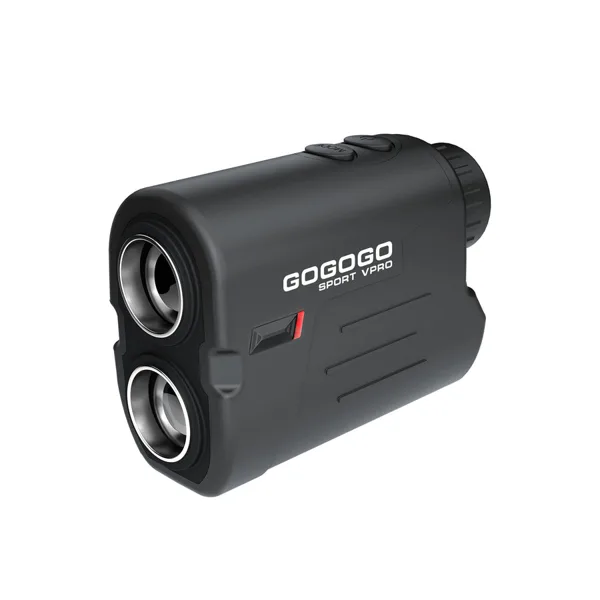
Gogogo Sport Vpro Laser Rangefinder
The internet's default budget rangefinder — and for most reviewers, the value benchmark the whole sub-$150 category is measured against. The Gogogo Sport Vpro pairs genuinely trustworthy yardages inside 150 yards, a fast basic-distance mode, a toggleable (tournament-legal) slope and a vibrating pin-lock with a price that routinely lands under $100. Experts from Plugged In Golf to Golf Monthly are near-unanimous that it 'punches well above its weight,' with Plugged In Golf grading it an outright 'A+ for value.' The honest ceiling is real, though: modest 6x optics with a black-only LCD, slower, fussier locking on long or cluttered targets, a lightweight plasticky body and only IP54 splash resistance. It earns a strong consensus from 11 sources as the best in golf at the one thing it sets out to do — deliver an accurate number for the least money — while staying clearly a budget tool, not a flagship.
We may earn a commission if you buy through this link — it never affects our scores or the price you pay.
The consensus
The Gogogo Sport Vpro is the rangefinder that taught a generation of golfers they didn't need to spend $400 to get a yardage. A perennial Amazon best-seller, it has become the default budget recommendation across golf media — and our consensus of 11 sources agrees: for accuracy-per-dollar, nothing beats it. The Vpro is a product line rather than a single device (the GS03 predecessor gave way to the current GS24, sold in 650-, 1,000- and 1,200-yard ranges, with or without slope and a cart magnet), but the core proposition is constant: trustworthy distances, a fast basic mode, a vibrating pin-lock and a tournament-legal slope toggle, all for a price that routinely lands under $100. Note one honest caveat on sourcing — MyGolfSpy's rigorous testing has crowned sibling Gogogo models (the GS91BL was its 2025 'Best Value' pick and the ZeroIn scored 9/10), but the Vpro itself is covered by expert reviews and a MyGolfSpy forum member review rather than a MyGolfSpy editorial award, so this is an expert- and community-anchored consensus rather than a lab-test one.
Where the sources agree most strongly is value and inside-150 accuracy. Plugged In Golf's Matt Saternus calls it the 'most affordable rangefinder I've ever tested' and grades it an outright 'A+ for value'; Golf Insider scored its value 92/100 and guessed blind it would retail for $199–$299. The accuracy holds up to the price: Golf Monthly's Joe Ferguson found its readings 'basically identical, to within 0.2 of a yard' against his trusted Bushnell Tour V3 JOLT, and The Hackers Paradise measured it 'within a single yard every time' next to a Bushnell Tour V5. Add a slope switch you can legally turn off for competition, ARC compensation, a vibrating flag-lock, AAA batteries and (on magnet configs) a cart mount, and reviewers keep landing on the same line — it has 'all the features of rangefinders two or three times the price.'
Where the consensus is honest about limits is optics, locking speed at distance, and build. The 6x glass and black-only LCD are merely functional — Golf Insider rated optics 75/100 and found the laser 'will pick up the background now and again and give you a false reading,' grabbing a tree or post behind the pin as the target gets to 180 yards and beyond. The light plastic body feels cheap (even as it survives drops), and the IP54 rating is splash resistance, not the IPX7 waterproofing of flagships. None of that dents its purpose. Placed against the field — premium flagships like the Bushnell Pro X3+ (our 9.4 benchmark) and mid-range slope units sit comfortably above it on optics, speed and feel — the Vpro lands at 8.4: clearly a budget tool, but the best one at the only job it's trying to do, which is hand you an accurate number for the least possible money. If that's the brief, it's the consensus pick; if you want refinement, spend up.
The internet's default budget rangefinder — and for most reviewers, the value benchmark the whole sub-$150 category is measured against. The Gogogo Sport Vpro pairs genuinely trustworthy yardages inside 150 yards, a fast basic-distance mode, a toggleable (tournament-legal) slope and a vibrating pin-lock with a price that routinely lands under $100. Experts from Plugged In Golf to Golf Monthly are near-unanimous that it 'punches well above its weight,' with Plugged In Golf grading it an outright 'A+ for value.' The honest ceiling is real, though: modest 6x optics with a black-only LCD, slower, fussier locking on long or cluttered targets, a lightweight plasticky body and only IP54 splash resistance. It earns a strong consensus from 11 sources as the best in golf at the one thing it sets out to do — deliver an accurate number for the least money — while staying clearly a budget tool, not a flagship.
Category ratings
What the community loves
Every source converges on the same verdict: nothing accurate costs less. Plugged In Golf's Matt Saternus calls it the 'most affordable rangefinder I've ever tested,' grades it an outright 'A+ for value,' and notes it undercut the sale prices of rival lasers by at least $40. Golf Insider scored its value 92/100 and guessed blind it would be a '$199–$299 rangefinder.' For a golfer who simply wants a real yardage without spending flagship money, the Vpro is the consensus best place to start.
The headline surprise is how close the raw numbers land to units costing three or four times more. Golf Monthly's Joe Ferguson cross-checked it against his 'tried and trusted Bushnell Tour V3 JOLT' and found the readings 'basically identical to within 0.2 of a yard.' The Hackers Paradise put it next to a Bushnell Tour V5 and measured it 'within a single yard every time,' and Golf Insider's quantified testing logged an average error under one yard inside 150 yards. For approach distances — where it matters most — the Vpro is trustworthy.
In its straight measuring mode the Vpro fires fast — Plugged In Golf rates it 'as quick as almost any rangefinder you can buy,' and GolfMagic clocks a roughly half-second reading. The Pin-Seeking flag-lock buzzes a short vibration pulse when it grabs the flag, the same confirmation cue the premium brands use, so on a clean target you get a confident lock without hunting. It's the feature most responsible for the device feeling far more expensive than it is.
The slope model adds a physical on/off Slope Switch, so you can use angle-compensated 'plays-like' yardages in practice and flip it off to stay legal for competition — a feature usually reserved for pricier units. It displays raw and slope-adjusted distances together, includes ARC angle-range compensation, a scan mode for multiple targets, and the magnet configurations (e.g. GS24MTL) add a strong cart mount. Reviewers repeatedly note it 'provides all the features of rangefinders two or three times the price.'
For a budget unit it survives golf-cart life: The Hackers Paradise reports its tester's Vpro 'dropped, fallen out of a golf cart... doesn't even show a scratch,' and GolfMagic praises the 'lovely ergonomic design that is comfortable to hold' at a light ~184g. The current GS24 runs on two standard AAA batteries — no proprietary CR2 to track down — which several reviewers flag as a quiet convenience win for an everyday, throw-in-the-bag rangefinder.
What to watch out for
This is where the budget shows. The glass is 6x (where premium rivals run 6–7x with brighter, multi-coated optics), and the display is a monochrome black readout with no illuminated or red option, so it can wash out in flat light or against dark backgrounds. Golf Insider scored optics just 75/100, and reviewers agree the view is functional rather than crisp. It does the job; it does not delight.
The speed advantage fades as distance and clutter grow. Golf Insider found it 'will pick up the background now and again and give you a false reading,' grabbing a tree or post behind the pin as you get to 180 yards and beyond, forcing a re-aim. Independent testing shows the error itself creeping toward two yards by 200, so on a back pin with trees behind it you'll occasionally fire twice to trust the number.
The flip side of cheap-and-light is that it doesn't feel premium in hand — reviewers describe the housing as plasticky even while praising its drop survival, and the body is plastic rather than the rubber-armored metal of flagships. Crucially it's rated IP54: splash and light-rain resistant, not the IPX7 full waterproofing of higher-end units. Play through a real downpour at your own risk; this is built to a price.
'Gogogo Sport Vpro' isn't one product but a sprawling line — GS03 vs GS24, 650 vs 1,000 vs 1,200-yard ranges, slope vs no-slope, magnet vs no-magnet, AAA vs CR2 vs rechargeable — and listings and specs shift between them, so it's easy to buy a config you didn't intend. Reviewers also flag practical nits: Golf Insider found some buttons 'feel stiff during operation,' and the multi-mode toggling takes a beat to learn. Read the exact variant before you click buy.
Is it right for your game?
What real people are saying
10 quotes from across the web, grouped by 5 themes. Click a theme to read the individual quotes.
Specifications
All sources analyzed
This review synthesizes opinions from 11 independent sources. Every claim on this page can be traced back to its original source. No manufacturer relationship or compensation.
The consensus score is built in four layers: raw source collection, normalization to a 0-10 scale, credibility-weighted combination, and quality adjustments.
Expert reviews (35% weight) are scored from language intensity and any numerical ratings provided. Data-driven testing (25%) converts product rank within the test group to a percentile score. Forum posts (30%) are AI-classified by sentiment, weighted by substantiveness. Retail reviews (10%) convert 5-star ratings with a 0.75x credibility discount to correct for systematic inflation.
Three quality adjustments are then applied: a source diversity bonus (up to +0.3 for coverage across all source types), a conflict penalty (up to -0.3 when sources strongly disagree), and recency weighting (recent reviews weighted higher than older ones).