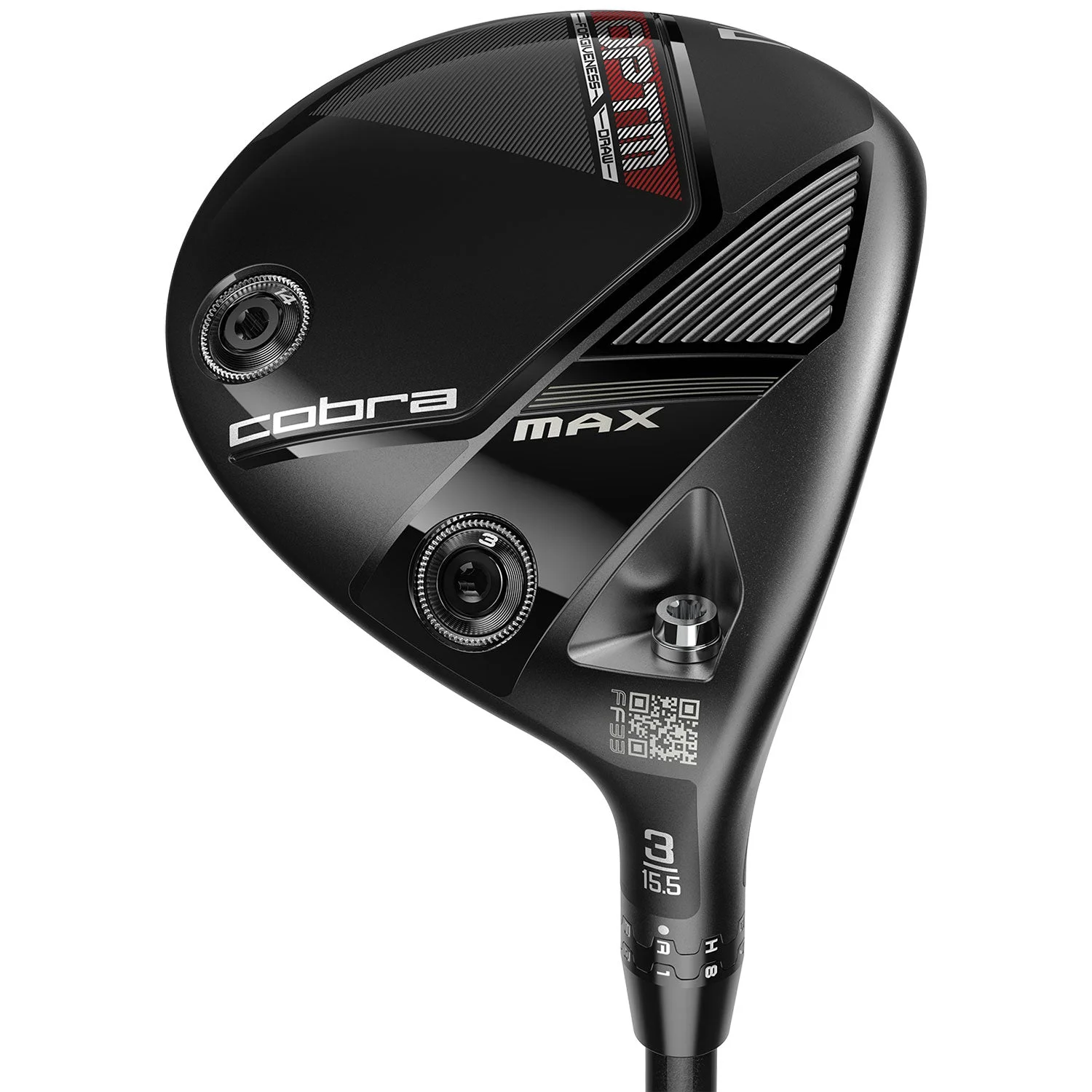
Cobra OPTM Max Fairway Wood
The most forgiving fairway wood in the Cobra lineup — back-and-heel weighted draw bias plus the shallowest face in the OPTM family make launching effortless, and at $329 it's the best value in the range for high handicappers fighting a slice.
We may earn a commission if you buy through this link — it never affects our scores or the price you pay.
The consensus
The Cobra OPTM Max is the most forgiving fairway wood in the 2026 OPTM family — purpose-built for high handicappers and slower swing speeds who need maximum launch, draw bias, and confidence at address. The back-and-heel weighted CG placement produces a natural draw that actively fights the slice, while the shallowest face in the OPTM lineup sits flush to the turf for effortless launch from fairway or tee. At 182cc, it's the largest head in the range, maximizing MOI for stability on off-center hits while Cobra's POI optimization keeps dispersion tight.
The Max shares the core OPTM technology platform — H.O.T. Face with 15-zone AI variable thickness, FutureFit33 hosel with SMARTPAD (33 positions, face stays square), and Adaptive POI Weighting — but packages it differently. The two movable sole weights (14g and 3g) are positioned for draw-bias in the stock configuration, and the steel/carbon body prioritizes forgiveness over the raw ball speed of the titanium LS. Available in four lofts from 15.5° (3W) through 24.5° (9W), it covers the widest range of any OPTM fairway wood.
The trade-off is spin and distance. MyGolfSpy recorded 4,313 rpm — significantly higher than the X and LS models — which means the ball flights higher but shorter, particularly off the tee. Faster swingers will notice 8-15 yards of distance loss compared to the OPTM X. The draw bias and high launch also make the Max a one-dimensional club — it resists fades and low flights. But at $329, it's the most affordable OPTM fairway by a wide margin, $40 less than the X and $140 less than the LS. For high handicappers who fight a slice and struggle to get fairway woods airborne, the Max delivers exactly what they need at the best price in the lineup.
The most forgiving fairway wood in the Cobra lineup — back-and-heel weighted draw bias plus the shallowest face in the OPTM family make launching effortless, and at $329 it's the best value in the range for high handicappers fighting a slice.
Category ratings
Where to buy
Prices checked June 2026. We may earn a commission from links above at no extra cost to you.
What the community loves
The shallowest face in the OPTM lineup combined with back-and-heel weighting produces the highest launch of any Cobra fairway wood. The ball gets up quickly even with slower swing speeds, making it the most accessible fairway wood in the 2026 Cobra range. Multiple reviewers noted it practically launches itself.
Back-and-heel weighted CG placement produces a natural draw bias that actively fights the slice. For high handicappers who consistently miss right, the Max provides built-in correction without requiring swing changes. The two-weight system (14g/3g) is pre-configured for maximum draw promotion.
The 182cc head is the largest in the OPTM fairway wood family, with a generous footprint that sits behind the ball reassuringly. MOI is maximized for stability on off-center hits, and the POI optimization keeps dispersion tight even when contact isn't perfect.
Available in 15.5° (3W), 18.5° (5W), 21.5° (7W), and 24.5° (9W), the Max covers the widest range of any OPTM fairway. The higher lofts are particularly useful for players replacing long irons or hybrids they struggle to launch.
At $329, the Max is $40 less than the X ($369) and $140 less than the titanium LS ($469). It undercuts most competitor flagship fairway woods while still featuring Cobra's POI optimization, H.O.T. Face technology, and FutureFit33 adjustability.
What to watch out for
MyGolfSpy data showed the Max producing 4,313 rpm of spin — significantly more than the X and LS models. This extra spin helps with stopping power on approach shots but costs meaningful distance off the tee, particularly for faster swingers who don't need the launch help.
The draw bias and high-launch design produce a single, repeatable ball flight that resists shaping. Players who want to hit fades or keep the ball low will find the Max fighting them. It's a one-trick pony — but that trick is exactly what its target audience needs.
The combination of higher spin and non-titanium construction means the Max gives up 8-15 yards from the tee compared to the OPTM X, and even more compared to the titanium LS. For players who use their fairway wood primarily as a tee club, this gap matters.
The steel/carbon body lacks the energy transfer of the LS's titanium construction. While the H.O.T. Face still performs well, the Max produces measurably lower ball speeds than both the X and LS, which use titanium framing in their construction.
Is it right for your game?
GolfWRX recommends the Max specifically for high handicappers who fight a slice — the draw bias and effortless launch are praised as genuinely transformative for that audience. The consistent community recommendation is 'Max for 20+ handicappers, X for everyone else.' The $329 price point is frequently cited as the best value in the OPTM family, though forum members note faster swingers should avoid the Max due to the spin-induced distance loss.
What real people are saying
11 quotes from across the web, grouped by 5 themes. Click a theme to read the individual quotes.
Specifications
Available shafts (no upcharge)
Premium shafts available at additional cost: Graphite Design Tour AD VF, Tour AD UB, Tour AD DI
All sources analyzed
This review synthesizes opinions from 10 independent sources. Every claim on this page can be traced back to its original source. No manufacturer relationship or compensation.
The consensus score is built in four layers: raw source collection, normalization to a 0-10 scale, credibility-weighted combination, and quality adjustments.
Expert reviews (35% weight) are scored from language intensity and any numerical ratings provided. Data-driven testing (25%) converts product rank within the test group to a percentile score. Forum posts (30%) are AI-classified by sentiment, weighted by substantiveness. Retail reviews (10%) convert 5-star ratings with a 0.75x credibility discount to correct for systematic inflation.
Three quality adjustments are then applied: a source diversity bonus (up to +0.3 for coverage across all source types), a conflict penalty (up to -0.3 when sources strongly disagree), and recency weighting (recent reviews weighted higher than older ones).