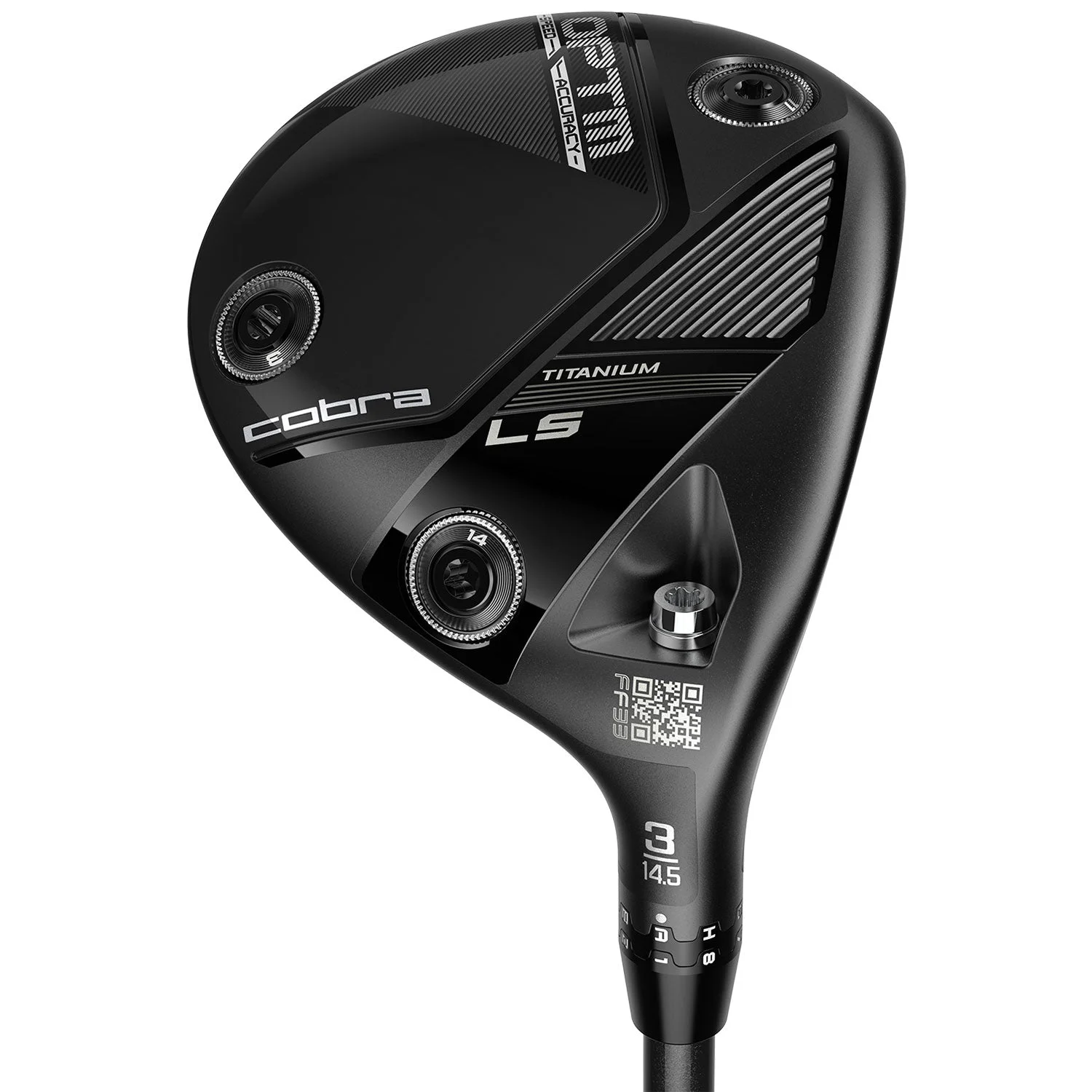
Cobra OPTM LS Fairway Wood
The fastest fairway wood in the Cobra lineup — titanium construction delivers 151+ mph ball speed and a penetrating low-spin flight that Golf Monthly headlined as the answer for golfers who 'Despise Your Driver,' though the compact head demands precision and costs $469.
The consensus
The Cobra OPTM LS is the speed king of the 2026 fairway wood lineup — the only fully titanium fairway wood in the OPTM family, built from an 8-1-1 titanium body paired with a forged titanium face featuring Cobra's H.O.T. Face 15-zone AI optimization. The result is ball speeds exceeding 157 mph in Golf Monthly's testing, prompting their headline 'Despise Your Driver? This Cobra Fairway Wood Might Be the Answer.' The LS designation means Low Spin, and the club delivers on that promise with a strong, penetrating trajectory that cuts through wind and maximizes roll-out.
Adjustability is exceptional — the most tunable fairway wood in the OPTM range. The FutureFit33 hosel provides 33 unique loft/lie positions with SMARTPAD technology keeping the face square at every setting, while three movable sole weights (14g, 11g, and 3g) allow more CG manipulation than the two-weight system in the X and Max models. This gives tour-level control over spin, launch, and bias. The carbon fiber crown saves weight for optimal CG positioning, and the compact ~184cc head enables the shot shaping that low handicappers demand.
The trade-off is clear: the LS demands precision. Multiple reviewers warned there is 'very little room for error' — the compact head punishes off-center hits more than any other OPTM fairway wood, and the low-spin design amplifies side spin rather than correcting it. At $469, it's also the most expensive option in the range, $100 more than the OPTM X that delivers nearly the same ball speed (~155 mph) in a more forgiving shape. For single-digit players with fast swing speeds who want a fairway wood they can work, the LS is outstanding. For everyone else, the OPTM X is the smarter buy.
The fastest fairway wood in the Cobra lineup — titanium construction delivers 151+ mph ball speed and a penetrating low-spin flight that Golf Monthly headlined as the answer for golfers who 'Despise Your Driver,' though the compact head demands precision and costs $469.
Category ratings
Where to buy
Prices checked June 2026. We may earn a commission from links above at no extra cost to you.
What the community loves
Full titanium construction (8-1-1 body + forged titanium face) produces the highest ball speeds of any OPTM fairway — Golf Monthly recorded 157 mph ball speed, with multiple sources noting 'some of the fastest ball speeds ever recorded' from a fairway wood. The H.O.T. Face 15-zone AI optimization maintains speed across the face.
The compact head and low-spin design allow skilled players to shape shots both ways with confidence. Multiple reviewers praised the ability to hit draws, fades, and penetrating stingers on command — a rarity in modern fairway woods optimized for forgiveness.
The 33-position FutureFit hosel with SMARTPAD (face stays square at every setting) plus three movable sole weights (14g, 11g, 3g) create the most tunable fairway wood in the OPTM family. Players can shift CG forward for even lower spin or back for more forgiveness.
Golf Monthly headlined their review 'Despise Your Driver? This Cobra Fairway Wood Might Be the Answer' — the LS produces a strong, boring trajectory that cuts through wind. Multiple testers found it viable as a primary tee club for accuracy-first players.
The all-titanium construction produces a distinctive, crisp impact sound that communicates speed. Reviewers described it as 'hot' and 'satisfying' — a higher-pitched crack compared to the steel-bodied X and Max models.
What to watch out for
The smaller ~184cc head looks noticeably more compact at address than the OPTM X (~180cc standard shape) or Max (~182cc oversized). Multiple reviewers warned there is 'very little room for error' — mishits are punished more than in any other OPTM fairway wood.
The aggressive low-spin design means mishits with side spin don't get the corrective effect of higher-spinning clubs — the ball curves away fast. Slices and hooks are amplified rather than moderated, making accuracy essential.
The titanium construction commands a $100 premium over the OPTM X ($369) and $140 over the Max ($329). While justified by materials, the price puts it in direct competition with the PING G440 LST ($370+) and Titleist GT3 Fairway.
Multiple sources — including Cobra's own positioning — suggest the OPTM X offers nearly the same ball speed (~155 mph vs 157 mph) in a far more forgiving package. Unless you specifically need lowest possible spin and maximum workability, the X is the safer choice.
Is it right for your game?
GolfWRX discussions praise the LS for its raw speed and penetrating flight — multiple members call it the best fairway wood for tee shots. However, the consensus recommendation is that the OPTM X is the better choice for most golfers, offering nearly identical ball speed (~155 mph vs 157 mph) in a significantly more forgiving package. The LS is reserved for single-digit players with fast swing speeds who specifically need lowest-spin performance and full workability.
What real people are saying
11 quotes from across the web, grouped by 5 themes. Click a theme to read the individual quotes.
Specifications
Available shafts (no upcharge)
Premium shafts available at additional cost: Graphite Design Tour AD VF, Tour AD UB, Tour AD DI
All sources analyzed
This review synthesizes opinions from 10 independent sources. Every claim on this page can be traced back to its original source. No manufacturer relationship or compensation.
The consensus score is built in four layers: raw source collection, normalization to a 0-10 scale, credibility-weighted combination, and quality adjustments.
Expert reviews (35% weight) are scored from language intensity and any numerical ratings provided. Data-driven testing (25%) converts product rank within the test group to a percentile score. Forum posts (30%) are AI-classified by sentiment, weighted by substantiveness. Retail reviews (10%) convert 5-star ratings with a 0.75x credibility discount to correct for systematic inflation.
Three quality adjustments are then applied: a source diversity bonus (up to +0.3 for coverage across all source types), a conflict penalty (up to -0.3 when sources strongly disagree), and recency weighting (recent reviews weighted higher than older ones).