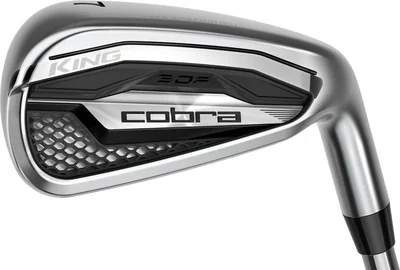
Cobra KING Irons
Cobra's 2026 flagship game-improvement iron brings 3D-printed technology down to an accessible price point — the hollow-body PWRSHELL construction and 80g catapult weight produce genuinely impressive ball speed, but feel lags the premium competition when you miss the center.
We may earn a commission if you buy through this link — it never affects our scores or the price you pay.
The consensus
The 2026 Cobra KING irons are the brand's flagship game-improvement iron — positioned below the premium 3DP range in price but above the entry-level KING MAX in player profile. GOLFTEC named them one of their top six iron picks for 2026, and performance data backs it up: compared to the previous DS-Adapt model, the KING irons produced 9.5% more greens in regulation and 1.4 strokes gained per round. Across 13 sources spanning expert reviews, launch monitor testing, and forum discussions, the KING irons earn consistent praise for distance, forgiveness, and value — with one shared reservation: feel on mishits is the price you pay for all that speed.
The technology story centers on three systems working together. The 80g catapult weight — suspended in shock-absorbing polymer at the base of the hollow body, and 15g heavier than in the DS-Adapt predecessor — drives energy transfer and ball speed. The 360 SPEEDSHELL face, now delivering 23% more flex than the previous generation, amplifies that speed across the full face through H.O.T. Face engineering that keeps off-center strikes competitive. And a 3D-printed ABS plastic rear medallion saves 5g of discretionary weight, allowing CG to drop 2mm for higher launch and steeper descent. The redesigned SKID SOLE rounds out the package with a bouncier leading edge and flatter mid-sole that works for both steep and shallow attack angles. Golf Monthly's tester, using a Foresight Sports GC3 launch monitor, confirmed the distance claims are real.
Where the consensus lands: buy the KING irons if you're a 9-20 handicapper with an average-to-fast swing speed who wants straight distance, genuine forgiveness on mishits, and a refined look that doesn't scream game-improvement. Accept that the hollow construction produces a slightly hollow feel on poor strikes — this is not an iron for feel purists or players who want to work the ball. The $999 steel price point makes it a compelling alternative to the Callaway Apex Ai200 and TaylorMade P790, both of which cost more and serve a slightly different player profile. If you need more launch and draw bias, the KING MAX (2-degree weaker lofts, larger profile) is the natural alternative within the same family.
Cobra's 2026 flagship game-improvement iron brings 3D-printed technology down to an accessible price point — the hollow-body PWRSHELL construction and 80g catapult weight produce genuinely impressive ball speed, but feel lags the premium competition when you miss the center.
Category ratings
Where to buy
What the community loves
The combination of the 80g catapult weight (15g heavier than in the DS-Adapt predecessor), the 360 SPEEDSHELL face (23% more flex than previous iterations), and strong lofts creates genuine power. Golf Monthly's tester measured data on a Foresight Sports GC3 launch monitor and concluded the KING irons are 'tough to beat in 2026' for raw distance. The H.O.T. Face technology improves ball speed across the full face, not just the center, narrowing the gap between center and off-center strike performance.
GolfMagic called the KING irons 'uber-forgiving, very fast and very straight.' The 3D-printed ABS plastic rear medallion saves up to 5g of discretionary weight and lowers the CG by 2mm, enabling high launch and tighter dispersion across a range of swing types and attack angles. The updated SKID SOLE adds leading-edge bounce and a flatter mid-sole for consistent turf interaction whether you're a picker or a digger. Forum members repeatedly praised straight flight as a standout quality.
At $999 for a 5-GW set in steel, the KING irons bring hollow-body construction, 3D-printed technology, and PWRSHELL face engineering into a mid-market price point. GolfMagic noted they are 'a great value proposition and well-priced compared to their main competitors from TaylorMade and Callaway.' The iron delivers most of what Cobra's pricier 3DP range achieves for roughly half the cost.
The KING irons have a refined, traditional game-improvement profile that doesn't look oversized or cartoonish. Reviewers noted a clean topline with moderate offset that inspires confidence at address without looking like a beginner's club. The progressive design geometry optimizes sole widths, CG placements, and lofts across the set — long irons have tungsten in the sole for added forgiveness, short irons are refined for control.
The redesigned SKID SOLE was specifically engineered to serve golfers with steep or shallow attack angles. The bouncier leading edge reduces digging for steep swingers while the flatter mid-sole helps shallow pickers make crisper contact. MyGolfSpy highlighted this as a meaningful improvement over the previous DS-Adapt model, noting it broadens the iron's effective user base.
What to watch out for
The one area where reviewer consensus tilts negative. GolfMagic was direct: 'An area where the KING irons lag a little behind their competitors is feel.' On poor strikes, a hollow, boardy sensation was noted that competing cavity-backs and hollow-body irons (like the TaylorMade P790 or Callaway Apex Ai200) handle better. Center strikes feel 'hot and powerful' but the feedback gap on mishits is noticeable for feel-conscious players.
The KING irons run strong throughout the set (4-iron at 19°, PW at approximately 43°). Golfers transitioning from traditional-lofted sets will need to re-evaluate their wedge gapping. The PW to sand wedge gap can be significant, and many reviewers and forum members flagged that a gap wedge or a 48° wedge becomes essential. Golfers who play a standard 52/56/60 wedge setup may find their short game distances don't flow naturally from the KING set.
MyGolfSpy noted that Cobra made a deliberate design decision prioritizing distance and playability over pure feel and workability. The KING is tuned for the 11-20 handicap golfer who wants straight distance — it lacks the workability and feedback that better players expect. Players seeking to shape shots or hit specific trajectories will be better served by the Cobra KING Tour or competing players-distance irons.
While Cobra's marketing prominently features 3D-printing technology, MyGolfSpy put it in perspective: the 3D-printed rear medallion is ABS plastic and saves just 5 grams of weight — a relatively modest contribution compared to the 3DP X and 3DP Tour irons where the printing is structural. The primary distance drivers here are the 80g catapult weight and 360 SPEEDSHELL face, not the 3D-printed element itself.
Is it right for your game?
Strong agreement on distance and forgiveness; the only meaningful divide is between players who accept the hollow feel trade-off and those who don't — the latter should look at the 3DP X or a forged alternative.
What real people are saying
19 quotes from across the web, grouped by 8 themes. Click a theme to read the individual quotes.
Specifications
Available shafts (no upcharge)
Premium shafts available at additional cost: Graphite Design Tour AD VF, Tour AD UB, Tour AD DI
All sources analyzed
This review synthesizes opinions from 13 independent sources. Every claim on this page can be traced back to its original source. No manufacturer relationship or compensation.
The consensus score is built in four layers: raw source collection, normalization to a 0-10 scale, credibility-weighted combination, and quality adjustments.
Expert reviews (35% weight) are scored from language intensity and any numerical ratings provided. Data-driven testing (25%) converts product rank within the test group to a percentile score. Forum posts (30%) are AI-classified by sentiment, weighted by substantiveness. Retail reviews (10%) convert 5-star ratings with a 0.75x credibility discount to correct for systematic inflation.
Three quality adjustments are then applied: a source diversity bonus (up to +0.3 for coverage across all source types), a conflict penalty (up to -0.3 when sources strongly disagree), and recency weighting (recent reviews weighted higher than older ones).