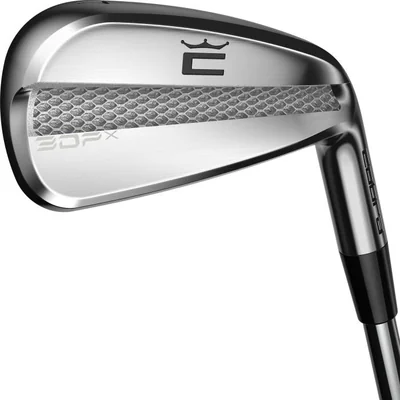
Cobra 3DP X Irons
The best game-improvement iron of 2026 — 3D-printed 316 stainless steel delivers forged-iron feel with super game-improvement forgiveness in a compact, players-inspired shape. But at $1,980 for six clubs, the price is the one thing holding it back.
We may earn a commission if you buy through this link — it never affects our scores or the price you pay.
The consensus
The Cobra 3DP X is a Golf Digest Hot List selection for 2026 and was called 'without doubt the best iron of 2026' by Golf Monthly. Built using Direct Metal Laser Sintering (DMLS) — the same 3D-printing process behind the award-winning 3DP Tour — the 3DP X targets mid-handicap golfers who want premium feel and exceptional forgiveness without the chunky profile of a traditional game-improvement iron. Across 12 sources spanning expert reviewers, forum discussions, and retail feedback, the consensus is clear: this iron delivers on nearly every performance metric. The one universal caveat is the price.
Where sources agree most strongly: feel and forgiveness. Golf Monthly gave a perfect 5/5 rating and praised the feel as 'nothing short of spectacular.' GolfMagic noted the feel rivals premium forged irons from Mizuno and Titleist. The internal lattice structure — made possible only through 3D printing — saves over a third of the club's weight and allows up to 55 grams of tungsten to be positioned in the toe and hosel for maximum MOI. Cobra claims the result exceeds the forgiveness of their own DS-Adapt Max, a much larger super game-improvement iron. GolfMagic measured tight dispersion with 145 yards of carry on the 7-iron at moderate swing speeds.
Where the consensus fractures: price and nothing else. At $1,980 for a six-piece 5-PW set ($330 per iron), the 3DP X costs roughly double what competing game-improvement irons charge. Golf Monthly acknowledged it plainly — the price is 'the one major issue.' GolfMagic called it 'a significant departure from Cobra's typical value positioning.' The question is whether the 3D-printed construction justifies the premium over excellent (and much cheaper) alternatives from TaylorMade, Callaway, and Ping. If budget is not a constraint, this is arguably the best game-improvement iron ever made. If it is, you have plenty of great options at half the price.
The best game-improvement iron of 2026 — 3D-printed 316 stainless steel delivers forged-iron feel with super game-improvement forgiveness in a compact, players-inspired shape. But at $1,980 for six clubs, the price is the one thing holding it back.
Category ratings
What the community loves
The defining achievement of the 3DP X. Despite being built from 2,600 layers of laser-sintered 316 stainless steel rather than forged, the feel rivals premium forged irons from Mizuno and Titleist. Golf Monthly gave it a perfect 5/5 and called the feel 'nothing short of spectacular.' The internal lattice structure absorbs unwanted vibration while transmitting precise feedback on center strikes.
Cobra claims the 3DP X exceeds the forgiveness of their DS-Adapt Max — a full-size game-improvement iron — despite having a significantly smaller, players-inspired profile. The internal lattice saves over a third of the club's weight, allowing up to 55g of tungsten to be positioned in the toe and hosel for maximum MOI. Reviewers consistently noted tight dispersion on mishits.
The 3DP X looks like a players iron but plays like a game-improvement club. Clean topline, moderate offset, and the exposed lattice structure on the back cavity give it a premium, tech-forward appearance. Multiple reviewers noted it looks like a low-handicap iron from the bag and frames the ball beautifully at address.
The 7-iron at 29 degrees is strong-lofted but the high launch from the low CG makes it play its stated distance. GolfMagic measured 145 yards carry with 5,084 rpm spin on the 7-iron. Golf Blue Heron rated distance 96/100. The lattice-backed thin face generates competitive ball speed across the face.
The DMLS (Direct Metal Laser Sintering) 3D-printing process enables internal geometries impossible with traditional forging or casting. The lattice structure is not decoration — it redistributes over 95g of weight to optimize CG position. Multiple reviewers praised Cobra for genuine R&D innovation rather than incremental loft changes.
What to watch out for
The dominant criticism across every review. At $330 per iron, the 3DP X costs roughly double what competing game-improvement irons charge. Golf Monthly's headline called it 'the one major issue.' GolfMagic noted it's a 'significant departure from Cobra's typical value positioning.' For the 10-20 handicap target market, $1,980 for six irons is a tough sell.
The standard set is 5-PW only (six clubs). There is a gap wedge available separately, but no 4-iron in the standard set. Golfers wanting a full set from 4-GW will pay even more. Competing sets from TaylorMade and Callaway typically include more clubs for less money.
While the 3DP X offers more shot-shaping ability than traditional game-improvement irons, it doesn't match the workability of the 3DP Tour or 3DP MB siblings. Golfers who want to flight the ball both ways or hit specific trajectories will find the high MOI works against them. This is the trade-off for the forgiveness.
A 29-degree 7-iron and 23-degree 5-iron are meaningfully stronger than traditional lofts. Golfers transitioning from traditional-lofted irons will need to re-gap their wedge setup. The 43-degree PW leaves a significant gap to a standard 56-degree sand wedge.
Is it right for your game?
What real people are saying
22 quotes from across the web, grouped by 8 themes. Click a theme to read the individual quotes.
Specifications
Available shafts (no upcharge)
Premium shafts available at additional cost: Graphite Design Tour AD VF, Tour AD UB, Tour AD DI
All sources analyzed
This review synthesizes opinions from 12 independent sources. Every claim on this page can be traced back to its original source. No manufacturer relationship or compensation.
The consensus score is built in four layers: raw source collection, normalization to a 0-10 scale, credibility-weighted combination, and quality adjustments.
Expert reviews (35% weight) are scored from language intensity and any numerical ratings provided. Data-driven testing (25%) converts product rank within the test group to a percentile score. Forum posts (30%) are AI-classified by sentiment, weighted by substantiveness. Retail reviews (10%) convert 5-star ratings with a 0.75x credibility discount to correct for systematic inflation.
Three quality adjustments are then applied: a source diversity bonus (up to +0.3 for coverage across all source types), a conflict penalty (up to -0.3 when sources strongly disagree), and recency weighting (recent reviews weighted higher than older ones).