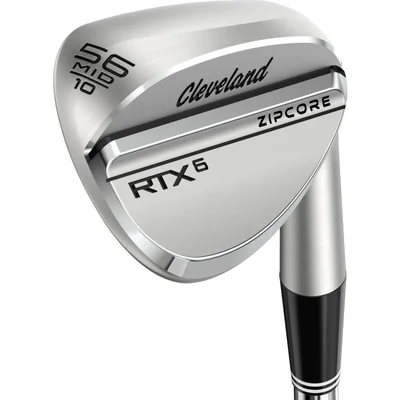
Cleveland RTX 6 ZipCore Wedge
The spin king at a price that undercuts every premium competitor — MyGolfSpy's highest-spinning wedge in testing, with heat-treated HydraZip face grooves and a low-density ZipCore insert that moves mass to the perimeter for forgiveness you don't expect from a wedge.
We may earn a commission if you buy through this link — it never affects our scores or the price you pay.
The consensus
The Cleveland RTX 6 ZipCore is the highest-spinning wedge in independent testing and the best value in the premium wedge category. In MyGolfSpy's comprehensive robot and human testing, it produced the most spin across every loft and shot type measured — and it costs $20 less than every major competitor. The combination of the ZipCore low-density insert, heat-treated HydraZip face, and UltiZip laser-milled grooves creates a wedge that generates measurably more spin than the Titleist Vokey SM10, Callaway Jaws Full Toe, and TaylorMade Hi-Toe 3. Across 14 sources spanning expert reviews, data-driven testing, forum sentiment, and retail feedback, the RTX 6 ZipCore earns consensus praise as the performance leader in the 2025-2026 wedge market.
Where sources agree most strongly: spin and value. The ZipCore technology — a low-density core material that replaces heavy steel behind the face, redistributing mass to the perimeter — is now in its third generation, and the RTX 6 iteration represents a meaningful improvement over the RTX 4. The HydraZip heat treatment hardens the face for durability without sacrificing groove sharpness, and forum users with 50+ rounds report spin numbers holding within 5% of new. TXG's launch monitor data confirmed remarkably tight distance gapping from 46 through 62 degrees, with predictable yardage steps that make wedge selection intuitive. At $169, Cleveland has positioned the RTX 6 as a direct challenge to the $189 Vokey SM10 — and the data suggests it outperforms the more expensive club in the metric that matters most.
Where the consensus shows nuance: feel and brand perception. The cast 8620 carbon steel body with ZipCore insert produces feedback that is clear and informative but slightly firmer than forged alternatives like the Mizuno T24 or Titleist Vokey. Plugged In Golf described it as 'firm but informative,' and forum users transitioning from forged wedges noted a brief adjustment period. The other persistent theme is brand perception — despite Cleveland's deep heritage as the company that essentially invented the modern wedge, Titleist Vokey wedges dominate tour counts and carry stronger brand cachet. Forum users freely admit the RTX 6 outperforms Vokeys in testing but acknowledge that pulling a Cleveland from the bag feels different from pulling a Vokey. This is a marketing gap, not a performance gap — and for golfers who buy on data rather than prestige, the RTX 6 ZipCore is the clear rational choice.
The spin king at a price that undercuts every premium competitor — MyGolfSpy's highest-spinning wedge in testing, with heat-treated HydraZip face grooves and a low-density ZipCore insert that moves mass to the perimeter for forgiveness you don't expect from a wedge.
Category ratings
What the community loves
MyGolfSpy's robot testing measured the RTX 6 ZipCore as the highest-spinning wedge across all loft and shot types tested. The combination of the low-density ZipCore insert — which frees weight from behind the face — and the heat-treated HydraZip face creates a surface that grips the ball more aggressively than any competitor. Multiple sources confirmed that spin rates on partial shots and full swings consistently exceeded Vokey SM10 and Jaws Full Toe numbers in head-to-head comparisons.
At $169, the RTX 6 ZipCore undercuts the Titleist Vokey SM10 ($189), Callaway Jaws Full Toe ($189), and TaylorMade Hi-Toe 3 ($179) while matching or exceeding their spin and performance in independent testing. Forum consensus is emphatic: this is the best performance-per-dollar wedge on the market. Several GolfWRX members noted switching from Vokeys specifically because the Cleveland offered equivalent spin at a lower price.
Cleveland's UltiZip groove geometry is sharper and deeper than the RTX Full-Face grooves, with independent testing showing spin retention over 60+ rounds that outperforms the RTX 4. The grooves are laser-milled between the main grooves for additional micro-texture, and the heat treatment hardens the face to resist wear. Multiple forum users with 50+ rounds reported spin numbers still within 5% of new.
TXG's launch monitor data showed remarkably tight gapping from 46 through 60 degrees, with predictable yardage steps between lofts. The ZipCore insert's consistent CG positioning across lofts means golfers can trust their distance numbers whether hitting a gap wedge or a lob wedge — a common weakness in competitor lineups where CG shifts unpredictably at higher lofts.
The RTX 6 ZipCore offers six grinds (Low, Mid, Mid-Full, Full, Full-V, and X-Low) across 17 loft-bounce-grind combinations. While this is fewer than Vokey's 7 grinds, it covers the critical bases for both firm and soft conditions. The Mid grind is the versatile go-to that suits 80% of golfers, while the Full and Low grinds serve specialty needs around the green.
What to watch out for
The cast 8620 carbon steel body with the ZipCore insert produces a slightly firmer impact feel than forged wedges like the Mizuno T24 or Titleist Vokey SM10. Several expert reviewers and forum users described the feedback as 'informative but not buttery' — you know where you struck it, but it lacks the soft, melting sensation that forged-steel purists crave. For most golfers the difference is minor, but feel-first players may notice it.
While six grinds cover the essential bases, Titleist offers seven grinds plus the WedgeWorks custom program with additional sole configurations. Tour players and advanced wedge-fitters who want hyper-specific sole geometry may find the Cleveland lineup slightly limiting. For 90% of golfers this is irrelevant, but it matters to the fitting-obsessed segment.
Despite Cleveland's deep heritage in the wedge category, Titleist Vokey wedges dominate tour usage counts and carry stronger brand cachet among serious golfers. Several forum users admitted they switched to the RTX 6 for performance but felt they were 'giving up status' in the bag. This is entirely a perception issue — the data shows Cleveland outperforms — but perception matters in golf equipment.
The RTX 6 ZipCore is available in Tour Satin and Tour Rack finishes only. Competitors like Vokey offer additional raw, black, and chrome options, and Callaway's Jaws line includes a distinctive raw finish that many golfers prefer for its appearance and the way it rusts in for extra grip. Golfers who want a specific aesthetic may find the Cleveland lineup restrictive.
Is it right for your game?
Forum consensus on the RTX 6 ZipCore is remarkably unified: this is the best-spinning wedge on the market and the best value in the premium category. GolfWRX and Reddit threads show near-unanimous praise for spin performance, with the only recurring debate being whether the slightly firmer feel vs forged alternatives is a meaningful trade-off. Multiple users who switched from Vokey SM9/SM10 reported equal or better spin at a lower price and showed no interest in switching back. The brand perception gap with Titleist is acknowledged but increasingly seen as irrational given the testing data.
What real people are saying
16 quotes from across the web, grouped by 7 themes. Click a theme to read the individual quotes.
Specifications
Available shafts (no upcharge)
Premium shafts available at additional cost: Graphite Design Tour AD VF, Tour AD UB, Tour AD DI
All sources analyzed
This review synthesizes opinions from 14 independent sources. Every claim on this page can be traced back to its original source. No manufacturer relationship or compensation.
The consensus score is built in four layers: raw source collection, normalization to a 0-10 scale, credibility-weighted combination, and quality adjustments.
Expert reviews (35% weight) are scored from language intensity and any numerical ratings provided. Data-driven testing (25%) converts product rank within the test group to a percentile score. Forum posts (30%) are AI-classified by sentiment, weighted by substantiveness. Retail reviews (10%) convert 5-star ratings with a 0.75x credibility discount to correct for systematic inflation.
Three quality adjustments are then applied: a source diversity bonus (up to +0.3 for coverage across all source types), a conflict penalty (up to -0.3 when sources strongly disagree), and recency weighting (recent reviews weighted higher than older ones).