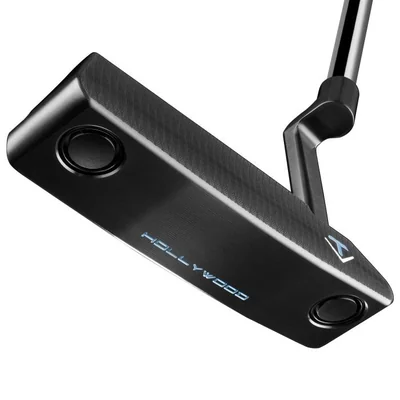
Toulon Hollywood H1 Putter
A CNC-milled blade inspired by Toulon's San Diego design with concave shoulders and Deep Tuna face milling — Today's Golfer's best blade putter for feel and roll out of 72 putters tested.
We may earn a commission if you buy through this link — it never affects our scores or the price you pay.
The consensus
The Toulon Hollywood H1 is a CNC-milled blade putter that represents Toulon Golf's vision of the classic blade, reimagined. Inspired by the brand's San Diego design but with softened, concave shoulders that create a vintage visual flow, the Hollywood quickly became Toulon's best-selling SKU despite the mallet-dominated putter market. In Today's Golfer's comprehensive 72-putter test, the Hollywood earned the top spot for feel and feedback across all putters tested and tied for first in roll quality — all while winning the gold medal for looks. National Club Golfer called the craftsmanship 'on another level,' and the putter has earned a devoted following among blade purists who value handmade quality and minimalist design.
Where sources agree most strongly: feel and roll are exceptional. The Deep Tuna face milling on 304 stainless steel produces what Today's Golfer called the best feedback in their entire 72-putter test. The front-loaded milled round weights improve ball speed consistency across the face, and the modified tri-sole with three distinct facets ensures the putter sits perfectly square at address every time. The Anthracite finish with Heritage Blue and Italian Racing Red accents is refreshingly understated — minimal branding, no commercial flair, just craftsmanship. The stability rating also surprised reviewers, with Today's Golfer finding the Hollywood was the most stable blade in the entire test despite its compact profile.
Where the honest trade-offs emerge: price, alignment, and forgiveness. At $600, the Hollywood H1 is one of the most expensive production blade putters available, and forum consensus suggests the performance gap versus excellent $300-400 blades is smaller than the price gap implies. The single white sight dot offers minimal alignment assistance — a deliberate design choice that rewards experienced players who trust their stroke but penalizes golfers who rely on visual guides. And as with any blade, forgiveness remains limited versus mallet alternatives with higher MOI. The Hollywood is for the golfer who prioritizes feel, aesthetics, and craftsmanship over alignment technology and forgiveness — and for that player, it competes with anything on the market.
A CNC-milled blade inspired by Toulon's San Diego design with concave shoulders and Deep Tuna face milling — Today's Golfer's best blade putter for feel and roll out of 72 putters tested.
Category ratings
What the community loves
Today's Golfer ranked the Hollywood H1 first overall for feel and feedback out of all 72 putters tested in their comprehensive review — blade and mallet combined. The Deep Tuna face mill on the 304 stainless steel creates a soft yet crisp impact that multiple reviewers described as addictive. The Hollywood also tied for first place in roll quality across the entire 72-putter field, producing a consistently true forward roll from first contact. National Club Golfer called the feel 'on another level' with a 'really natural feel off the face.'
The Hollywood is an all-new blade inspired by Toulon's San Diego but with softened, concave shoulders that create a vintage visual flow described by Today's Golfer as the 'Mona Lisa of putters.' The Anthracite finish with Heritage Blue and Italian Racing Red accents is refreshingly free of excessive branding — minimal text and logos, with the focus purely on craftsmanship. The design achieves understated elegance that blade purists consistently praise as one of the best-looking putters available at any price.
Today's Golfer found the Hollywood won for stability in the blade category, calling it extremely stable for its size. The front-loaded milled round weights improve ball speed consistency across the face, meaning off-center strikes lose less speed and direction than typical compact blades. This is a meaningful differentiator versus competitors where blade stability is usually the first compromise.
The tri-sole design features three distinct facets with a flat center section and gentle heel and toe relief. This ensures the putter soles consistently and sits perfectly square at address on any green surface. Multiple reviewers noted that the putter inspires confidence immediately at setup — you place it down and it just looks right, every time.
Toulon Golf operates as Callaway's premium putter division, CNC-milling each head from a single block of 304 stainless steel. The manufacturing quality consistently draws comparisons to Scotty Cameron. Toulon putters have built a devoted following among players who value hand-finished craftsmanship, and the Hollywood was their best-selling SKU despite the mallet-dominated market.
What to watch out for
The Hollywood features only a single white sight dot on the topline — no sightlines, no alignment marks, no visual guides beyond the clean topline itself. Today's Golfer specifically noted that alignment is not the putter's strongest feature. While blade purists view this as a positive (promoting trust in your stroke), mid and high handicappers who rely on alignment aids for consistent setup will struggle. This is a putter that asks you to aim with instinct, not assistance.
At $600 MSRP, the Hollywood H1 costs more than nearly every standard production blade putter on the market — including the Scotty Cameron Super Select Newport 2 at $449. The craftsmanship and materials are premium, but the performance gap versus excellent $200-350 blades from Ping, Cleveland, and Odyssey is narrower than the price gap. Forum users who have compared them note diminishing returns beyond the $400 price point.
Despite the Hollywood's strong stability rating for a blade, it still offers significantly less MOI and forgiveness than any mallet putter at a similar price. Off-center strikes lose more speed and direction than high-MOI alternatives. Golfers who consistently miss the sweet spot will putt better with a mallet regardless of how good the Hollywood feels on pure strikes.
The Hollywood H1's 45-degree toe hang is designed for moderate to strong arc putting strokes. Golfers with a straight-back, straight-through or minimal-arc stroke will find the putter wants to open and close more than their mechanics demand. The H1 hosel configuration is the only option — there is no face-balanced or reduced toe hang version of the Hollywood.
Is it right for your game?
The Hollywood H1 earned the top spot for feel and roll quality across Today's Golfer's entire 72-putter test, and the community consensus strongly validates that result. The Deep Tuna face milling, front-loaded weights, and CNC-milled construction deliver blade putter performance that rivals Scotty Cameron at $150 less. The honest debate: at $600, you're paying a significant premium for craftsmanship and aesthetics — golfers who prioritize scoring over sensory experience should compare the Hollywood against the PING PLD Milled Anser and Scotty Cameron Newport 2 before committing.
What real people are saying
12 quotes from across the web, grouped by 5 themes. Click a theme to read the individual quotes.
Specifications
Available shafts (no upcharge)
Premium shafts available at additional cost: Graphite Design Tour AD VF, Tour AD UB, Tour AD DI
All sources analyzed
This review synthesizes opinions from 10 independent sources. Every claim on this page can be traced back to its original source. No manufacturer relationship or compensation.
The consensus score is built in four layers: raw source collection, normalization to a 0-10 scale, credibility-weighted combination, and quality adjustments.
Expert reviews (35% weight) are scored from language intensity and any numerical ratings provided. Data-driven testing (25%) converts product rank within the test group to a percentile score. Forum posts (30%) are AI-classified by sentiment, weighted by substantiveness. Retail reviews (10%) convert 5-star ratings with a 0.75x credibility discount to correct for systematic inflation.
Three quality adjustments are then applied: a source diversity bonus (up to +0.3 for coverage across all source types), a conflict penalty (up to -0.3 when sources strongly disagree), and recency weighting (recent reviews weighted higher than older ones).