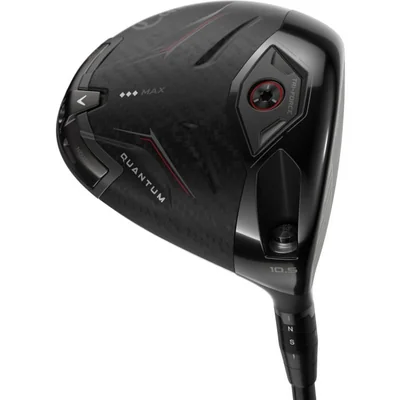
Callaway Quantum Triple Diamond Max Driver
The most complete driver of 2026 — blending the explosive ball speed and low-spin characteristics of a Triple Diamond with genuine forgiveness in a full 460cc shape. Today's Golfer named it their overall best driver of 2026, and Golf Digest awarded it a Hot List Gold Medal.
We may earn a commission if you buy through this link — it never affects our scores or the price you pay.
The consensus
The Callaway Quantum Triple Diamond Max is a low-spin, tour-validated driver built around Callaway's breakthrough Tri-Force Face — a three-layer construction of titanium, poly mesh, and carbon fiber that's AI-tuned to optimize speed, spin, launch, and accuracy. At 460cc, it offers the low-spin characteristics of a Triple Diamond in a larger, more forgiving package that was previously available only on tour. Across 9 sources spanning expert reviews, data-driven testing, forum opinions, and retail feedback, the consensus is clear: this is the most complete driver Callaway has made in years.
Where sources agree strongly: ball speed is elite, forgiveness is surprisingly good for a low-spin head, and the feel at impact is sensational. Golf Monthly awarded 5/5 for both tech and performance and called it the best-feeling Callaway driver ever. Today's Golfer named it their overall Best Driver of 2026 after comprehensive testing — praising its combination of near-top-5 carry distance (282.9 yards), manageable spin (2,065 rpm), and tight dispersion. Golf Digest gave it a Gold Medal on their 2026 Hot List.
Where opinions diverge: the $699.99 price point draws criticism, with some questioning whether it justifies a $100 premium over the Quantum Max. The slightly triangular head shape at address divides aesthetic opinion — some love the aggressive tour look, others find it less confidence-inspiring. And while forgiveness is strong for a Triple Diamond, this is still a better-player's driver. Today's Golfer experts suggested a 10-15 handicap floor. High handicappers and slower swing speeds should look at the Quantum Max or Max Fast instead.
The most complete driver of 2026 — blending the explosive ball speed and low-spin characteristics of a Triple Diamond with genuine forgiveness in a full 460cc shape. Today's Golfer named it their overall best driver of 2026, and Golf Digest awarded it a Hot List Gold Medal.
Category ratings
What the community loves
The three-layer face construction — titanium, poly mesh, and carbon fiber — is AI-tuned and produces ball speeds that consistently rank among the fastest in the 2026 class. Today's Golfer measured 161.1 mph ball speed. Multiple reviewers describe the face as feeling like a trampoline at impact.
Unlike typical Triple Diamond models that punish mishits, the TD Max delivers stability closer to a game-improvement driver. Today's Golfer found its left-to-right dispersion of 16.3 yards competitive with forgiving-category heads. Callaway rates its forgiveness as "Higher" — matching the Quantum Max.
Reviewers consistently describe the TD Max's feel as uniquely satisfying — solid and powerful but with an understated, bouncy quality from the Tri-Force Face. Golf Monthly's reviewer called it the best-feeling Callaway driver ever made. Sound is muted and refined, preferred by better players.
Won the most comprehensive independent driver test of 2026 outright. Beat the entire 2026 field by combining near-elite distance (282.9 yards carry, 5th overall), tight dispersion, and manageable spin (2,065 rpm). The testers called it a true jack-of-all-trades.
The Triple Diamond Max shape was previously tour-only. This is the first time Callaway has offered a full 460cc head with Triple Diamond low-spin characteristics to consumers. Golf Monthly highlighted how rare retail access to this head shape is.
A 10g adjustable rear weight with neutral and fade positions lets players fine-tune shot shape. The OptiFit hosel provides up to +2°/-1° loft adjustment across 8 configurations. Combined, this gives fitters meaningful levers to optimize launch and bias.
What to watch out for
At $699.99, it's among the most expensive drivers in 2026 — $50 more than the standard Triple Diamond and matching the top-tier pricing from TaylorMade and Titleist. Some reviewers questioned whether the performance gains justify the premium over the Quantum Max at $599.99.
Golf Monthly noted the at-address look is slightly triangular with a lean toward the heel, which some golfers may find less confidence-inspiring than a traditional rounded shape. Today's Golfer's tester described the look as polarizing among mid-handicappers in their fitting group.
While more forgiving than a standard Triple Diamond, this is still a low-spin, tour-oriented driver. High handicappers who struggle with consistent contact will get better results from the Quantum Max or Max Fast. Today's Golfer suggested it suits golfers from about 10 handicap and below most comfortably.
Golfalot measured spin rates around 2,500 rpm on the Triple Diamond vs. the TD Max's approximately 2,065 rpm in Today's Golfer's test. Golfers who need the absolute lowest spin for maximum distance should test the standard Triple Diamond head, which is 10cc smaller but spins less.
Is it right for your game?
Sources broadly agree this is the most complete driver of 2026, but the value question divides opinion. At $699.99, it's the most expensive Callaway driver — and some forum users argue the $599.99 Quantum Max delivers 90% of the performance for $100 less. The aesthetic split is real too: the triangular-ish head shape is Tour-inspired but doesn't suit every eye. If you're a single-digit player who wants low spin with real forgiveness, this is likely your driver. If you're above a 15 handicap, test the Quantum Max first.
What real people are saying
22 quotes from across the web, grouped by 9 themes. Click a theme to read the individual quotes.
Specifications
Available shafts (no upcharge)
Premium shafts available at additional cost: Graphite Design Tour AD VF, Tour AD UB, Tour AD DI
All sources analyzed
This review synthesizes opinions from 9 independent sources. Every claim on this page can be traced back to its original source. No manufacturer relationship or compensation.
The consensus score is built in four layers: raw source collection, normalization to a 0-10 scale, credibility-weighted combination, and quality adjustments.
Expert reviews (35% weight) are scored from language intensity and any numerical ratings provided. Data-driven testing (25%) converts product rank within the test group to a percentile score. Forum posts (30%) are AI-classified by sentiment, weighted by substantiveness. Retail reviews (10%) convert 5-star ratings with a 0.75x credibility discount to correct for systematic inflation.
Three quality adjustments are then applied: a source diversity bonus (up to +0.3 for coverage across all source types), a conflict penalty (up to -0.3 when sources strongly disagree), and recency weighting (recent reviews weighted higher than older ones).