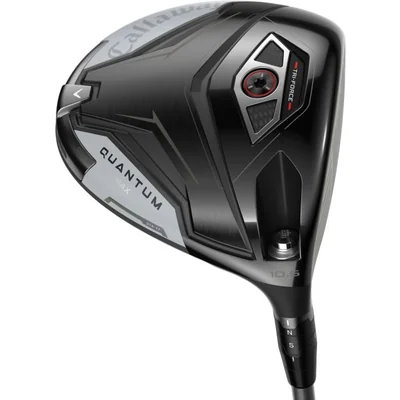
Callaway Quantum Max Driver
Callaway's 2026 flagship driver pairs a first-of-its-kind Tri-Force Face with AI-optimized face mapping to deliver elite ball speed and consistency. Runner-up in MyGolfSpy's Best Drivers of 2026 and a Golf Digest Hot List Gold Medal winner — the Quantum Max is a must-try for golfers who want speed without sacrificing forgiveness.
We may earn a commission if you buy through this link — it never affects our scores or the price you pay.
The consensus
The Callaway Quantum Max is the company's 2026 flagship core-model driver, replacing the Paradym Ai Smoke family with a groundbreaking Tri-Force Face — a three-layer construction layering titanium, poly mesh, and carbon fiber into a single face for the first time in driver design. Combined with next-generation AI-optimized face mapping, the result is a driver built for speed and consistency across the entire hitting area. Across 12 sources spanning expert reviews, data-driven testing, forum opinions, and retail feedback, ball speed and distance are the clear consensus strengths.
Where sources agree strongly: the Quantum Max delivers elite ball speed that matches or beats every competitor tested. MyGolfSpy ranked it #1 for distance (163.7 mph ball speed, 286.2 yards carry) and runner-up overall in their Best Drivers of 2026. Golf Digest awarded it a Hot List Gold Medal. Today's Golfer called it 'the most accurate core-category driver we've tested in two years.' The feel from the Tri-Force Face is a clear step forward — meatier, more powerful, and more responsive than recent Callaway generations.
Where the consensus fractures: forgiveness and value. Despite strong expert reviews, MyGolfSpy's data testing found forgiveness merely average for the class — the Quantum Max is a speed-first driver, not a forgiveness-first driver. Multiple sources also flagged the $649.99 price as steep, noting the TaylorMade Qi4D and Cobra OPTM X offer comparable performance for less. And existing Elyte owners may not see enough improvement to justify the upgrade — Golfstead found ball speed gains of just 0.2–0.4 mph. If you're buying fresh, the Quantum Max is an outstanding choice. If you're upgrading from last year's Callaway, test before you buy.
Callaway's 2026 flagship driver pairs a first-of-its-kind Tri-Force Face with AI-optimized face mapping to deliver elite ball speed and consistency. Runner-up in MyGolfSpy's Best Drivers of 2026 and a Golf Digest Hot List Gold Medal winner — the Quantum Max is a must-try for golfers who want speed without sacrificing forgiveness.
Category ratings
What the community loves
The Tri-Force Face generates ball speeds consistently at or above competing drivers. MyGolfSpy recorded 163.7 mph ball speed and 286.2 yards carry, ranking it #1 for distance in their 2026 test. Golfalot measured 154 mph average with 259 yards carry. Today's Golfer called it 'the most accurate core-category driver we've tested in two years.'
The three-layer face (titanium, poly mesh, carbon fiber) delivers a feel that reviewers describe as solid, bouncy, and fast. Plugged In Golf noted ample feedback on strike location. GolfMagic called it 'a much meatier, powerful sensation compared to some of Callaway's softer previous models.' A clear step forward in feel from the Elyte generation.
MyGolfSpy ranked it runner-up for accuracy. Today's Golfer called it the most accurate core-category driver they'd tested in two years, with dispersion notably tighter than the Triple Diamond Max and Max D. Golfstead praised consistent spin across the entire face.
The OptiFit hosel offers 8 loft/lie configurations (up to +2°/-1°), and a movable perimeter weight allows neutral or draw-biased setups. Golfstead noted the draw weight introduces up to 10 yards of draw. Premium adjustability for a core-model driver.
Unlike many core-model drivers that favor either better players or high handicappers, the Quantum Max is praised for suiting almost any handicap level. Plugged In Golf said it 'can work for almost any handicap depending on ball flight preference.' The combination of speed and stability makes it a versatile platform.
What to watch out for
Despite being Callaway's core model, MyGolfSpy found forgiveness only average in their test group. Golfalot noted a slight reduction in speed on off-center strikes. This is a speed-first driver, not a forgiveness-first driver — if maximum mishit protection is your priority, the Max D or competitors like the Ping G440 may be better choices.
Multiple sources noted the performance gains over the Ai Smoke Elyte are incremental rather than transformative. Golfstead found ball speed 0.2–0.4 mph lower than the Elyte and spin 100–200 RPM higher. Golfalot and GolfMagic both questioned whether the upgrade justifies the price for existing Elyte owners.
At $649.99, the Quantum Max is $50 more than the TaylorMade Qi4D and $120 more than the Cobra OPTM X. GolfMagic specifically flagged the price as a weakness, noting competitors offer comparable or better value. Several UK reviewers at £599 called the price difficult to justify in the current economic climate.
The grey carbon sole and thin white chevron alignment aid drew mild criticism from multiple reviewers. Golfalot gave looks just 3/5. Today's Golfer called the grey sole colorway uninspiring. Golf Monthly noted the design closely resembles the previous generation. The Triple Diamond Max is considered the better-looking sibling.
Is it right for your game?
The biggest split across sources is on forgiveness. Expert reviewers consistently praise the Quantum Max's stability and consistency, but MyGolfSpy's robot testing found forgiveness merely average for the class. This is fundamentally a speed-first driver. If maximum mishit protection is your top priority, test it against the Quantum Max D or the Ping G440 before committing.
What real people are saying
27 quotes from across the web, grouped by 9 themes. Click a theme to read the individual quotes.
Specifications
Available shafts (no upcharge)
Premium shafts available at additional cost: Graphite Design Tour AD VF, Tour AD UB, Tour AD DI
All sources analyzed
This review synthesizes opinions from 12 independent sources. Every claim on this page can be traced back to its original source. No manufacturer relationship or compensation.
The consensus score is built in four layers: raw source collection, normalization to a 0-10 scale, credibility-weighted combination, and quality adjustments.
Expert reviews (35% weight) are scored from language intensity and any numerical ratings provided. Data-driven testing (25%) converts product rank within the test group to a percentile score. Forum posts (30%) are AI-classified by sentiment, weighted by substantiveness. Retail reviews (10%) convert 5-star ratings with a 0.75x credibility discount to correct for systematic inflation.
Three quality adjustments are then applied: a source diversity bonus (up to +0.3 for coverage across all source types), a conflict penalty (up to -0.3 when sources strongly disagree), and recency weighting (recent reviews weighted higher than older ones).