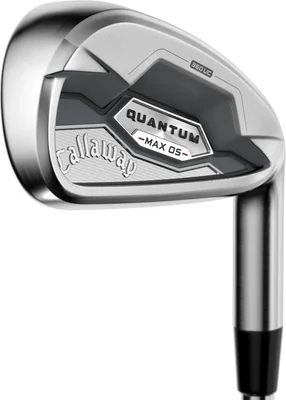
Callaway Quantum Max OS Irons
The widest, most forgiving iron in Callaway's 2026 Quantum lineup — the Max OS pairs an oversized head with extreme perimeter weighting, AI-optimized face technology, and Urethane Microspheres to deliver the easiest launch and biggest sweet spot Callaway makes, without the clunky look that haunts most super game-improvement irons.
We may earn a commission if you buy through this link — it never affects our scores or the price you pay.
The consensus
The Callaway Quantum Max OS is the most forgiving iron in Callaway's 2026 Quantum lineup — a super game-improvement iron built for high handicappers, seniors, and players who want maximum help without picking up a club that looks like a shovel at address. Awarded a Golf Digest Hot List Gold Medal, the OS earns its distinction through a combination of an oversized head with extreme perimeter weighting, a Modern 360° Undercut Cavity, and Callaway's AI-optimized face — the same face technology in the Quantum Max driver applied here to maximize ball speed and launch consistency across the entire hitting area. Urethane Microspheres dampen vibrations at impact for a feel noticeably better than what this category usually delivers.
Where sources agree most strongly: forgiveness and distance. National Club Golfer praised the Max OS's exceptional stability on mishits, with consistent carry distances even when contact is off-center. Golfalot's reviewer looked up expecting to watch a mishit fall short, only to see it still flying long and straight — a defining feature of max-MOI construction. Golf Digest's testing panel recorded tight dispersion, high penetrating launch, and strong carry, awarding it Gold on the 2026 Hot List. The Urethane Microsphere feel drew consistent surprise — reviewers expected a hollow, dead sensation and instead found a firm, lively impact the category rarely provides. And the looks earned approval: Golf Monthly noted the OS avoids the clumsy appearance common to super GI irons, with clean shaping that breeds confidence at address.
Where the conversation gets more nuanced: the OS is clearly not for everyone, and that's by design. Golf Monthly's review tested both the Quantum Max and Quantum Max OS and concluded performance is very similar between models — the decision comes down to which head you prefer at address. If you're below a 15 handicap and considering the OS, the standard Max is probably the better choice. MyGolfSpy also raised a fair question about whether the OS is meaningfully more forgiving than the Max in real-world play. For its target market, though — players breaking 90, seniors, slower swing speeds — the consensus is clear: the Max OS is one of the best-executed super game-improvement irons of 2026, delivering Callaway's best technology in the category that needs it most.
The widest, most forgiving iron in Callaway's 2026 Quantum lineup — the Max OS pairs an oversized head with extreme perimeter weighting, AI-optimized face technology, and Urethane Microspheres to deliver the easiest launch and biggest sweet spot Callaway makes, without the clunky look that haunts most super game-improvement irons.
Category ratings
What the community loves
The defining attribute across every source. The oversized head, extreme perimeter weighting, and Modern 360° Undercut Cavity push MOI to the highest levels in the Quantum line. National Club Golfer praised the Max OS's exceptional stability on off-center strikes, noting golfers who miss the center consistently will still see playable trajectories. Golfalot's reviewer looked up expecting to watch a mishit die short, only to see it still flying long and straight — a consistent theme across testing.
The AI-optimized face and 29° 7-iron loft combine for carry distances that surprise testers in this category. Golf Digest's Hot List panel noted strong distance, high penetrating launch, and tight dispersion from the face. Golfstead confirmed the OS delivers slightly more ball speed than the previous-generation Elyte OS, while also holding greens better thanks to the higher launch angle and soft landing. The strong lofts put the 7-iron in the 185-200 yard range for moderate swingers.
The most consistent surprise across sources. Golf Monthly noted the Max OS avoids the clumsy, oversized look common to super GI irons — the shaping is clean and well-balanced at address. National Club Golfer praised the thicker topline and wider sole for visually breeding confidence without looking like a hybrid. Bunkered's James Tait said the club sits great behind the ball, noting Callaway avoided the visual pitfalls that plague many clubs in this category.
Callaway's Urethane Microsphere technology absorbs unwanted vibrations at impact while preserving enough feedback to feel solid and responsive. National Club Golfer described the feel as firm and satisfying — not the mushy, dead sensation some super GI irons produce. Today's Golfer echoed this, with testers noting the impact feels robust and lively without being harsh. For a two-piece hollow construction, the sound and feel earned consistent praise.
The reengineered sole geometry adapts from long irons through wedges, with a leading-edge chamfer that sits higher off the ground to reduce digging and raise the impact point on the face. National Club Golfer highlighted clean turf interaction from a range of lies. Complete Golfer confirmed the sole design helps players who tend to bottom out early and take fat shots — a common issue for high handicappers the OS targets.
What to watch out for
The oversized head and thick topline are features for the target market but a clear deterrent for anyone below a 15 handicap. Golf Monthly tested both the Max and Max OS and noted the OS is a step too far visually for mid-handicappers who already feel confident at address. MyGolfSpy raised the question of whether the additional forgiveness of the OS is meaningfully better than the standard Max, questioning the need for two models so close in purpose.
While the Urethane Microspheres improve on generic game-improvement feel, sources note there are softer and more feedback-rich options for players who prioritize touch. Golfalot acknowledged the feel is pleasant but not distinctive — testers who wanted to feel where they hit the face were left with less information than premium irons provide. This is an intentional trade-off: the OS prioritizes consistent ball speed over feedback.
The 29° 7-iron is 3-4° stronger than traditional specs. Golfalot's tester saw the launch monitor numbers and immediately noted the distance gains are partly loft-driven, not purely from technology. Complete Golfer warned that golfers switching from a traditional set should expect to carry every club 5-10 yards farther — a benefit, but one that requires deliberate yardage recalibration and may create gapping issues at the short end.
At $1,149 for a 7-piece steel set, the Quantum Max OS is priced above many competitors in the super GI category. Bunkered noted that players who need this level of forgiveness often have budget concerns, and the OS faces stiff competition from the TaylorMade Qi Max Irons and Cleveland Launcher XL Halo at similar or lower price points. The Callaway branding and Golf Digest Hot List gold justify some premium, but it's worth comparing before committing.
Is it right for your game?
The key split in reviews is between the Quantum Max OS and the standard Quantum Max — performance between the two models is very similar, so the choice comes down to which head size gives you more confidence at address. For its target market (high handicappers, seniors, slower swingers), the OS is one of the best-executed super game-improvement irons of 2026. For anyone below a 15 handicap, the standard Quantum Max is the better fit.
What real people are saying
24 quotes from across the web, grouped by 8 themes. Click a theme to read the individual quotes.
Specifications
Available shafts (no upcharge)
Premium shafts available at additional cost: Graphite Design Tour AD VF, Tour AD UB, Tour AD DI
All sources analyzed
This review synthesizes opinions from 13 independent sources. Every claim on this page can be traced back to its original source. No manufacturer relationship or compensation.
The consensus score is built in four layers: raw source collection, normalization to a 0-10 scale, credibility-weighted combination, and quality adjustments.
Expert reviews (35% weight) are scored from language intensity and any numerical ratings provided. Data-driven testing (25%) converts product rank within the test group to a percentile score. Forum posts (30%) are AI-classified by sentiment, weighted by substantiveness. Retail reviews (10%) convert 5-star ratings with a 0.75x credibility discount to correct for systematic inflation.
Three quality adjustments are then applied: a source diversity bonus (up to +0.3 for coverage across all source types), a conflict penalty (up to -0.3 when sources strongly disagree), and recency weighting (recent reviews weighted higher than older ones).